Mirror, Mirror: Sales of a different sort
Prices have been slashed on items rarely discounted before.
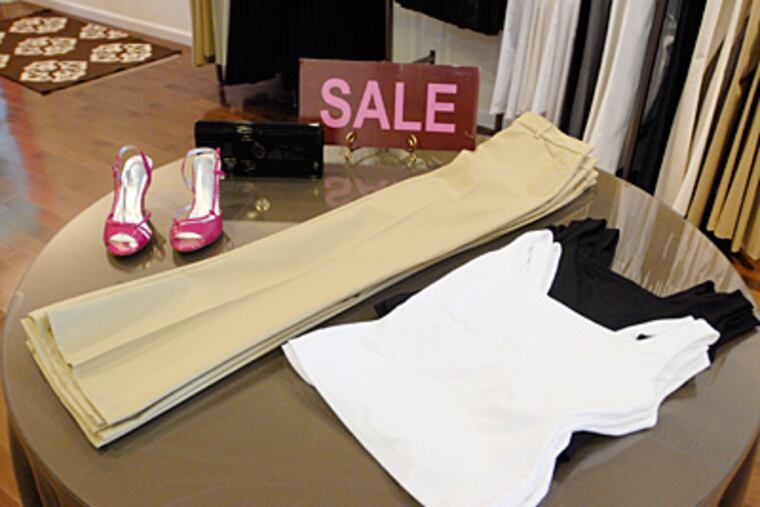
At first glance one might think the S-A-L-E signs that began popping up in earnest last week were simply announcing run-of-the-mill summer clearances and fall's all-too-early annual retail arrival.
But upon closer inspection, a shopper will find more than the size 2 white pants, or the size 22 bathing suit.
In the midst of an economic downturn that has brought the slowest retail sales in decades, the business of style this summer has become about slashing prices on fall items, stocking up on unique pieces, and pushing off summer - just a little bit - so stores can stay afloat.
That means the style seeker with just a little discretionary income can make a killing.
Take me, for example. Last weekend I bought a fire-engine-red shirt dress, some running clothes, a pair of feather-gray leggings - with snaps at the calves - and a matching tunic for under $100 at New York & Company, thanks to sales and a 30-percent-off coupon.
Specialty stores are not to be left out.
At Bryn Mawr's Skirt, basics that rarely go on sale, like the much-coveted Theory pants, are dominating sale racks. At neighboring store Pants, men will find deals on all eclectic brands, such as jeans from AG Adriano Goldschmied and Relwen. And at Totally Posh in Manayunk, owner Kia Wongus is offering a $75 gift card to customers who host a trunk-show party in their homes. Wongus said her store also was taking 40 percent off designer denim.
Some stores that never, ever have seasonal markdowns are slashing prices, too. Mona Lisa Jackson, owner of lingerie store Coeur, will start a 25-to-50-percent-off sale today.
Sebastian McCall, the owner of Charlie's Jeans, is knocking down prices on new dresses and shirts by 20 to 40 percent. The sale also includes up to half off certain brands of men's and women's denim. And that's something McCall says he never does.
"I'm trying to maintain the cash flow," said McCall, who said his summer sale would last at least through the end of July. "I'm known for not going on sale, but how long could I do that without customers going other places? So to keep the flow, we thought it would be a good idea to offer new products at discounted prices."
"I never put my basics on sale," agreed Maureen Doron of Skirt. "I'd put them in the basement and bring them out next year. Now I'm like, 'No, I have to get rid of them.' "
The fourth quarter is traditionally the most important time of year for merchants. But this year it's even more crucial to the bottom line because the first half of the year was so dismal. The second half promises to be more of the same.
In fact, said Washington, D.C.-based National Retail Federation spokeswoman Ellen Davis, total annual retail sales are expected to decline 0.5 percent. This is the first time the federation has predicted an overall drop since it was founded. That said, a big profit becomes secondary as stores struggle just to make enough money to stay open.
"Retailers are doing everything they can to lower operating costs," said Davis. "They are cutting back hours, cutting back inventory, and even cutting back on quality."
But most are hoping and praying to lure shoppers in by changing the dynamic of the sale from clearance to promotion. As a result, sale areas in stores have grown this year. And, Yarrow said, the cheaper merchandise isn't relegated to the back of the store. In most instances, it's right up there in the front, side by side with the new arrivals. You might even have noticed that sales started a few weeks earlier.
"There is a new anatomy of a sale," said Kit Yarrow, a consumer psychologist and professor at Golden Gate University. Last year's financial meltdown was the catalyst that sent retailers into price-slashing recovery mode after they bought too much inventory.
"Retailers know that consumers will wait as long as possible to buy something because they know it's going on sale," she said.
In addition to more sales, Yarrow said, boutique owners are putting basics - that means white shirts, black shoes, dark denim, pencil skirts, and black pants - on sale. (Talk about music to my wallet.)
"These are what we call in grocery-store terms 'the loss leaders,' " Yarrow said. "Stores usually take a loss on them, but they lead people in the stores to buy other, more special things."
What I find most refreshing is that summer pieces are enjoying a little bit of a longer shelf life. Part of it is because retailers are starting to realize that seeing wool sweaters in the first week of July is depressing, not to mention the plethora of transitional-weight pieces.
But this year's lack of early fall merchandise is because buyers didn't order as much.
"I bought a little less for fall, said Knit Wit owner Ann Gitter. "Not drastically less, but I'm definitely buying closer to the season. Normally [at this time of year] I'd have more coats and heavier sweaters, but I brought in more lighter cottons."
That doesn't mean fashion forwardness is dead. The pieces just have to be special, said Doron of Skirt. For example, while her basics were on sale, she nearly sold out of an early grouping of fall Nanette Lepore, a bold plaid yet neutral collection.
Ellen Shepp, one-half of Center City fashion destination Joan Shepp, agreed.
In the midst of her summer sale, she took a chance and told some of her best customers about an early delivery of Rick Owens' pieces. The cool, structured looks were a hit and she's sold a lot of them already.
"They wanted to see it and they bought it, right there on the spot," Shepp said. "People still like to shop, and fall is the most important season of the year. We're just all smarter about it."