Renowned blanket maker expands iconic art form
By Mike Dunham
McClatchy Newspapers
(MCT)
She recalled seeing her uncle,
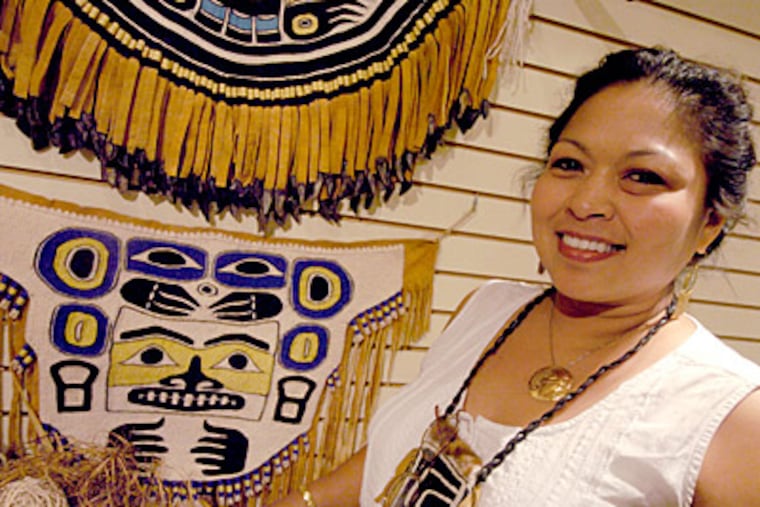
The large five-sided blanket with its dominant yellow, white and black colors is one of the most identifiable traditional art forms in
Similar weavings were made throughout the
Yet in the 20th century, the ranks of weavers grew thin. The late Jenny Thlunaut is often listed among the last women who remembered the skill.
Fortunately for Ehlers, Thlunaut was a close friend with her grandmother. As a girl Ehlers often watched Thlunaut weaving while her grandmother made beaded moccasins.
Later she studied under Thlunaut as well as with
"From the moment I started in the Chilkat technique, it was as if I had always done it," Ehlers said. "I'm not sure if I am that good a weaver, but I love the art form."
She may not be sure, but others are. Her work can be seen at the
In 2006 she was among the first American artists to receive a
This year she received a major grant from the
Awards notwithstanding, making a living as a Chilkat weaver is a "daunting task," she noted, enormously time-consuming.
With her family she collects yellow cedar bark in the spring and separates out the inner layer, which is soaked until supple, then split into paper-thin layers that are split again into "spaghetti-shaped strips."
The bark is then hand spun with wool. In the old days that would have been mountain goat wool.
Nowadays, Ehlers said, "I'm a modern girl. I use commercial 100 percent wool for the colored design relief."
The resulting yarn, or "warp," is hung on a simple cross-beam loom and woven together using a basic twining technique.
"It may take four to five months to spin enough warp for a large Chilkat blanket," she said, "depending on how much help I have."
A lot of the help comes from her three children, Marie, Billy and Alexis.
"All work the raw materials with me," she said. "Granted it is not their favorite thing to do, but the family's help ... is the reason that I have accomplished making 18 large Chilkat blankets in the last 30 years."
She also makes tunics, aprons, headdresses and other Chilkat "regalia" plus beadwork "to refresh my mind."
The blankets, however, have a special place in her resume, not only making them — which is rare enough — but uniquely expanding the art form by experimenting with different ideas and materials.
Like silk.
She was visiting a bridal kimono shop in
Another non-traditional material is gold. Ehlers said the idea came after her daughter told her about a dream in which her mother wove a Chilkat-style face from gold.
"I could hardly wait for the
Her blankets are intertwined with family stories. An enormous potlatch blanket, 7 1/2 feet wide by 6 feet high — "the largest one in the world ever made," she said — was presented at a ceremony in Klukwan honoring her late father in 2007 where it was cut into pieces and distributed to guests.
"There was a long silence as the blanket was taken down and (Ehlers) carefully sliced it into small pieces that she gave to special people.
"The beautiful, rare blanket, worth thousands of dollars, was apparently destroyed to repair a tear in the fabric of the tribe that happened so long ago most of the folks didn't know the details. Anna's father had, though, and it was his dying wish that she do this to make whatever was wrong right again."
Another special blanket was for her mother, whose grandmother had a fine blanket that she sold to relatives from another village. The boat sank on the return trip and the blanket was never recovered.
"This story was related to us children at night after dinner," Ehlers said, "as we had no television." Stirred by that tale, she resolved to make her mom a blanket to replace the one that had left the family.
"It took me 40 years, but I eventually did make my mother a Chilkat blanket," Ehlers said. In the blanket she depicts herself and her late twin, Anita. The two sisters often worked together in their younger years.
Ehlers is mindful of her parents' roots in Klukwan, a village renowned for superb Tlingit artisanship, in the heart of the
It all worked out.
"We have been married over 30 years," she noted, "and my art still comes first."