MING MING'S NO MING
7-9 Sun Ming Ming has been mistaken for Yao Ming, but he's a big, big project
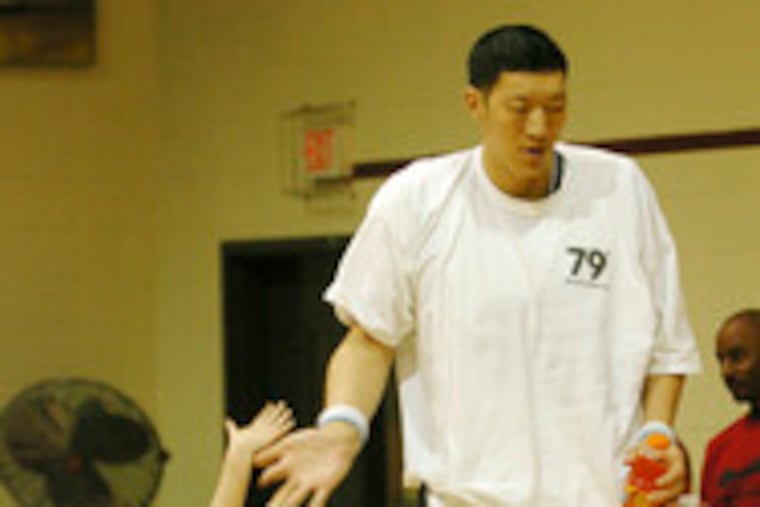
ROCKVILLE, Md. - Occasionally, the world can be an unpleasant place if you happen to be the second-tallest man in it. Wherever you go - especially in crowded areas such as airports - people are always looking and pointing. This occurred recently at Reagan National in Virginia, where a fellow spotted the 7-9 Sun Ming Ming and shouted in glee: "Yao Ming!"
The person traveling with Sun corrected him. "No," said Tom Doyle, the owner of the ABA Maryland Nighthawks, "this is Sun Ming Ming."
The fan could not be swayed, despite the fact that Houston Rockers center Yao Ming is a mere 7-6. "No, that is Yao," he said. "I know that dude when I see him."
Doyle just laughed and walked on. "Being with Sun has given me a glimpse into how obnoxious people can be," said Doyle, as Sun prepared to play the Quebec Kebs Saturday at the Rockville campus of Montgomery College. "We were in another airport when a woman came up to me and said, 'I think it would be so funny if I took a picture with him, because I only come up to his knees.' And I looked at her and said, "He is a human being, not some freak show just to take a picture with. He has feelings.' And the woman said, 'Oh . . . well . . . I guess I never looked at it that way."
How Sun Ming Ming ended up in the United States to pursue his dream of one day playing in the NBA is a somewhat lengthy story. Some of it has been told in the superb Discovery Channel documentary, "Anatomy of Giant," which told how Sun came from China under the care of California sports agent Charles Bonsignore in 2005, only to discover that he had a tumor on his pituitary gland. Doctors told him he could expect to die young unless it was removed. Aided by Bonsignore and others, he had two operations with the aim of extracting the tumor, which had flooded his system with an overabundance of growth hormones. While it is still unclear if the tumor has been neutralized - he has an MRI scheduled for May - Sun has experienced a spike in his energy level. Says Bonsignore: "He has been told that he can look forward to a normal life expectancy."
But his prognosis as a player is somewhat less certain at this point. While he has exhibited a boost in endurance on the court since the second surgery, he still has work to do if he hopes to follow Yao Ming into the NBA. The upside is that he is 7-9 and - as the old adage goes - "you cannot teach height." He is also an exceedingly strong 387 pounds with a surprisingly soft touch. The downside is that he is so slow that opposing players blow by him as if he were a toll booth on a lonely highway. Some of his lack of mobility has to do with his feet, which are a size 19 and look like the exposed roots of a 400-year-old oak tree. His toes are curled upward and gnarled, in part due to the fact that he showed up in America wearing shoes that were three sizes too small. Invariably, his feet are covered with blisters that Sun has to trim back at the end of every game and practice. Bonsignore says, "We plan to have a doctor look at them again at the end of the season."
That the 23-year-old Sun is even playing today is providential. He grew up (and up) in the small northern Chinese village of Bayan, which is not far from the Siberian border and is commonly steeped in subzero temperatures. His parents labor in the fields and operate a small store. The oldest of three children (his brother and sister are normal size), Sun was on the Chinese Junior Olympic team, which played some games in California in the spring of 2002. Bonsignore was friendly with the director of the Chinese team, Zhang Weisping, who told him that "we have a kid who has never been coached but is 7-foot-9 and teachable." That intrigued Bonsignore, who began what he later termed fairly easy negotiations with the Chinese officials to bring Sun to America in February 2005. Says Bonsignore: "I think they had Sun pegged as lazy, that he was someone who would never get in shape."
Initially, Bonsignore suspected that the sluggishness he observed in Sun was due to the cultural shock of being in America. To get him away from Los Angeles to more tranquil environs, Bonsignore sent him to stay with an associate in North Carolina, Rocky Manning. Immediately, Manning was struck by the fact that Sun looked like "an unhealthy 60-year-old," that he would sit with his head down and hands clasped behind his neck. Manning says, "He looked whipped." When Sun began experiencing discomfort in his shoulder, Manning arranged for him to be checked out. An MRI revealed the presence of the tumor. Surgery was performed in September 2005 by Dr. Hrayr Shahinian, the director of the Skull Base Institute in Los Angeles. Shahinian cautioned that he could not be certain he got the whole tumor - that a piece of it could be lodged precariously behind a blood vessel - but he predicted that Sun would feel like a changed person within a few weeks.
"Suddenly, he seemed to become animated," Bonsignore says. "He was staying with us then and he began washing dishes and wiping down the counters. I remember thinking, 'Wow, look at the way he is interacting now.' "
But the surgery did not eradicate the tumor. The small piece that Shahinian anticipated remained, and it continued to produce an excess of growth hormones. Because Sun has no health insurance, Bonsignore petitioned Novartis and Pfizer for help in defraying the expense of the two drugs that had been recommended for Sun: one to attack the tumor and the other to stem the production of growth hormone. Doctors at Wake Forest University performed a second operation free of charge last Nov. 30, a radiation procedure called gamma knife surgery. Sun was well enough within days to begin playing with the Nighthawks, but his debut was delayed by a commitment he had to appear in the Jackie Chan film, "Rush Hour 3." He joined the Nighthawks in mid-January.
"That he is out there running up and down the court and not falling over is a big step forward for us," says Bonsignore. "What is important now is that he gets out there and plays."
Sun played 27 minutes in the Quebec game, which the Nighthawks lost, 116-111. Sun was 3-for-11 and 4-for-7 from the foul line, for 10 points. He also had five rebounds and three assists. While he executed a splendid behind-the-back pass for a basket, which had the public-address announcer booming, "Where did that come from?" he seemed in large part tentative and two or three steps behind the flow of play. His 6-10 opponent easily stole the opening tip from him, slapped the ball from his hands and sprinted by him on the dribble. But whatever shortcomings he had on the court, it was clear that the fans just adored him, especially small children. As he sat on the bench during the final 7 minutes or so, in part because the action was moving too quickly up and down the floor, a small boy said to his friend: "We need Ming." To which the friend replied. "I know, but that coach has him on the bench." They both shouted: "Put Ming in!!!"
"The fans across the league love him," says Doyle, an attorney and former amateur boxer. "Whenever we play, they get big crowds. I kid the other owners, 'You should start paying me.' "
How far Sun is from the NBA is contingent on his ability to develop his game. NBA scouts are aware of him, but as a Sixers source said, "He has a long way to go." Bonsignore said he expected Sun to be a "2-year project" and he is encouraged by the fact that he is a hard worker who seems to have an eagerness to learn. While Manning says a big problem is that the Nighthawks rarely pass the ball to Sun, which is indicative of the bombs-away style of play in the American Basketball Association, Doyle has done what he can to help Sun improve his game. He has him working with former NBA big man Gheorghe Muresan and has hooked him up with a strength and flexibility coach. Says Doyle: "Remember, he has only played nine games with us."
Whatever problems he has on the court, Sun had adapted well to America. While he occasionally gets homesick - he says he talks to his parents once or twice a week - his ability to learn some English has helped him immensely. When he talks with reporters, he does so with the aid of an interpreter, which can lead to conversations that wander in and out of coherence. As the gym cleared Saturday, he sat in a folding chair and fielded a few questions, none of which elicited more than just a few disjointed sentences.
How do you think your play is progressing?
"OK," he began. "I have a cold. Sore throat."
How do you like being in Maryland?
"People are nice. I like it."
Would you like to play for China in the 2008 Olympics?
He paused and said, "No one talk to me. Hard to say."
What do you plan to do when the season is over?
"Play in another league. For another team."
Are you any closer to your dream of playing in the NBA?
He shrugged. "I do not know."
The interview ended a few minutes later. Sun then grabbed his gym bag and ascended from his seat. He then walked to the door, lowered his head and headed back into the outside world, where surely someone would come up to him and say: "Hey, you know you should play basketball!" *