Giving 'Em Fitz: Masterton's death a haunting memory
On Jan. 13, 1968, in what was a more telling indictment of my social life than my taste in sports, I was sitting in the basement TV room of a college dormitory in Wisconsin watching a Saturday night hockey game between the Minnesota North Stars and Oakland Seals.
On Jan. 13, 1968, in what was a more telling indictment of my social life than my taste in sports, I was sitting in the basement TV room of a college dormitory in Wisconsin watching a Saturday night hockey game between the Minnesota North Stars and Oakland Seals.
It wasn't by choice. I was 18. It was Saturday night. And if I had to spend it in front of a TV, I'd have preferred the Jackie Gleason Show, Get Smart, or The Dating Game. But I was a freshman, and this was Wisconsin. We watched hockey.
I'm not sure if it was the first NHL game I'd seen. I'm certain it was the most unforgettable.
In the first period at the North Stars' brand-new Met Center, Bill Masterton, a 29-year-old Minnesota winger, stole the puck and headed for Oakland's end.
Six years earlier, frustrated by his failure to crack the six-team NHL, Masterton had quit hockey. But when the league expanded to 12 teams in 1967-68, he rebooted his dream. He would be the first player signed by the new North Stars.
Watching disinterestedly, I saw Masterton flick a backhand pass to right winger Wayne Connelly. Turning to rush the goal, Masterton never saw oncoming Seals defenseman Ron Harris. The violent collision that followed elicited yelps of delight in the testosterone-charged TV room.
"It was the strangest thing," North Stars coach Wren Blair told me in 1988. "After getting hit, he stood there motionless with an eerie look on his face for a second or two."
And then he collapsed.
The back of Masterton's head thudded against the unyielding ice. Left wing Dave Balon was the first to reach his fallen teammate. What he saw, and Masterton's cryptic last words, haunted him the rest of his life.
"He looked at me," Balon, who died in 2007, recalled two decades later, "and he started to turn pale. But before he fell into unconsciousness, he looked up at me and said: 'Never again. Never again.' "
Masterton was motionless, bleeding from the nose, ears, and mouth as he was lifted onto a stretcher and carted off the ice. He never regained consciousness, dying two days later in a Minneapolis hospital.
That horrific incident, still the last death in North American team sports related directly to an in-game injury, seared into my brain. Recalling it now, two days shy of its 47th anniversary, I'm struck by how different the images in my head are from the hockey of 2015.
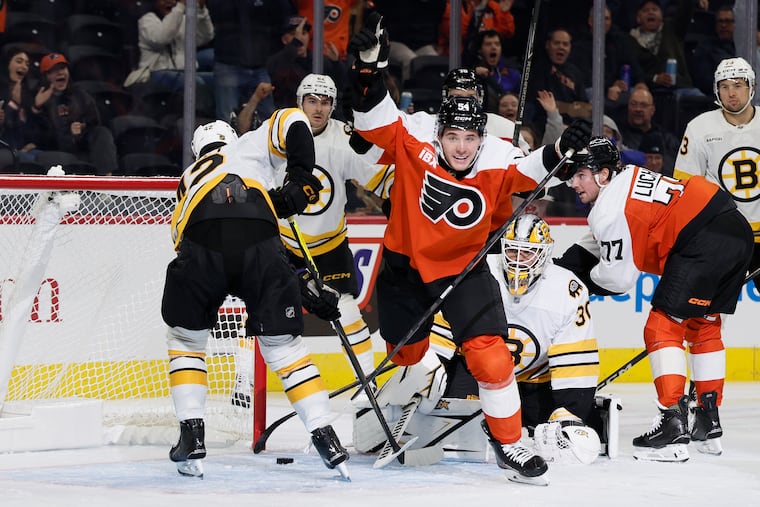
The playing pace was stroll-in-the-park compared to today's frenetic NHL tempo. The game's players were remarkably homogenous: no Europeans, all but two (Americans Lou Nanne and Charlie Burns) Canadians. And most jarring to my mind, almost all, including Masterton, were bareheaded.
Rooted in the rugged, isolated towns of frigid Canada, hockey has always had a macho edge. Violence has been tolerated to a degree unmatched in any other team sport. For 50 years, few in the league wore helmets, not even after Toronto's Ace Bailey died following an ugly stick fight with Boston's Eddie Shore in 1934.
By 1968, each team had a few players who wore them, typically those concerned about earlier head injuries. Prodded by Masterton's death, minor and amateur leagues made helmets mandatory. And for a time, it looked as if the NHL would too.
On Jan. 17, four days after Masterton collapsed, the NHL Players Association issued a statement urging that helmets be mandatory, though acknowledging as many of its members opposed as favored them.
The statement fell on deaf ears. NHL officials feared hockey's popularity would suffer if the faces of its stars were partially obscured.
"The owners felt helmets would create a deep recession in interest," Alan Eagleson, the longtime NHLPA director, said in 1988.
Imperious NHL commissioner Clarence Campbell suggested Masterton's death, the result of a clean check, was merely an unfortunate by-product of a physical sport. Then, almost unimaginably, he withheld league support for an exhibition game to benefit the player's family.
"It was a routine accident that could have happened in any hockey game . . . a normal hazard of the occupation," Campbell said. "[Helmets] are optional now, and we think that is the best method of dealing with it."
Their use increased after the Soviet team, entirely helmeted, put on a dazzling show against NHL stars at 1972's Summit Series.
Not until 1979, when 70 percent of players were wearing them, did the league make helmets mandatory. Even then it equivocated, permitting players drafted before 1979 to make their own decisions.
In today's NHL, head injuries may be an even greater concern. Though the league pioneered concussion protocols, the bigger, presumably safer headgear that ex-players such as Mark Messier have touted remain as unpopular as helmets were in 1968.
As for Masterton, then and now there were teammates and family members who believed an earlier head injury may have contributed to his death. An autopsy disagreed, blaming it instead on the hit and fall that Jan. 13.
Not long ago, his son, Scott, told the Toronto Star that regardless of how serious the earlier head injury was, his father would not have allowed it to sideline him.
"The idea that you persevere goes back in time immemorial," Scott Masterton said. "It's a badge of honor. It's also the mind-set that [for hockey players] will shorten their lives and destroy their bodies. Men are the way men are."
I can't exactly remember how I spent the rest of my Saturday nights that freshman year. All these years later, the memories are an indistinct mix of bars and cars, poker and pool, discoveries and disappointments.
All I know for sure is that whenever our basement TV was tuned in again to hockey, I couldn't watch.