Frank's Place: Sad story of a storied pitcher
On Sept. 29, 1883, as the Phillies were ending their dreadful debut season with a 15-3 loss at North Philadelphia's Recreation Park, a city native who once was the National League's top pitcher was dying in a boarding house not far away.
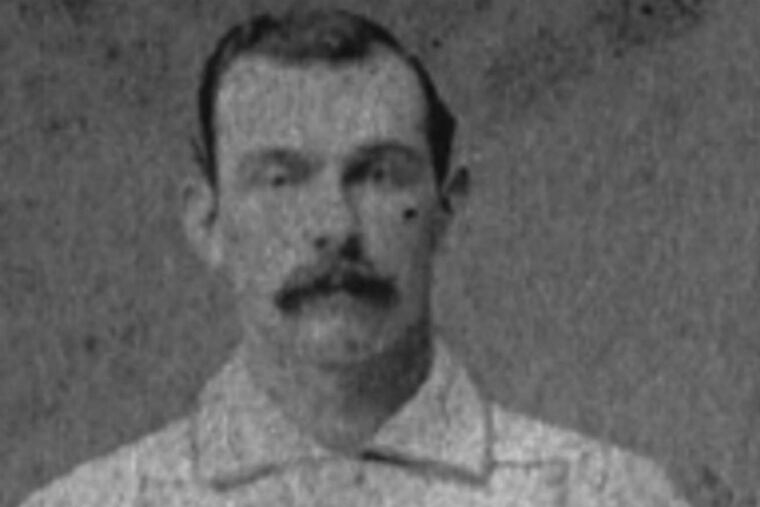
On Sept. 29, 1883, as the Phillies were ending their dreadful debut season with a 15-3 loss at North Philadelphia's Recreation Park, a city native who once was the National League's top pitcher was dying in a boarding house not far away.
It would be another 11 days before Jim Devlin, just 34, passed. Although he had been a Philadelphia cop since 1880, the steady job hadn't reformed a dissolute life. His widow and son were left in debt, and an autopsy revealed that chronic alcoholism had exacerbated the tuberculosis that killed him.
Devlin's is a sad story, one that came to mind last week when the Cincinnati Reds announced that Pete Rose would be entering their Hall of Fame. While that team's CEO termed it "one of the greatest days in the history of this franchise," it's doubtful the disgraced player viewed it that way.
The Hall of Fame Rose craves is located in Cooperstown. And it seems clear now that he'll never get there.
The reason is Section 21(d) of the major-league rule book. That states "any player, umpire or club or league official or employee who shall bet any sum whatsoever upon any baseball game in connection with which the bettor has a duty to perform shall be declared permanently ineligible."
The rule, though few realize it, predates the 1919 Black Sox scandal. It goes back to 1877, to an incident in which four Louisville teammates were accused of throwing games.
One was Jim Devlin.
Uneducated but athletically gifted, Devlin was 23 in 1873, when the Philadelphia White Stockings of the professional National Association plucked him off a South Philly sandlot. He spent the next two seasons in Chicago, and in 1876, when the National League was formed, joined its Louisville Grays.
There Devlin, believed to be the first pitcher to throw a sinker, was a sensation. In 1876, he led the Grays in hitting (.315) and compiled a 1.56 ERA in 68 starts.
The next year, he accomplished something no big-league pitcher before or since has matched. He started and completed every one of Louisville's 61 games, winning 35. Astonishingly, the 599 innings he amassed that season were 23 fewer than he threw the previous year.
But late in that 1877 season, his Grays inexplicably squandered a four-game lead and the pennant. A writer attributed their fatal seven-game losing streak to "bonehead plays and poor pitching."
When Devlin and some Grays were seen in Louisville sporting expensive jewelry, suspicions grew. Summoned by NL president William Hulbert, Devlin and teammate George Hall were eager to tell their stories. They admitted throwing games but only because the club's owner owed them $500 in back pay.
Perhaps they thought the admission would absolve them. Instead it turned out to be a foolish act of naivete.
A Louisville Courier-Journal editorial noted that if they had "locked their jaws," they'd still be playing baseball. Instead "these two true-blooded numbskulls . . . began squealing worse than two stuck pigs."
Hulbert expelled them from baseball, and soon Section 21(d) was added to the rule book, though it then prohibited all baseball betting.
Growing desperation
With no means of income and a drinking problem, Devlin returned to Philadelphia with few prospects.
Living in a tiny South Philadelphia apartment on what is now Fairhill Street, he incessantly pleaded his case. The more he did, the more his desperation grew.
He petitioned Hulbert annually for reinstatement and wrote regularly to other baseball officials. One letter, filled with hopelessness, went to Boston manager Harry Wright:
"I write to you to see if you could do anything for me in the way of looking after your ground or anything in the way of work. . . . I am honest, Harry. You need not be afraid. The Louisville people made me what I am today, a beggar. I have not got a stitch of clothing, or has my wife and child. I am dumb, Harry. I don't know how to go about it, so I trust you will answer this and do all you can for me."
(That letter, by the way, was among several early baseball documents stolen from the New York Public Library, prompting an FBI investigation and its eventual recovery.)
He did during his exile occasionally play with some minor-league clubs, and on one occasion he pitched six innings in a pro vs. amateur exhibition at a Tasker Street field.
Then, one cold Chicago morning in 1878, Devlin turned up at Hulbert's office. His clothes were "threadbare and seedy . . . his shoes worn-through," and his face was described as "a picture of abject misery."
Confronting the league president, Devlin broke down. Falling to his knees, he cried, pleading for help. Hulbert told him his hands were tied by the rules, then handed him $50 and sent him away.
Devlin, according to a later Chicago Tribune report, gambled away the money before that day was done.
Finally, in 1880, perhaps helped by his Irish surname as much as by his athletic reputation, he was hired by the Philadelphia Police Department. He worked in the Second District in North Philadelphia, where the ballparks of the professional teams that came and went were located.
On Oct. 10, 1883, he died, and, days later, was buried in New Cathedral Cemetery at Front and Luzerne Streets.
All these years later, you can still find Devlin's name in baseball's record books. His 1.90 ERA remains the third-lowest among pitchers with 1,000-plus innings, behind only Hall of Famers Ed Walsh and Addie Joss. His ERA-plus is third all-time as well, topped only by those of two modern stars, Mariano Rivera and Pedro Martinez.
To modern eyes, one of Devlin's most amazing stats is that in 1,405 innings, he walked only 90 batters.
Sadly, he couldn't control his life nearly as well.