Here's the 'situation': Franco's a smarter hitter
CLEARWATER, Fla. - A year ago Sunday, Maikel Franco stuffed a red duffel bag with his baseball belongings. He walked to the Carpenter Complex as a minor-league player, the result of overswinging to impress Phillies officials in spring training. His time, they told him, would come.
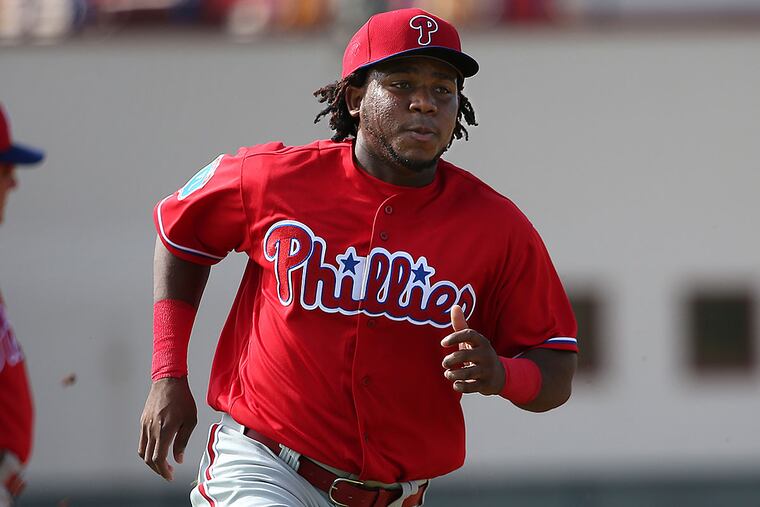
CLEARWATER, Fla. - A year ago Sunday, Maikel Franco stuffed a red duffel bag with his baseball belongings. He walked to the Carpenter Complex as a minor-league player, the result of overswinging to impress Phillies officials in spring training. His time, they told him, would come.
Franco became Sal Rende's pupil once again. The hitting coach at triple-A Lehigh Valley met with Franco and outlined his goals. Better pitch selection. More patience. Knowing the situation, a word Franco constantly repeats from his established corner of the clubhouse at Bright House Field.
"Everyone told me," Franco said. "Sometimes, depending on the situation, you have to make an adjustment. You have to understand the situation. If the situation tells you a pitcher will not throw a good pitch to hit, I have to understand the situation."
That patience will soon be tested.
Franco, in the last year, has gone from demoted prospect to the Phillies' most dangerous lineup threat. He is 23, and team officials gush about his power potential. No one has hit more homers this spring than him. He shattered Freddy Galvis' windshield with a batting-practice bomb. He has more confidence than ever.
That is why opposing pitchers will have little incentive to throw him strikes come April.
The list of current Phillies who have hit more than 12 homers in a season is four names long: Ryan Howard, Carlos Ruiz, Darin Ruf, and Franco. This is a team bereft of power. There is little protection around Franco, and opponents could tempt the aggressive swinger into chasing pitches out of the zone.
The Phillies see a young hitter better equipped for that potential challenge.
"I hope he is," manager Pete Mackanin said, "because teams are going to potentially pitch around him depending on how good the guys hitting behind him are going."
The team is at least concerned enough about the circumstances to have spent considerable time drilling it into Franco's mind. Rende, who spends most of his spring in big-league camp, said Franco and he have had multiple conversations about the upcoming season.
The topic? "What might happen," Rende said, "and how are you going to handle it?"
Franco laughs when asked about his younger self, the hitter who was so aggressive that the force of his swing would sometimes knock his helmet from his head. Patience, he said, is something he has embraced.
"It's easy to say, but it's hard to do," Franco said. "I just have to try to pick one pitch to hit. So if I'm looking for a fastball and he's throwing me sliders, I have to be ready to know this is not my pitch. That's what I have put in my mind and what I'm working on right now."
The numbers support anecdotes of Franco's adjusted approach. His walk rate, using combined numbers from the minors and majors, jumped from 5 percent to 7 percent in one season. Last season, from July 1 on, Franco walked 17 times in 154 plate appearances - an 11 percent rate - against just 24 strikeouts.
"There is no doubt," Rende said, "that he's become a hitter."
Franco's two stints in the majors, both small sample sizes and separated by a brief return to triple A, hint at maturation. His debut in September 2014 was 16 games long. Franco swung at 43.9 percent of pitches out of the zone, according to FanGraphs. He trimmed that to 33.7 percent in his 80 major-league games during 2015. The percentage of swings at balls inside the strike zone increased from 66.2 percent to 69.3 percent.
He made better decisions, while still maintaining hints of that prolific aggression.
"I could see it last year in Lehigh Valley," Rende said. "His swing, his pitch selection, and knowing the situation, what they're going to try to do to him - it got way better. Obviously, the success shows that. He's still going to chase some pitches. Every hitter is going to. If you're an aggressive hitter, you'll chase pitches. But he's gotten so much better at controlling his swing in situations. Taking a base hit to right field. Knowing when to look for a pitch to pull."
Franco will bat third. Mackanin said he expects to slot either Howard or Ruf, whomever is at first base that day, behind Franco. Aaron Altherr who could be lost for the season after wrist surgery, was another possible power option for the middle of the order. Cameron Rupp, not regarded as a power hitter in the minors, could hit fifth.
Either way, Mackanin will mix and match around Franco.
"His plate discipline is much better than in previous years we've seen him," Mackanin said. "I think that comes from confidence. I think he feels like he's a major-league hitter right now. So hopefully that aspect of it, if it comes into play, he'll be able to conquer that also."
Franco recalled after his demotion last spring a conversation with Rende, who told Franco: "You have to be more selective. When you know you're more selective, you'll have more success."
Rende nodded last week. The minor-league hitting coach remembered the same talk about discipline, but with one postscript:
"As soon as you get pretty good at that," he said to Franco, "you're going to go, and you're never going to come back."
@mattgelb