Phillies grounds crew has a field day
"I HOPE you're ready for a whole lot of nothing," Mike Boekholder said as he passed the mouth of Citizens Bank Park's rightfield tunnel. Gray clouds peeked over the scoreboard and a white tarp covered the infield.
"I HOPE you're ready for a whole lot of nothing," Mike Boekholder said as he passed the mouth of Citizens Bank Park's rightfield tunnel. Gray clouds peeked over the scoreboard and a white tarp covered the infield.
Boekholder, director of field operations, credited the ominous skies for the expected slow day. To the groundskeepers who work in the belly of the Phillies' ballpark, weather is king. They receive three different radar models, emailed directly to their respective smartphones every half-hour, and they're looking to add another.
The Phillies were supposed to play at Citizens Bank Park for the first time in nearly six months, an exhibition game against Baltimore. At least, that's what the schedule said. Mike wasn't so sure. His phone told him rain would roll in right around first pitch, just after 6 o'clock.
For fans, this is a nuisance; for players, an occupational disturbance.
For the Phillies' grounds crew, rain means work.
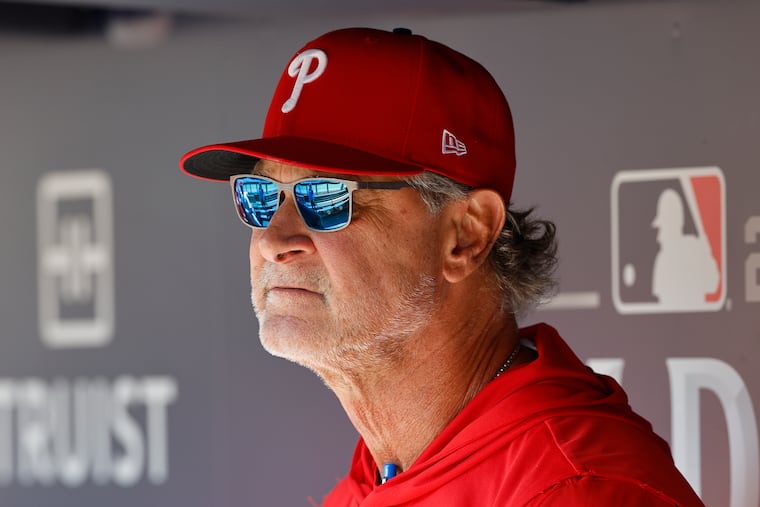
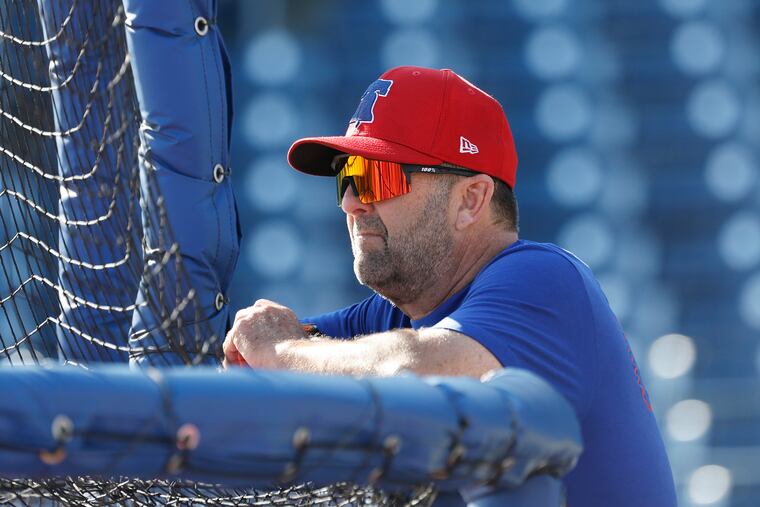
Mike, who is bald, and Jeremy Wilts, who has shaggy, blond surfer hair that he keeps long just because Mike hates it, are in charge of keeping Citizens Bank Park not just playable, but pristine.
Mike's wife sent a text. It had started to pour at their house in Delaware.
It was 10:07 a.m.
"People think we just mow grass," said Colton Turns, a Rutgers student and one of the grounds crew's two interns for this season. He shook his head. "Nah. It's a whole degree."
Step into Wilts' office; he's manager of field operations. Not the one with a computer and scattered manila folders, but the one with John Deere logos, bags of fertilizer, and a hot-dog launcher.
It's a decided step up from where his career began, working for the Albany Tri City Valley Cats, bartering with equipment suppliers and trading advertising space for tools.
"Now, if we need one tool, we have two, and if we don't need one, we still have one," Jeremy said.
After a few down months in the heart of winter, the fertilizer program in the first week of March signifies the beginning of the Phillies' spring treatment, getting the field ready. The staff starts checking moisture levels in the clay, examining the state of the fields, and adding layers of top dressing.
Top dressing? That's the stuff you see kicked up in a slo-mo replay of a slide into second base. It's a mixture of calcined and vitrified clay, tiny bits of intensely fired clay scattered on top of the clay surface, used to absorb moisture. Calcined absorbs water faster; vitrified retains it longer.
Three days before April Fools' Day, the crew started watering the field heavily to create a base moisture in the clay surface. You don't want it too dry and hard, Jeremy explained, or the ball will rocket off the surface.
The same goes for the grass. The infield has been switched to bluegrass, and, at the request of the Phillies' coaching staff, it's being grown slightly longer - around an inch and a half - to slow the ball down a touch.
Jeremy calls the pitching mound his baby. He's in charge of keeping it in order before each game, knowing when to water it and when to leave it be.
Each pitcher likes the mound a certain way. Some, such as Jamie Moyer, preferred a little give around the rubber. Others prefer it drier. Some don't really care.
When Aaron Nola made his first career start last July, the rookie pitched six innings and gave up only one run, a third inning-homer. Nola looked sharp, so Jeremy asked the youngster what he thought of the mound's construction.
"Oh, it was fine," Nola said, and that was that.
Jeremy thinks the 22-year-old was just being a rookie. Veterans can be more particular.
Once, when the Phillies had a July road trip, the crew changed the entire makeup of the park's infield clay mixture.
Star second baseman Chase Utley came up to Mike after just a few minutes. He'd fielded maybe a dozen ground balls.
"It's different," Utley noted. "What'd you guys do?"
Mike told him they had changed the clay. Utley nodded, and went back to work.
When Mike worked the grounds in Yakima County, Washington state, his minor league team didn't have a tarp. It rained so scarcely that, in his three years on the job, there was only one rainout.
Philadelphia, he says, is a little different.
"I hate rain," he muttered, a begrudging grin stretched across his face.
Lucky for him, the weather models started to turn in the Phillies' favor. The rain, once showering the field, was breaking up.
Time to lift that tarp.
Jeremy trotted out to the left end of the tarp and grabbed one of the ring holds attached to its edge. He and the eight other full-timers, including Mike, broke into a run and dragged the big. white canvas toward the rightfield wall. The tarp billowed as air snuck underneath. The crew reversed course once the tarp reached the wall.
Mike barked out directions as they went: "Left! A little to the right! Hold it!"
The biggest problem with dragging the tarp across the infield is disturbing the field dressing, Jeremy said. They're always trying to avoid clay getting stuck in the cracks between the grass and the base path. Moving the tarp is tough.
After folding the tarp down to a manageable size, the crew wrapped it around a black plastic tube and moved it past the third-base line.
Little did they know, they would be rolling out the tarp again during the game, when the inevitable rain arrived and delayed the ballgame for 47 minutes.
Lunchtime arrived, and the sun pushed through the thinning cloud cover.
It was 12:05 p.m. Maybe the Phillies would play after all.
The sun shined as the crew prepared for the Phillies to take batting practice. They watered the clay and combed the basepaths with nail rakes, a square made from four pieces of wood with nails stuck in the bottom.
Then they set up the cage around home plate. Jeremy placed tarps underneath each piece of equipment, so as not to disturb the manicured field.
It was still sunny and crisp as the Orioles took batting practice. Adam Jones parked a ball in the upper left deck.
Jeremy walked to the bullpen and checked on the surface underneath the calcined clay on the mound. A few divots. He had someone patch it.
On the way back to the workshop, he looked at the warning track. It was too dry.
"It didn't rain as much as we expected," Jeremy noted.
It was 3:58 p.m. A strong wind kicked up an auburn dust near the rightfield wall.
As soon as the Orioles ended batting practice, the entire 22-member game-day grounds crew jumped into action. One excited member actually leaped over the dividing rope before his coworkers took it down.
Dark-gray clouds infringed upon the Phillies' 2016 debut, but the crew continued to work. PA announcer Dan Baker stood behind home plate as the crew stripped the field of the protective tarps and the batting cage.
Jeremy was all business now, conducting his nearly two-dozen piece orchestra. Fans filled the lower sections.
It was 5:30 p.m.
It was going to be a close call. The rain was closing in.
This happens a lot. In less significant games, such as this exhibition, Mike has final say. Later in the year, the decision climbs a ladder, to the umpires, once the game is underway. The Major League Baseball Players Association gets involved when the discussion turns to rescheduling games and taking the matter of consecutive games into account.
Stairs to the right of the visiting team's dugout lead to the grounds crew's holding room, a sparsely decorated space with three couches, two televisions, extras of just about everything on the field, and a computer dedicated to radar.
To signal the impeding rain, the computer emitted a foghorn noise. Mike rolled his eyes.
The majority of the grounds crew, including Jeremy, headed to a pit behind the third-base line, near the rolled-up tarp. In case of rain, they're in position to protect the field. A few senior members of the staff, including Mike, walked down to the holding room just a few minutes before first pitch.
A remote was grabbed and The Weather Channel, not the Phillies game, was the choice. Mike stood at the computer monitor, examining.
The foghorn moaned again, but Mike ignored its cries.
He climbed the stairs, conferred with an umpire, and gave the go-ahead. A boy in an Orioles jersey held out his hand and appeared to catch a raindrop. It would be here soon.
It was 6:07 p.m. The Phillies and Orioles played ball.
@AdamWHermann