Jeff Gordon still thinks about winning, not crashing
LONG POND, Pa. - Jeff Gordon claims to have a poor memory, but ask him for his recollections of what was probably the worst crash of his NASCAR career, here during the 2006 Pocono 500, and the details flood out of him, as if he keeps a recording of the sequence stored somewhere in his mind.
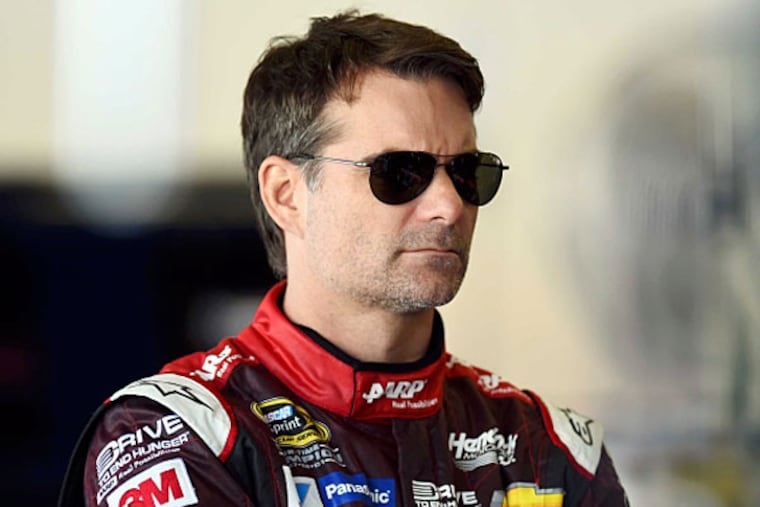
LONG POND, Pa. - Jeff Gordon claims to have a poor memory, but ask him for his recollections of what was probably the worst crash of his NASCAR career, here during the 2006 Pocono 500, and the details flood out of him, as if he keeps a recording of the sequence stored somewhere in his mind.
Turn 1 of Pocono Raceway banks at 14 degrees, and when Gordon entered it, he pushed down on the brake pedal and sent it straight to the floor. A right-front rotor had failed. "When you're doing close to 200 m.p.h. and it goes to the floor," he was saying Friday morning inside his trailer, "it feels like it picks up 10 m.p.h. You just go into kind of a panic mode of trying to save it."
He threw the car into first gear and turned left. The maneuver shot his car across the infield grass. "I hit something down here," he said, and the car spun and went airborne. Through the windshield, before the driver's-side rear of the car struck the wall, Jeff Gordon could see the sky.
Gordon is 43, and he announced in January that this would be his final NASCAR season, that he would retire. He will race here Sunday in the Axalta "We Paint Winners" 400, then again in early August in the Pennsylvania 400 - two of the 23 events left on this year's Sprint Cup schedule. Gordon has 92 Sprint Cup victories, the third most in NASCAR history. He has won six times at Pocono, more than any other driver. He thinks about adding to those totals before the season and his career end in November. He does not think about what might happen to him if he crashes.
That's what drivers call it: "thinking about it." Gordon said he never does, not even now that he is older and is married for the second time and has two children, now that everyone in and around the sport acknowledges and accepts that his presence and performance in the 1990s yanked stock-car racing into the mainstream of American consciousness. He walked away from that 2006 crash just as he's walked away from every crash in his career, even the nasty one in 2008 at an all-concrete track in Las Vegas that, unlike Pocono, did not have a Steel and Foam Energy Reduction (Safer) barrier rimming it at the time. And he does not worry that he - a husband and father and competitor with everything to lose - might indeed lose everything in a single terrible moment.
"I think somebody who doesn't do what I do has a hard time understanding that," he said. "When you do this as often as you do it and you get into that moment, you're not thinking about, 'Man, this guy could come from here and take me out, and my career could be over, or I'd be a vegetable.' I'm not thinking about what's going to happen if I blow a brake rotor. It's 'How do I get the car to victory lane?'
"It bothers me when I hear people say, 'When you have kids, that's going to change your approach on the track.' Or they're starting to think about fear or the danger and they're not as sharp as they once were. I mean, none of us stay as sharp for our whole life. But I feel like when my kids came, it drove me more. I wanted to make them proud. I wanted to show them what their dad can do. When I'm in the car, I'm not thinking about anything else other than those things I told you. I'm not wondering how my kids are doing."
Gordon began contemplating retirement three years ago, but he wanted to wait, he said, until he was driving well again. That way, no one could say, He can't get it done anymore. He won four races last year, his most since 2007. It made the decision easy. He had no worlds left to conquer.
Like so many ex-athletes do, he will begin a career in broadcasting - an easy transition for someone who hosted Saturday Night Live, and took a chair next to Letterman and guest-starred on sit-coms alongside Drew Carey and Michael J. Fox, someone whose California roots and pretty-boy image and widespread celebrity challenged the insular culture of NASCAR. Fans booed him in 1995, when he edged Dale Earnhardt to win the first of his four series championships, because they perceived he wasn't one of them. Now they quiver and scream when he shakes their hands, as he did Friday morning at a fan-access event here.
"It's been an incredible transformation," he said. "It's amazing how things have evolved."
At its core, though, the sport is the same. And through all the changes that Gordon has borne witness to over the last 20 years - the safety measures that NASCAR has implemented since Earnhardt's death at Daytona in 2001, the rise and fall of the sport's popularity - it will remain so, through these final races of his career, through his retirement. Jeff Gordon topped out at 176.3 m.p.h. during practice here Friday, and one more time, for one of the last times, he walked away without seeing the sky, or thinking about it.
@MikeSielski