Playing the race card a sloppy move by Hopkins
Bernard Hopkins is wrong to think his popularity is not transcendent because he is black.
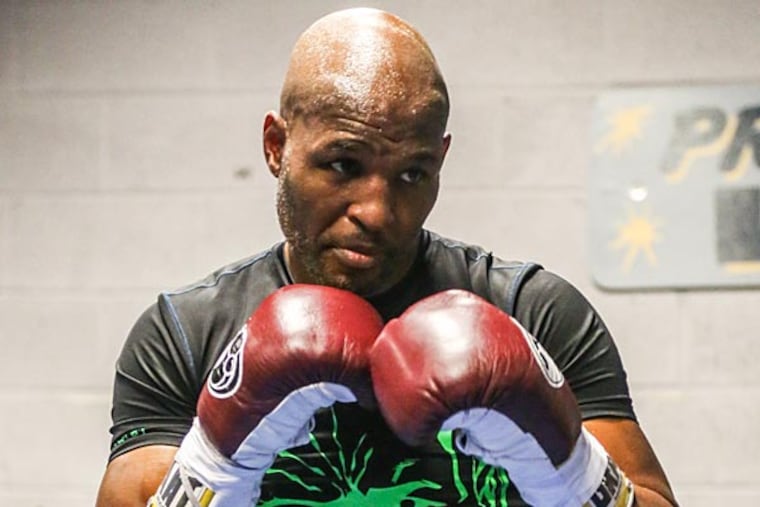
BERNARD HOPKINS was foolish to throw down a race card.
Of the many ways the Philadelphia boxing icon could have expressed his displeasure with what he perceives as a lack of appreciation for his accomplishments, complaining that it's "because I'm black" is least likely to garner support.
When the purpose is to self-congratulate and pat oneself on the back, people don't like to be labeled as having a racial agenda simply because they might not think you are as iconic as you believe.
Still, leading up to his light heavyweight unification bout against Sergey Kovalev at Boardwalk Hall in Atlantic City tomorrow night, that's what Hopkins did in an interview with ESPN.com.
Hopkins, who is 2 months short of turning 50 and looking to extend his record as boxing's oldest recognized world champion, believes his athletic accomplishment transcends his sport.
He also apparently believes the only reason the rest of America doesn't celebrate it that way is because of his race.
"Because I'm black," Hopkins said when asked why recognition of his historic achievements is confined to the boxing world. "What do you think if my name was Augustine, Herzenstein, Stern? Cappello? Marciano? Don't you understand the conflict of interest?
"If I was any of those names of any other background, I'd be on every billboard and every milk carton and everyplace to be."
No, he would not.
I don't think Bernie Hopkinstein would be any more recognized than Bernard Hopkins.
Hopkins' rise from being a convicted felon to becoming a future Hall of Fame fighter is inspiring and compelling. It is not, however, uniquely special or transcendent.
We have to look exactly at what Hopkins claims.
His argument is that being black has stopped him from being celebrated does not match the evidence.
Historically, only a few athletes of any race have been celebrated in the manner Hopkins is talking about, but three near the top of every list are Pelé, Muhammad Ali and Michael Jordan.
That is a dark-skinned Brazilian and two African-Americans.
If you want to talk about current society, some of the biggest pop-culture icons are LeBron James, Kobe Bryant and Kevin Durant - three African-American basketball players.
The lack of recognition is not Hopkins' race.
Part of it is his sport.
Boxing no longer holds that status it did when Ali, Rocky Marciano, Sugar Ray Leonard or Mike Tyson could step way beyond their personas in the ring.
Today, the "sweet science" lags way behind football, basketball, baseball, hockey and NASCAR.
Because athletes such as James, Peyton Manning and Dale Earnhardt Jr. dwarf Hopkins in brand recognition has nothing to do with their racial identity.
Since the fall of Tyson, no boxer of any race has become an out-of-the-ring megastar.
Most important, however, you have to examine the individual - Bernard Hopkins.
It's not all about achievement. People also must like a particular athlete to want to celebrate him.
Hopkins has rarely done much to make people want to like him - especially those in position to turn him into a household celebrity.
In fact, he has mainly done the opposite. Hopkins' history as a boxer is filled with actions that have turned people against him.
For much of his career as "The Executioner," Hopkins embraced the role of villain, often using race as his weapon of choice to stir the pot.
In 2001, Hopkins nearly caused a riot when he threw a flag of Puerto Rico to the floor while in the country promoting his fight with Felix Trinidad.
Once, during a media event for someone else's fight, Hopkins shouted at Joe Calzaghe, "I would never let a white boy beat me!"
The fact he told ESPN that, of all his great victories, beating Kelly Pavlik - who will be nothing more than a sidebar in boxing history - "was the greatest moment of my life because it was undeniably white against black" illustrates that Hopkins still likes being the antihero to a large segment of society.
Hopkins has always said that his actions were never about his actual views on race but merely a means to hype his fights using tried-and-true methods.
Still, that excuse does not fly with many. It has certainly created an aura around Hopkins that Madison Avenue finds toxic.
Troubling pasts can be spun into positives. Purposely creating racial tension cannot.
Despite the horrible things Tyson has done, many people still want to like him. He is more popular than ever, with a New York Times best-seller, and a one-man show that played Las Vegas, Broadway and HBO.
Tyson just premiered a cartoon series on Adult Swim called "Mike Tyson Mysteries" that features him, his adopted daughter of Asian heritage, a talking pigeon and the ghost of the ninth marquess of Queensbury.
After years of negative race hustling to benefit himself, it is disingenuous for Hopkins to now complain that people he intentionally antagonized with racial strife do not celebrate his achievements as transcendent because of race.
Respecting a person's accomplishments differs from liking their actions and how they go about doing their business.
When it comes to elevating an athlete to an iconic status, likability plays a large role. People, not the individual athlete, determine who becomes transcendent.
It's not because of his race that Bernard Hopkins has not crossed that threshold. It's because he is Bernard Hopkins, and some of his actions have rubbed too many people the wrong way for them to admire him that way.
Blog: ph.ly/DNL