Duke holds off Butler for NCAA title
INDIANAPOLIS - This would have been no miracle, no act of the basketball gods. In the years and decades to come, it would have been described that way.
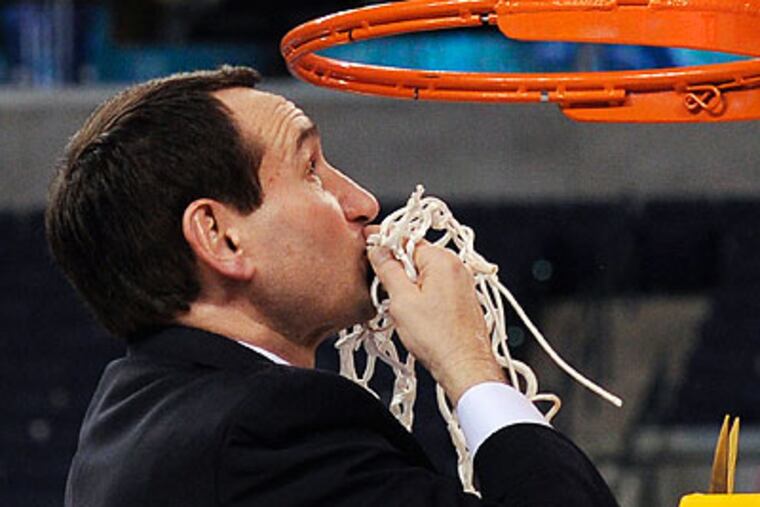
INDIANAPOLIS - This would have been no miracle, no act of the basketball gods. In the years and decades to come, it would have been described that way.
If, however, that miracle shot from halfcourt had gone in, it would have been replayed forever. It came as close as a shot can come without going in.
It was the last shot of one of the great NCAA Tournaments, perhaps the last one with the beloved 65-team format.
And while Gordon Hayward's shot was in the air, as the buzzer sounded, all 70,930 people in Lucas Oil Stadium must have held their breath. The trajectory was true. The arc was good. It hit the backboard, rammed off the front of the rim and bounced harmlessly to the floor.
A team finally had scored 60 on Butler in the tournament. Duke got there - barely. And it was enough - barely.
Duke 61, Butler 59.
It was clear from the start last night that if Duke (35-5) was going to get that fourth national championship, Butler (33-5) was going to make certain that it was earned and not given.
There were no losers in this classic. Duke won a championship it certainly deserved. Butler won hearts that will stay won as long as basketball is played.
All game, Duke seemed in some control, at least on the scoreboard. But the lead was never enough to relax. Butler was far too determined for that.
Even when Duke finally seemed to have it, leading 60-55 with the ball and barely 2 minutes to go, Butler forced a turnover, a miss at the rim and, then after a short-armed Kyle Singler jumper was short, had the ball, after two Matt Howard layups, with a chance to win.
Hayward got the ball at the top of the key, his team trailing 60-59, a modern-day Bobby Plump ready to hit the game-winner. Only his right baseline fadeaway was long. Duke's Brian Zoubek got the rebound and was fouled with 3.6 seconds left.
He made the first, missed the second. Hayward got the rebound, took off up the right sideline and launched just before the clock turned to zeros.
"I was standing at halfcourt and thought it was going in," Howard said. "That makes it even a little more devastating . . . I've seen him make that numerous times before in practice and in games.''
He almost made it again.
In the first year of Duke's ascension back to the national stage under young coach Mike Kyzyzewski (1986), Butler had a recruiting budget of $3,000. The Bulldogs played in funky old Hinkle Fieldhouse, but they were somewhere between afterthought and no thought.
As Duke became the gold standard over the succeeding quarter century, little Butler took slow but sure steps up the college hoops ladder. This March and April it took a giant leap for the kinds of schools that hope and believe and just want a chance.
When the story is retold, Milan High and "Hoosiers" and Plump will be cited. And that will be fine.
But this NCAA championship game was about a team that knocked out one heavyweight after another until it got to the heaviest of weights in the championship game. Playing 6 miles from its campus, Butler was not in awe of the moment or the opponent.
Duke was great and had to be. Butler was great and did everything but win.
The Blue Devils were favored six times and won six times. Butler beat No. 4 in the country, No. 7, No. 13 and nearly No. 3.
Duke had won its first five NCAA games by an average of 17 points. This was not like that.
Coach K had won No. 868 and none will be remembered any longer than this one. It was the fifth championship in the last 10 years for the mighty ACC. And that will matter.
Butler, trying to win for the Horizon League and all those leagues that time forgot, will matter more.
"When you coach these guys with their effort, their focus, their determination, you're at peace with whatever result happens on the scoreboard because you've got a group that's given it every single thing they have," Butler coach Brad Stevens said.
If you just looked at the shooting stats, you could not imagine how Butler trailed just 33-32 at the half. The Bulldogs were shooting 34.2 percent while Duke was shooting 50 percent.
The Bulldogs were hanging in the game for one simple reason - they wanted to. They were winning all the effort stats. During the tournament, Duke had outrebounded its first five opponents by 47 boards. The Blue Devils were especially lethal on the offensive glass, leading to tons of second-chance points.
The Bulldogs protected their defensive glass brilliantly and owned their offensive glass. They were not going to watch all their missed shots. They were going to retrieve them. They were hanging, making Duke realize there would be no walkover. It was not going to be about the school on the jerseys. It was going to be about the players inside them.
Stevens made a fascinating tactical decision on Duke's Big Three of Singler, point guard Jon Scheyer and Nolan Smith. He would put a smaller, quicker player on Singler and he would put his best defender, Ronald Nored, on Scheyer, Duke's point guard. He would try to cut off the head.
Still, the Big Three is lethal. They combined for 47 points. Duke, with three seniors and two juniors in the starting lineup, was the veteran team. Butler started three sophomores, a junior and a senior.
Duke really asserted itself on the glass in the second half, actually winning the board battle, 37-35. Zoubek's final rebound, his 10th, made all the difference.
Singler (19 points, nine rebounds) was named Most Outstanding Player. He made difficult shots and made life very uncomfortable for Butler star Hayward.
Smith won the championship 30 years after his late father, Derek, won across town with Louisville at now-demolished Market Square Arena.
"I can't explain how happy I am," Smith said. "This is for my dad. Like father, like son. This is so special to me right now."
Smith had a great look at that final shot.
"I just thought, 'Please don't,' " he said. "It looked good. I was praying it didn't go in."
This was one of those games that will stand the test of time. It wasn't necessarily pretty, but the effort, combined with the stakes and the possibilities, made it a game for the ages.
"In all my years of watching the national championship game, this was the best one I've seen," Smith said.
On the last halfcourt offensive possession, Duke really had to dig in. It was a basket from losing.
"To get that last stop, it was why we won all year - defense," said Zoubek, the former Haddonfield High star playing his last college game.
Incredibly, Butler shot 34.5 percent for the game. Duke's length was a huge problem near the rim. But, if that last shot had been an inch more in another direction and a touch softer, the Bulldogs would have won the championship. And maybe that really would have been a miracle.