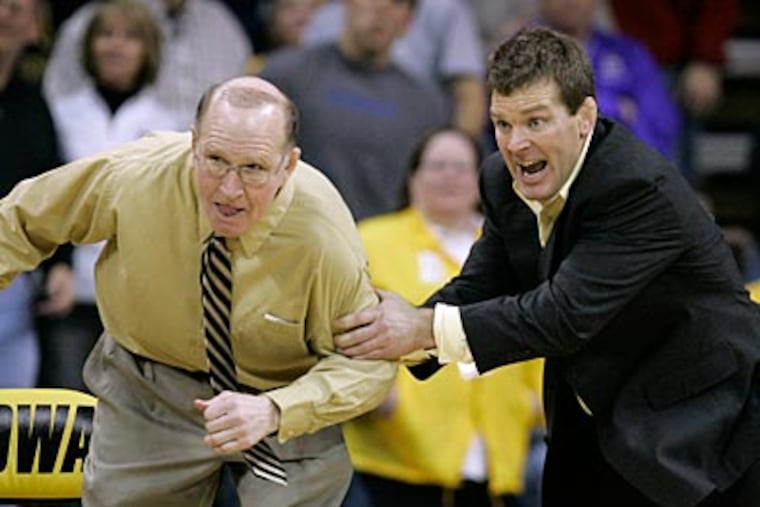
IOWA CITY, Iowa - Dan Gable, his sport's most recognizable figure, has become something of an EMT for college wrestling, which, depending on your vantage point, is either glowing with good health or on its deathbed.
With a multibillion-dollar budget shortfall threatening several California teams, Gable has made six trips there in the last year, dispatched in a sometimes futile effort to stop the bleeding.
Just this week, he traveled to Chicago for a five-hour O'Hare Airport meeting aimed at establishing a single voice for a sport that at its highest level, Division I, has been badly injured by the twin onslaughts of Title IX and a recession.
And virtually every day, Gable has to attach a Post-it note to his cell phone, reminding the legendary Iowa State wrestler and Iowa coach which radio station, potential donor or beleaguered coach to telephone.
"I don't mind," said Gable. "I'll do anything if it helps wrestling."
Virtually retired now, Gable is the sport's chief ambassador because his is its most galvanizing presence and because the sport he loves is wrestling with a strange dichotomy:
While the 2011 NCAA Championships later this month in Philadelphia (March 17-19) will showcase all that's well with wrestling, much of the discussion there will, as always, focus on its ongoing problems.
"Wrestling's vital signs are very strong," said Mike Moyer, the executive director of the National Wrestling Coaches Association, headquartered in Manheim, Pa., "except at Division I."
The positive figures are impressive. All 105,000 tickets to the three-day championships at the Wells Fargo Center sold out weeks ago. The fans who will attend are so devoted that adjacent Lincoln Financial Field will be employed as the site of a multi-event, NFL-like Fan Festival.
There are 40,000 more high school wrestlers than a decade ago. Earlier this month, the Iowa state high school tourney drew 77,000 fans to Des Moines. Youth league participation is at an all-time high, an estimated 750,000. And, in a countertrend to a decades-long contraction, 70 colleges have added wrestling in recent years, though almost all at a non-Division I level.
But while more wrestlers are being created, the neck of the funnel that leads the best of them to a top-level college program has narrowed considerably.
Since 1972, when Title IX was enacted, more than 450 colleges and junior colleges - including Temple, Villanova, La Salle and dozens of others in Pennsylvania - have eliminated varsity wrestling.
While 345 NCAA schools offer Division I basketball, just 80 have men's wrestling. The sport has virtually disappeared from colleges in the South and Southwest.
There are, for example, 380 high school wrestling teams in Georgia. But until Shorter College, an NAIA school, added wrestling last year, there was not a single college program in that state. The numbers are similar in Texas, where there are 250 high school teams and one college team, Wayland Baptist, also from the small-school NAIA.
Across the nation, according to NCAA statistics, 5 percent of high school athletes go on to play in college. For wrestlers, that figure is halved, 2.4 percent.
"There's a downsizing trend going on, and not just for wrestling but for all men's Olympic sports," said Moyer. "We're trying to do all we can."
Wrestling officials have eased their public criticism of Title IX, the landmark 1972 federal law that, as interpreted, demands opportunities be provided in proportion to the gender makeup of the student body. In creating women's sports, colleges have been forced to cut nonrevenue generating men's teams.
The focus now, said Moyer, has turned away from the courts, where the NWCA lost a major Title IX challenge in 2007, to lobbying college administrators and state legislators.
"I'm a graduate of West Chester, which dropped it [in 1987] after having had a long tradition of developing wrestlers and wrestling coaches," Moyer said. "We're trying to educate these people about the important role collegiate wrestling and these other sports play in developing people who will become the coaches and mentors in their high schools. Historically, that's been how they were trained. And I think more and more of these administrators and legislators are starting to connect the dots."
Monday's O'Hare summit, which brought together officials from the NWCA, the National Wrestling Hall of Fame, and USA Wrestling, plus Gable and several other significant figures, was intended to put all the sport's advocates on message.
"These are formidable challenges we face," Moyer said. "And there's never been a more important time to reduce the duplication of effort and be focused in core areas. We need to be much more organized, to get everybody under the same umbrella."
So far those officials, and the schools themselves, have been hard-pressed to develop a coherent solution.
In the recent past, schools like Binghamton University and New Mexico Highlands lobbied hard and well enough to attract needed state support. But that's not likely to happen now, in an even tighter fiscal environment for states.
What does still work is uncovering wealthy private benefactors. Some of the luckier, often more prestigious, colleges have done that to save or restore wrestling.
When, for example, Bucknell dropped wrestling in 2001, Philadelphia businessman Bill Graham rode to the rescue. Three years later, the ex-wrestler's $7.6 million donation restored the men's sport.
But, under Title IX's court-tested proportionality standards, if you're going to add a men's team, you've got to provide an equal number of opportunities for women. So Graham's money also financed a new women's rowing program at the Lewisburg school.
Women's rowing, because the several dozen opportunities it provides help balance the men's football numbers, has boomed, often at wrestling's expense.
According to the NWCA, there now are 144 NCAA schools that offer women's rowing but none has women's wrestling, even though high school participation in the latter sport has exploded.
"Women's wrestling is a great sport but it doesn't give you the numbers to offset football," Moyer said. "As for the men, sometimes in order to save wrestling, you have to save as many as three women's sports. It makes it all very complex."
Other universities, like Princeton and American, have followed the same private-financing paradigm as Bucknell.
"Title IX is a great law that has had terrible consequences," said Chris Ayers, the coach at Princeton, which was without varsity wrestling for four years in the 1990s.
It's also worked for 2011's top two Division I teams, Cornell and Iowa. Cornell wrestling alum Stephen Friedman has donated millions to his alma mater. And at Iowa, which has won the last three national titles, the upgrade to powerhouse was made possible by a significant financial commitment from alum Roy Carver. Carver's cash made it possible for the Hawkeyes to lure Gable, a grad of hated rival Iowa State, as an assistant in 1973. He would guide Iowa to nine consecutive NCAA titles.
The story is similar at Oklahoma State, another traditional wrestling power, where T. Boone Pickens' money is transformed into first-class facilities and coaches.
Arizona State, one of the few schools outside of Iowa and Oklahoma to win an NCAA title, also found its program in jeopardy recently, until it, too, uncovered a large donor.
"You've got to have a sugar-daddy these days," said Phil Haddy, the former sports information director at Iowa and an authority on that state's long wrestling history.
But a lot of schools, particularly state schools, don't have that luxury.
"Big benefactors are nice," said Moyer, "but they don't grow on trees at public universities. The bigger question at those schools is, do public universities have an obligation to provide their students with activities that are deeply embedded in that state? After all, these are taxpayer-funded institutions. Is it fair that Washington has 300 high school wrestling teams and none at the college level?"
Curiously, while the economy is hurting wrestling at the large colleges, it's proven to be a benefit at smaller, nonscholarship schools. Desperate for new students, they've recognized the large pool of unrequited high school wrestlers.
By starting a relatively inexpensive wrestling team, they can attract 25 or more tuition-paying wrestlers eager to find an outlet for their talents.
"Wrestling is very attractive to these NAIA and Division III schools," said Moyer. "It's inexpensive, has a large roster size and an underserved population. The economy is our best friend at these schools."
Gable has been to California so often recently because the budget crisis has impacted several of that state's remaining wrestling programs. Cal-Davis has dropped the sport, at least for one year. Cal-Bakersfield and Cal-Fullerton will do so next year. And Fresno State axed the sport six years ago.
That leaves just Stanford, San Francisco State, Cal Poly and NAIA Menlo with wrestling teams in the nation's largest state.
"We've taken a hit because we really haven't been focused," said Gable. "We used to leave it up to the coaches, who are so involved in coaching their teams they couldn't possibly try to save the sport.
"What we've got to do is convince people of the values that can be formed through wrestling. Leadership. Independence. It's sad to say, but every time I see a story in the paper about a military guy who's been killed, I stop and read it. Because so many times they were wrestlers. Those are the kinds of people the sport is producing."
Sports on the Rebound
Since 2001, 75 college wrestling programs have been added nationwide, going against a trend that has seen nearly 400 dropped over that same time period.
Added programs in Pennsylvania include D-II Mercyhurst (2001), NAIA Mercyhurst Northeast (2002), D-II Seton Hill (2006), D-I Bucknell (dropped in 2001; reinstated in 2006), USCAA Penn State-Dubois (2009), Penn State-New Kensington (2009), and Penn College (2010). In New Jersey, Stevens Institute of Technology reinstated its D-III program in 2004 after dropping it in 1992.
SOURCE: usawrestlingnation.com
EndText