Some ideas on winning at tournament time
IF YOU CRUNCHED hundreds of numbers and tried to quantify what wins in the NCAA Tournament, the answers still probably would be the obvious - talent and coaching, in that order.
IF YOU CRUNCHED hundreds of numbers and tried to quantify what wins in the NCAA Tournament, the answers still probably would be the obvious - talent and coaching, in that order.
The game has changed so much over the last generation that it makes it even more difficult to come up with specific attributes. Back in the day, experience would have been at the top of the list. Once upon a time, senior guards often equated to winning.
With the top freshmen now hardened by hundreds of AAU games, you get champions like Syracuse (2003) with freshmen Carmelo Anthony and Gerry McNamara playing starring roles against a much more experienced Kansas team. You get freshmen Greg Oden and Mike Conley putting Ohio State in the 2007 title game.
Imagine what this 68-team tournament would be like if we had seniors Derrick Rose (Memphis), Kevin Love (UCLA), Michael Beasley (Kansas State) and O.J. Mayo (USC). Alas, those days are history.
So what wins in the tournament today?
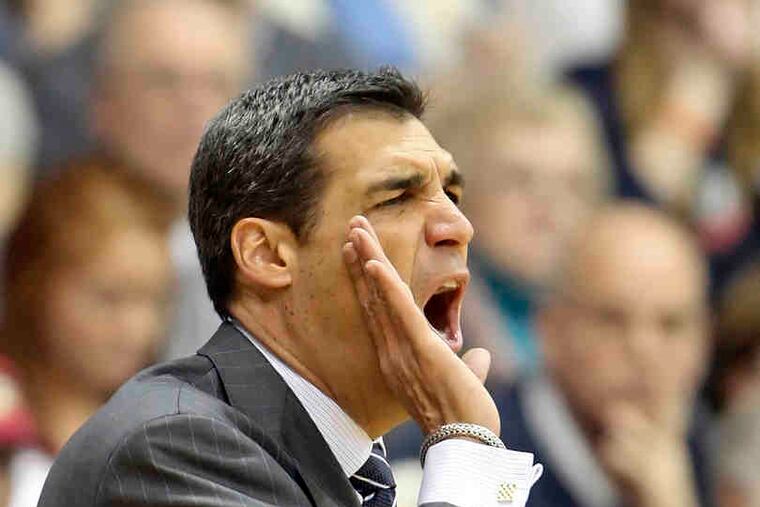
We have two active coaches in this city who have won a combined 18 NCAA games. Villanova's Jay Wright has 12 of them, including two Sweet 16s, a Final Eight and a Final Four. Saint Joseph's Phil Martelli has a Sweet 16 and a Final Eight on his resume.
ESPN's Dick Vitale and Jay Bilas have seen hundreds of NCAA games. Bilas played in the tournament for Duke.
So?
"You've got to be able to defend and rebound," Wright said. "If you're relying on making shots, there's going to be some game in the tournament where you're bound to come out and miss some shots. You've got to find a way to win those games when you're not making shots. So that would be No. 1, I think.
"Then I think you have to define yourself, on how you want to win. You've got to have had some success, and understand how a game has to go for you, how you get things done. It might not be the same way another team gets it done. But you have to know yourself, and what works best for you. You have to be able to look at teams and say, 'Hey, how do we get this game to be our game?'
"In the regular season, you can kind of go into the game and adjust. But when all the pressure's on, your guys have to be comfortable, playing your style. So you just try to do everything you can to keep things as simple as possible for the players. There's so much going on around you, everything you can do to keep it the same as a regular-season game, that's a challenge."
Martelli is all about preparation. He has been known to pull all-nighters where his only company is several tapes of the next opponent.
"You know I hate them, but I think it is a true cliche: I think you have to concentrate on that one game," Martelli said. "We never looked at it as a six-game season. It was really one game at a time.
"To me, that first game, even though they'll say it's an unknown opponent, I think it's an easy game to prepare for because you might in some cases have 3 or 4 days. And we've just gone through January, February with 2 days to prepare. So now you have a third day to prepare.
"I think the second game of the weekend is much more daunting when you haven't done that where you've had to turn around in 40 hours or whatever it would be. To me, it's all flat-out preparation."
Vitale's formula for winning is a bit less complicated than his often-zany commentary.
"I think it's very simple: Execute in terms of shot selection, taking good shots, making certain you defend exceptionally well as a unit," Vitale said. "Understand the strengths and weaknesses of your people. You always put yourself in a position to win.
"In a tournament scenario, because of the length of timeouts and how guys get a little more conservative, I don't think the fatigue factor is as major as some people talk about. I really think players are resilient and you'll see coaches not sub as often.
"I think it's get down to the old principles that have worked for years . . . You need a three-point shooter and you better convert at the free-throw line. Do those things and you got a great chance to win."
Bilas is one of the game's most insightful commentators and he has an interesting take on the subject.
"To me, I think what is underemphasized as far as postseason success is halfcourt efficiency," Bilas said. "I think in postseason play you are playing against good teams that can slow the games down and make it into a halfcourt game.
"People think defense wins championships and no team is going to win without being good defensively. But I think you have to be really efficient on the offensive end. And by that I mean your offense has to help your defense in postseason play.
"If you take a bad shot that causes a runout, your defense cannot stop that. You're allowing the opponent by doing that to play ahead of your defense. Same thing with a turnover. If you're loose with the ball, that allows your opponent to play ahead of your defense. The teams that are most successful in postseason play are the ones that are the most efficient offensively and I'm not sure that we pay as much attention to that as we should."
If you want to know why Michigan State has been so good in the postseason under Tom Izzo, re-read Bilas' comments. No team in America runs more and better halfcourt sets. (This season, however, might be the outlier for the Spartans.)
Unique styles win in the NCAA. See Loyola Marymount, 1990. See Temple under John Chaney. See the confidently coached midmajor that never takes bad shots and won't shoot until ready.
"I don't know the numbers, but I think you have to be a team that can comfortably get to 70, 72, 75 points," Martelli said. "I don't think you see a lot of the NCAA games, particularly after the first round, where a team's [going to win in the 50s]."
And, if your team is fortunate to win four games, it will be faced with a completely different set of circumstances at the end.
"That's probably the lesson I learned the most [from the Final Four]," Wright said. "All the guys told me that had been there, that there would be so many things that were different off the court. If we get the chance to go back, I could tell you a million things. You've got to go through it one time. That's the truth. It's dead-on right. There's just so much [stuff] you're doing."
And there is knowing yourself.
"There's something to be said for the 'it' factor," Wright said. "That's a good way to say it. You've got to define your way of success. You have to know what your 'it' is, so when you're in those games your players know and you rely on your 'it.' You have to have done it, and know how to do it, and go into a game and say, 'OK, how are we going to get to this point?' And if we get to that point, we have a good chance of being successful.
"Like that Final Eight game [against Pittsburgh]. We knew. We'd played some great games against some great teams. So we knew we were just going to battle and battle. In the end, our three-quarter-court press, we were hoping we were going to create that play [the Dwayne Anderson steal that led to a three-point play during a late comeback].
"It was like, 'This is what we do.' It's tight. We've done that all year. We kind of knew it. We didn't even talk about it. The last play, even, you sort of see that happening. That's our play. We run the same play all the time [in practice], so we knew if we got to that point we were going to make the pass, and make the pass, and there were 4 seconds left and Scottie [Reynolds] was going to take three dribbles and hopefully get a good shot off. Just the way we worked on it. And that night, all of that paid off for us."
It helps if you have Reggie Redding throwing it to Dante Cunningham throwing it to Reynolds and the ball goes into the basket.
Eleven Saturdays before Reynolds made the unforgettable basket, Villanova ran another perfect end-of-game play against Louisville at the Wells Fargo Center. The Wildcats did everything right. Then they missed two foul shots and two tips and lost by a point.
We can all analyze. We can look back. We can anticipate.
In the end, it is always about the players. The ball either goes into the basket or it doesn't. *
Mike Kern contributed to this report.