Lehigh stirring echoes of its rich past
BETHLEHEM, Pa. - Lehigh University's musky wrestling room in 104-year-old Taylor Gym, festooned with inspirational banners and the sepia-toned photos of the school's many NCAA and EIWA champions, smells of the sport's long history there.
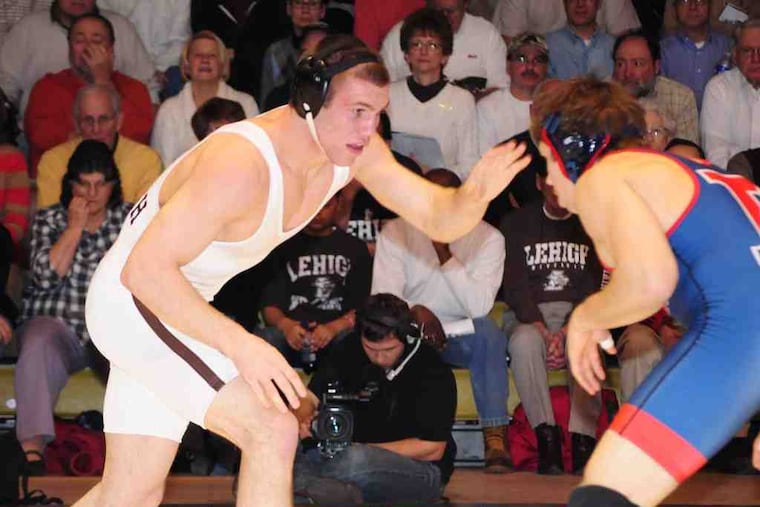
BETHLEHEM, Pa. - Lehigh University's musky wrestling room in 104-year-old Taylor Gym, festooned with inspirational banners and the sepia-toned photos of the school's many NCAA and EIWA champions, smells of the sport's long history there.
The tiny, private school here, near the heart of the Lehigh Valley's rich lode of high school wrestling, has turned out more individual NCAA champions (26) and won more EIWA team titles (34) than any team in the East. And, for 42 years, Lehigh was coached by one of the college sport's seminal figures, Billy Sheridan.
While Lehigh hasn't contended seriously for an NCAA team title since World War II - the Mountain Hawks were runners-up in 1939, fourth a year later - its Division I program, which like all others hands out 9.9 scholarships a year, has clung like a desperate wrestler to its notable tradition.
Despite an enrollment of 4,700, Lehigh is ranked No. 9 in the nation, according to the latest poll by the website InterMat.
And with eight wrestlers qualified for the 2011 NCAA Wrestling Championships - including top-seeded heavyweight Zach Ray and No. 2-seeded Robert Hamlin at 184 - the Mountain Hawks undoubtedly will play a role in determining who hoists the NCAA trophy Saturday night at the Wells Fargo Center.
Two months ago, on the icy night of Jan. 20, in a match moved from tiny Grace Hall to Stabler Arena to accommodate a raucous crowd of nearly 4,000, Lehigh's wrestlers awakened the echoes from their rich past. That night they handed the current NCAA favorites, No. 1-ranked Cornell, its only defeat, a 17-14 decision.
"That was a great night," said Larry Sheridan, the son of the coach who put Lehigh on the wrestling map in the first half of the 20th century. "It reminded me of when they used to pack 3,500 into Grace Hall, with another 500 or 600 watching upstairs on closed-circuit TV. The history here, it's wonderful."
The elder Sheridan, a Hall of Famer who died in 1960, coached Lehigh from 1911 to 1952, making the program nearly as well-known as the school's engineering curriculum.
He had discovered the sport as a boy in his native Scotland. Teaching himself, training with a brother, he became a British Isles champion before he was 20.
"He and his brother got interested in it from reading books," said Sheridan. "My dad was about 5-foot-5 or 5-6, but he was well-built, with speed coordination, and power. . . . Eventually he left Scotland, went to Canada, and then came to Philadelphia."
Sheridan spent 1910 as coach of the University of Pennsylvania, where, according to a contract on display at the National Wrestling Hall of Fame in Stillwater, Okla., he was paid $30 annually.
After Lehigh's three-year-old program lured him from Philadelphia, Sheridan quickly began to lay the foundation for the sport's growth in Bethlehem and beyond.
He transformed the Lehigh Valley into one of the sport's scholastic hotbeds by urging local high schools to take up the sport, organizing the first National Prep Tournament in 1935. That same year he started the country's first wrestling camp and clinic in Saylorsburg, which became a breeding ground for a generation of future coaches and officials.
"Billy Sheridan was above all an innovator," said Greg Strobel, who coached Lehigh for 13 years. "He was a Knute Rockne-type figure in that he was ahead of his time."
By 1939, Lehigh was strong enough to finish second in an NCAA tourney that, like most in that era, was won by Oklahoma A&M (now Oklahoma State). A year later, Lehigh was fourth. Then World War II came, and the program never got so close again.
"I always wondered why Lehigh didn't win more NCAAs back then," said Sheridan. "Well, my dad said he often didn't even send a team. If it was out in Oklahoma, say, the [athletic director] would say, 'We can't afford to send four or five guys way out there.' Sometimes my dad said he had to pay half the costs to get wrestlers to the tournaments they did participate in."
When Sheridan retired, he chose Olympic silver medalist Gerry Leeman, a star at what is now Northern Iowa, to succeed him. Leeman's teams went 161-38-4 in 18 seasons and produced nine individual NCAA titles. His best was Mike Caruso, the current Lehigh trustee who won three straight NCAA championships and lost just one match in his career.
Leman's teams were so successful and popular that in 1967 an arena-record 4,650 packed Grace Hall for a Lehigh-Navy match. That record won't be broken at Grace since, more recently, Bethlehem's fire marshal has capped attendance there at about 2,000.
"I don't think anybody had a stronger feeling for Lehigh than Coach Leeman," said Thad Turner, who wrestled for him, then succeeded him as coach in 1971. "Maybe it was because he came from Iowa, but he really appreciated and was interested in how things operated."
This year, Ray and Hamlin could add their pictures to the Taylor gym wall, where the gallery of NCAA champs is flanked by John Engel (1931) and Troy Letters (2004).
Austin Meys will be the 11th seed at 174. The other five Mountain Hawks in Philadelphia - Frank Cagnina (133), Stephen Sutton (141), Joey Napoli (149), Brandon Hatchett (165), and Joe Kennedy (197) are unseeded.
And, with the NCAA tournament so close, there figures to be a lot of brown-and-white-clad fans in this week's sellout crowds.
"I didn't have a difficult time motivating our men with 3,000 people in Grace Hall stomping on their seats," said Turner. "I was fortunate to work with a lot a great young people, and for 18 years I never had a bad day."