Legendary Philly U coach Magee set to enter Hall of Fame
HERB MAGEE needed just one shot. Really, why would he need two? It was revealed in the winter that Magee was a first-time finalist for the Naismith Memorial Basketball Hall of Fame. It was announced at the Final Four that he had been elected. Tomorrow night in Springfield, Mass., the Philadelphia University coach will be formally inducted in a ceremony at Symphony Hall.
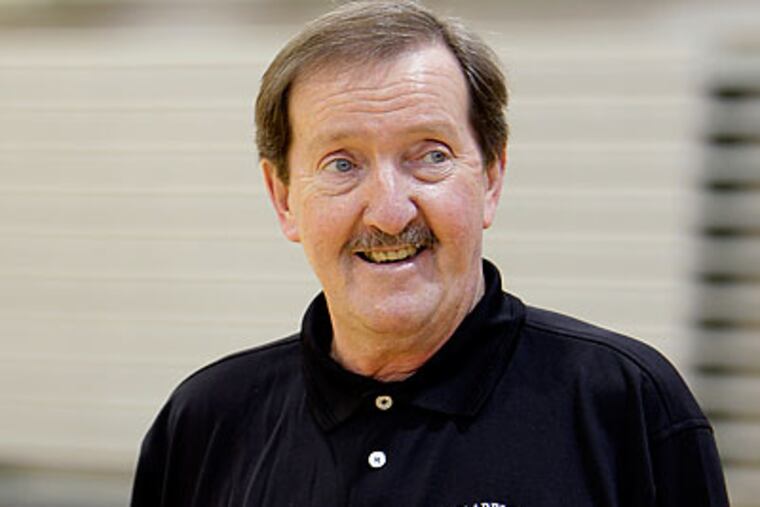
HERB MAGEE needed just one shot. Really, why would he need two?
It was revealed in the winter that Magee was a first-time finalist for the Naismith Memorial Basketball Hall of Fame. It was announced at the Final Four that he had been elected. Tomorrow night in Springfield, Mass., the Philadelphia University coach will be formally inducted in a ceremony at Symphony Hall.
When you can navigate the mysterious process that is the Hall of Fame balloting and come out the other side with enough votes in your first try, you simply must be doing something right. Really, this was not difficult. All you must do is trace the arc of a career.
Magee learned to shoot by watching Paul Arizin and Tom Gola play for the Warriors at Convention Hall. He put up 500 jump shots every day, cataloging each group of 50 to see where the misses went. He does the same thing today when he teaches shooting to young kids or NBA players.
As a kid, his biggest goal in life was to make the team at West Catholic. He played there with lifelong friends Jim Lynam and Jim Boyle.
His mom died when he was 12, his father when he was 13. So his uncle, Edwin Gallagher, a Catholic priest, raised Magee and his three brothers.
In 1959, Magee appeared on the campus of what was then known as Philadelphia Textile. He has been there ever since - player, assistant coach, head coach since 1967. Now, for his playing career (a then school-record 2,235 points), his coaching career (his 922 wins in 44 seasons are more than any men's coach in NCAA history) and his other career as a shooting guru where he has taught neophytes and retaught pros, Herb Magee is taking his place among the greats in his sport.
"Still to this day, hard to believe," Magee said.
The coach has been to the Hall of Fame three times. He saw all the plaques. The next time he visits he can see his plaque.
"I remember looking at them going, 'This is unbelievable. If I could ever be in this, the Hall of Fame, that would be it,' " Magee said.
Tomorrow night is it, the culmination of a career that is hardly over. Even after 30 20-win seasons, 25 NCAA Division II Tournaments and that 1970 national championship when his team outscored its five opponents by a combined 119 points, the 70-year-old Magee said retirement is not something on his agenda.
Lynam was Magee's backcourt mate at West Catholic. A.J. "Butch" Iancale played with Magee for 2 years at Textile. Steve Donahue's first college job was with Magee. Patrick Chambers played under Magee. They get it and they get him.
"Good health willing, he will end up with more coaching basketball victories than any human in the history of planet Earth," Lynam said. "When you look at his body of work, [the Hall of Fame] is a no-brainer."
It's not just the coaching; it's also those shooting clinics.
While the kids assemble at camps, Magee just starts idly shooting. Lyman calls it "a trick."
"He kind of mesmerizes them because he makes every shot," Lynam said.
Once he would finish shooting, Magee would announce how many he had made in a row. It was usually 100. One time, Lynam wanted the campers to check out the claim. So, he had them count.
When Magee was done, two kids came running over to Lynam. Magee had made 77 straight.
"My father loved Herbie," Iancale remembered. "He'd always give us a couple of bucks after a game. He'd give us like $5. Herbie had 30 points one game so he gave him $20. My father wasn't rich. He was a machinist at the Navy Yard. He said, 'It's got to be 40 now.' So, he got 40 one game. My father said, 'I can't afford this.' "
So, 40 became 50. If he got 50, he would get $50.
"So, he gets 50 against Wilkes," Iancale said.
"My father said: 'That's it, see you later.' "
Iancale was a freshman when Magee was a junior, the season he averaged a still school-record 29.1 points per game.
"[Magee] brags to everybody that I am the only guy to ever play alongside him that averaged double figures," Iancale said. "He took all the shots."
And made most of them.
"He never got tired," Iancale said. "Played the whole game. Never wanted to come out."
One time, Textile played the Camden Bullets of the Eastern League. It wasn't much of a contest. The pros were far better. But nobody could guard Magee.
"The guy [guarding him] got so frustrated, I set a pick for him and he ran right over top of me and broke my hand," Iancale said. "I said, 'Look what I do for you, Herbie.' "
Iancale was diverted before finishing college. He wasn't a great student. One day, he ended up at Brandywine, the old harness track in Delaware. He has been around one track or another ever since. He knows everybody in racing and everybody knows him. Just like Magee, he found his calling. And never left.
Donahue was an assistant for 2 years under Magee, then an assistant at Penn before becoming the head coach at Cornell and now Boston College.
"Guys you know, guys you work with, it's almost like an oasis you never got to," Donahue said of the Hall of Fame. "To think a guy you worked with is getting that honor is pretty remarkable."
Just like the man himself.
"What Herb did was create another vision of offense for me," Donahue said. "It wasn't what most people did. It was kind of something people did in the '50s and '60s. To me, it's back now."
And, Donahue said, Magee always had great confidence, which gave his players great confidence.
Chambers, now the Penn State coach after 2 years at Boston University, was one of Magee's favorite players for some of his best teams. Chambers was the point guard for teams that went 111-16.
"There's something to be said for staying in one place that long," Chambers said. "Sure, he could have chased the almighty dollar. He looks like he's 40. The guy doesn't age. There's a confidence about him, but he doesn't come off like you don't want to be around him."
Magee has worked diligently to keep stress out of his life. He had offers. He liked where he was. He stayed.
"He figured this out," Chambers said. "The guy's a genius. I look like I'm 70. He looks like he's 32. Something's wrong here."
The coach judges a season by how many times he raises his voice. He almost never did with Chambers' teams.
"He was great at reading the personality of a team," Chambers said.
And he teaches the fundamentals
"The things you learn about a shot," Chambers said. "It's like a golf swing to him . . . He can sit at the foul line, make 100 free throws and have a conversation at the same time, which is mind-blowing."
When Magee first came to Textile, there was no gym. Now, there is a beautiful arena with a court named for the coach. When he started school, there were 350 students taking 36 hours of textile classes per week. These days, there are 2,200 students taking classes in just about everything.
And there is always the shooting, his and everybody else's. When he was first asked to lecture at a camp, he said he wanted to speak about shooting. He has never spoken about anything else.
His first year in the Poconos, he noticed some rafters in the gym. So, he demonstrated technique by shooting it over the rafters. And in.
After that, he was the "rafters guy."
Herb Magee was also the guy who made all those shots from all over the court and taught all those campers to shoot it right. He is also the man who coached all those players and coached all those coaches.
Winning all those games was simply a byproduct of all those hours in the gym, by himself, with his teammates, with his teams. The sum of the clinics, the preparation, the practices, the games and the record is a plaque in the Basketball Hall of Fame.
Also in the Hall
Dennis Rodman, Chris Mullin, Artis Gilmore, Arvydas Sabonis; Tom "Satch" Sanders; five-time Olympic gold medalist Teresa Edwards; coaching greats Tex Winter and Tara VanDerveer and the late Reece "Goose" Tatum of the Harlem Globetrotters also will be inducted.