It's all about money in the NCAA
REMEMBER that it's always about the "student-athlete." In a world more populated by frauds every second, college sports may have more frauds per square inch than any endeavor on earth.
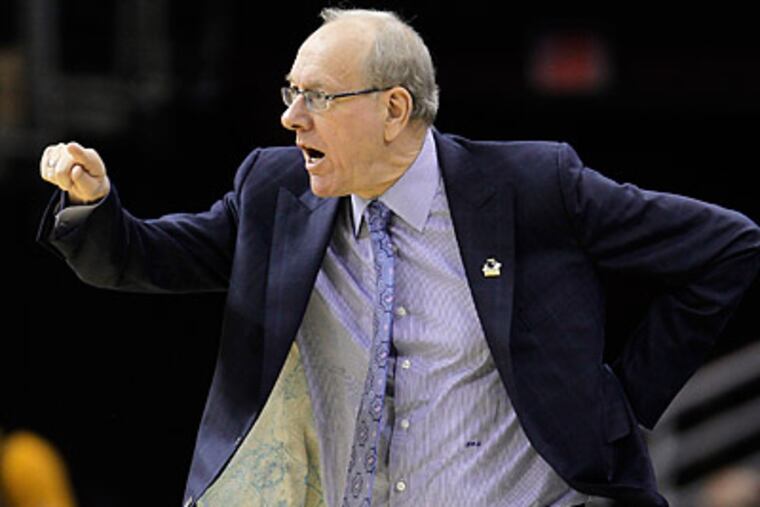
REMEMBER that it's always about the "student-athlete."
In a world more populated by frauds every second, college sports may have more frauds per square inch than any endeavor on earth.
Administrators preach education and practice business, cold-hearted, ruthless business. Athletic programs are for sale to the highest bidder.
But if a "student-athlete" gets free tattoos or sells memorabilia, that teenager or young adult is branded, suspended and sometimes ruled permanently ineligible.
Witness the latest deal - Syracuse and Pittsburgh to the Atlantic Coast Conference.
The Big East was formed in 1979 as a conference that would marry basketball and cable television in the Northeast. It was the brainchild of Dave Gavitt, one of the great basketball/business minds of the 20th century. It has been so successful that since 1982, conference teams have accounted for 17 Final Fours and six national championships, not to mention a jammed Madison Square Garden each March for its tournament, a massive TV presence, and a gigantic fan base.
The iconic program in conference history has been Syracuse, one of seven charter members. There are all those unforgettable players and the Carrier Dome, the giant on-campus arena that brought crazy crowds out of the snow and recruits from as far as California when they saw games from the Dome on TV.
It was more than a bit ironic that the moves were announced on the weekend Gavitt passed away. A great coach at Providence and an even better administrator, Gavitt saw the future three decades ago. He also probably saw this, too. He just could not have been terribly happy about it.
One has to keep in mind that none of this conference chaos is about basketball or, of course, the student-athletes. It is all about football and the cold, hard cash generated by the BCS cartel.
It may be against the rules for a player (and they really are players) to market himself, but there is no rule about a school attempting to find the best market for itself.
Not a bit of hypocrisy in that.
When in doubt, follow the money. The NCAA is in the midst of a $10.8 billion, 14-year contract with Turner and CBS for the basketball tournament. But that money is used to fund the NCAA operations in Indianapolis and is distributed among the schools in a relatively benevolent, socialistic way.
The big boys don't get fat from basketball. They get fat from football. The conferences, not the NCAA, control the football money generated from television. Which is why there is no playoff, something that would have to be administered and controlled by the NCAA.
The cartel does not want to share that money so, school by school, it is consolidating into super conferences.
So what happens to leagues like the Big East when schools like Syracuse and Pittsburgh, a member since 1982, head out the back door? And what happens when some of the other six remaining football schools look for a better landing spot?
Think they are breathing a many million-dollar sigh of relief out on the Main Line this morning. It was just last spring when Villanova was prepared to say yes to Big East football, ready to make the monetary commitment it would take to get a seat at the cartel's table. The Big East told Villanova to wait. Imagine if Villanova had made that commitment to a league that looks a whole lot different today than it did then.
In the short term, ACC basketball, which, with the notable exception of North Carolina and Duke, has been way down in recent years just went way up with perennial powers Syracuse and Pittsburgh.
Big East hoops took a serious hit. When the move is finalized, there will be no more Syracuse at the Wells Fargo Center, no more Pitt-'Nova classics. No matter how it plays out, it will never be the same.
The Big East put 11 teams in the 2011 NCAA Tournament. There was no argument about the best basketball conference in America. There will be now.
Think Louisville is going to hang around very long? Or Connecticut?
Miami and Virginia Tech gave the Big East some football cachet before heading for the ACC in 2004. They were not there for basketball, and were no help.
When charter member Boston College left for the ACC in 2005, that was the hint that the storm was coming. It has now arrived with hurricane-force winds.
If it's just about the basketball-only schools, that won't work. Georgetown, Villanova and Marquette are solid. DePaul, Providence, Seton Hall and St. John's are not. And there is Notre Dame, in for everything but football.
TCU is supposed to come aboard next year. Think it is looking for an escape clause?
UConn is probably the key to what goes down next. Jim Calhoun's team has won half those Big East national titles. The football team won the 2010 league championship. If UConn goes to the ACC, the Big East is done.
Hey, maybe the ACC will want to get into the Philadelphia market. Temple plays really good basketball and these days quite respectable football. Villanova could try FBS football in the ACC. Then you could get Syracuse, Pitt, UNC and Duke at the Wells Fargo Center during hoops season. Think that might work?
So, what does Villanova do? Athletic director Vince Nicastro wanted football to help ensure the future of his Rolls Royce of a basketball program. Now that the college sports earth has shifted again in his neighborhood, options will have to be considered and scenarios imagined. Eventually, decisions will have to be made.