Shroud of secrecy begins to lift at Penn State, and view isn't pretty
Now Joe Paterno, the increasingly frail 84-year-old Penn State football coach, must endure the greatest tempest of a legendary tenure that began when he arrived in State College as an idealistic Rip Engle assistant in 1950.
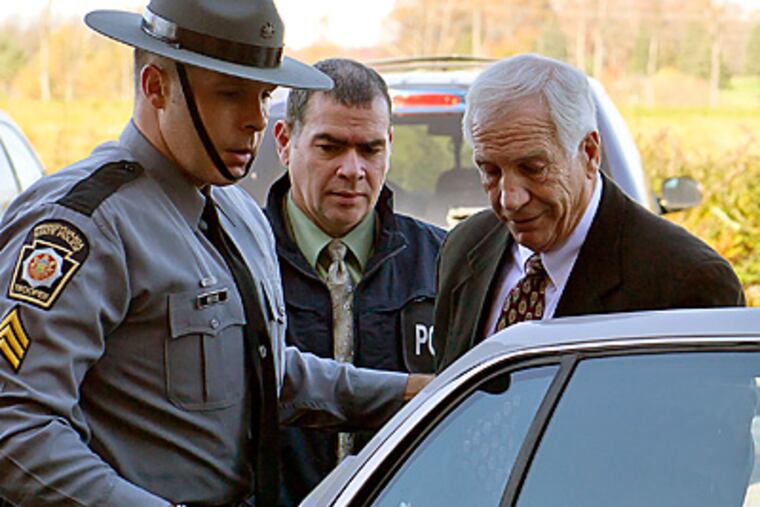
Now Joe Paterno, the increasingly frail 84-year-old Penn State football coach, must endure the greatest tempest of a legendary tenure that began when he arrived in State College as an idealistic Rip Engle assistant in 1950.
Paterno's legacy as the much-admired conscience of college sports will be permanently tarnished by the criminal sex-abuse investigation that led to charges against longtime assistant Jerry Sandusky and expanded on Saturday to athletic director Tim Curley and another key aide, who were charged with perjury.
State College and the greater Penn State nation are trying to absorb this news, this ethical earthquake. It is difficult to envision a scenario in which athletics at the university in the future, whether the principals are absolved or not, will look anything like what existed before Friday and Saturday's disturbing revelations.
The painful but inevitable transition out of the Paterno era, something neither the coach nor the school have ever been able to confront, has begun.
Ironically, should these charges all prove true - and we're a long way from that point - it appears that Curley and assistant Gary Schultz will have been ensnared by the very culture they promoted, the shroud of secrecy Paterno wrapped around his successful program.
If Curley and Schultz did lie, as is alleged, in an apparent effort to cover up Sandusky's behavior, the attempted cover-up makes perfect sense. They were reacting in much the same way most other Penn State athletic officials have long dealt with the outside world.
They withdrew into the comfortable cocoon Paterno wrapped around his program.
For reasons both logical and illogical, the coach has long been obsessed about sheltering his Nittany Lions team, as if it were a wartime army.
Practices are closed to the media. Assistant coaches are off-limits. Reporters have virtually no access to players. Information - think of Paterno's long-secret salary - is locked away.
A decade ago, for example, when The Inquirer did a lengthy series on the growing influence of money in college sports, Penn State jealously guarded information - such as the dollar amount of its contract with Nike - that other schools, schools with less-upright reputations, readily made available.
Now, unsettling as the implications might be for Penn State's loyal followers, outsiders will want to know what else has been hidden from public view over the years.
There will be speculation that perhaps the reason Paterno's program never ran afoul of the NCAA was because the NCAA couldn't cross the moat. What else went on in the remote mountains of Central Pennsylvania? What other trouble stayed hidden behind the blue-and-white curtains?
The reputation for integrity that Paterno and Penn State developed has been a shield of sorts. It deflected criticism and potential problems. It was Penn State's currency, and with it the school bought the confidence of recruits and, especially, their parents.
Even shrouded in secrecy, it shone through.
Now, sadly, that light has dimmed.