Joe Juliano: Finally, the officials let the two teams play
They're like the weather, college basketball officials who received the plum assignments of working in the NCAA tournament being discussed and scrutinized and criticized - and never ignored.
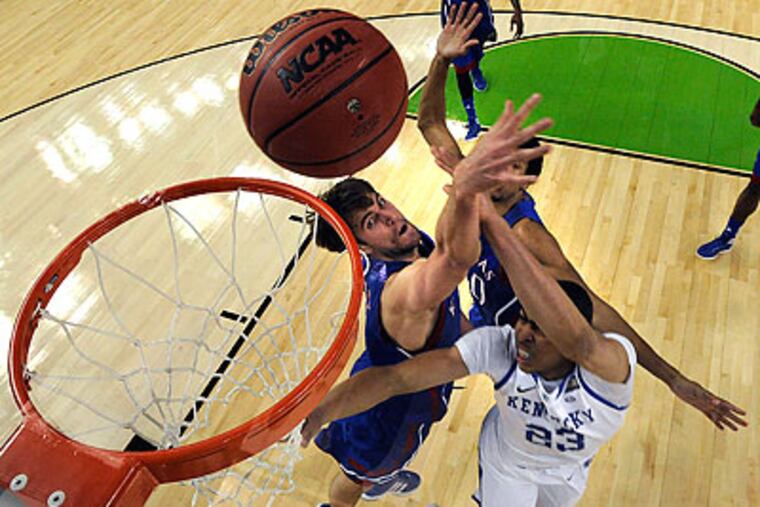
They're like the weather, college basketball officials who received the plum assignments of working in the NCAA tournament being discussed and scrutinized and criticized - and never ignored.
The officials have received a lot of scrutiny and criticism during the three weeks of the Big Dance, perhaps more than in recent memory. And eyes were expected to be keenly focused on the trio of Vance Harris, Mark Whitehead, and Mike Stuart, who worked Monday night's championship game between Kentucky and Kansas.
If you evaluated the first 66 games of the 2012 tournament, you can't remember seeing a game in which you didn't say to yourself, your wife, or your dog: "How could they make that call?"
It started on opening day in Pittsburgh, when Syracuse fought to avoid the embarrassment of being the first No. 1 seed to lose to a 16 seed (North Carolina-Asheville) since the 64-team field was instituted in 1985. The Orange's Brandon Triche lost the ball out of bounds in the final minute, but the official's call went Syracuse's way and there would be no embarrassment.
Then there were some moments in Saturday night's semifinal between Kansas and Ohio State that opened the officials to some headshaking, such as a foul call that eventually was changed to the Jayhawks' Thomas Robinson, a questionable travel call against KU's Jeff Withey in the final 30 seconds, and the crucial lane violation on a free throw by Aaron Craft, which was the correct call.
But Monday night's game, won by Kentucky, 67-59, had no head-scratching moments. The officiating crew let the teams play, and although the scrums in the paint got a little nasty at times, the calls versus non-calls were just about right.
As the games before Monday night have come and gone, the biggest lament with the officiating has been the block/charge call. It seemed as if every time a defender fell down, the offensive player was called for the foul regardless of whether the opponent slid under the player with the basketball while he was in mid-air.
When the tournament began, however, the main emphasis for the officials was to make sure college basketball didn't have a repeat of the embarrassing brawl between Xavier and Cincinnati in December.
Not that we thought any coaches and players competing in college basketball's spotlight would be that stupid to embarrass themselves and their universities. But the NCAA and its officials made sure that respect and sportsmanship, not the charge/block call, were focal points.
According to a blog post on NCAA.com, John Adams, the NCAA supervisor of officials, told the Final Four officials at a meeting Saturday that they must understand "the value of a warning, getting between two kids before it escalates, taking that extra necessary step to keep the game focused on the play and not on the officiating."
That wasn't a problem in Monday night's championship game, although Kentucky's Michael Kidd-Gilchrist, from Camden County, went down clutching his right shoulder on the game's very first foul call on a clothesline of sorts administered by the Jayhawks' Elijah Johnson.
There was nothing after that to suggest that rough play would be a characteristic of the final, even if the officiating crew decided to let the teams play. The inside players of both the Wildcats and the Jayhawks were involved in some pitched battles under the boards, with arms flailing and bodies careening all around, making you wonder whether the guys in the striped shirts would call a foul at all.
"Fouls versus fouls called in this game are 4-to-1," ESPN's Jay Bilas tweeted at one point. "Letting them play doesn't mean letting them foul."
The officials remained consistent in the second half. At one point, Kentucky coach John Calipari, believing that his big-man tandem of Anthony Davis and Terrence Jones was being mistreated, could be seen saying, "Come on, Mike" to Stuart, the only one of the three title contest officials to have worked games in the Big East Conference this season.
Still, the work of the referees drew the praise of former coach Dan Dakich, an ESPN commentator, who tweeted, "This is the best officiated game of the year, not anticipating fouls, letting players compete and no flops."
The game came down to a stirring finish, thanks to Kansas' comeback from a 14-point halftime deficit. But the focus throughout at least was on the players, as it should be.