Cameron Indoor Stadium rivaled only by the Palestra
If Duke basketball is a religion, its sanctuary is a quirky campus arena located 350 miles south of Philadelphia, where the Blue Devils made yet another NCAA tournament appearance this weekend.
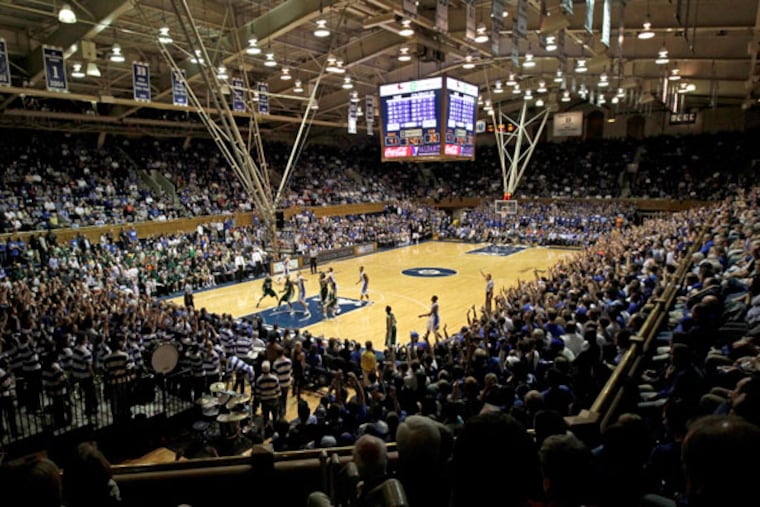
If Duke basketball is a religion, its sanctuary is a quirky campus arena located 350 miles south of Philadelphia, where the Blue Devils made yet another NCAA tournament appearance this weekend.
Thanks to Duke's prolonged run of excellence, 73-year-old Cameron Indoor Stadium - quaint, intimate, home to a noisy and whimsical student section - has become the most ballyhooed symbol of history and charm in a sport that typically pays little attention to either.
Classically Georgian in design, Cameron has girdered ceilings, a utilitarian pre-World War II elegance, and an acoustical magic that can transform several thousand voices into an earthquake.
Those descriptions, of course, apply to another famous arena, one that in its heyday occupied the same lofty spot in the basketball world's imagination that Cameron does today - the Palestra.
Duke's most recent visit here serves as a reminder of the connections between, arguably, the nation's two most famous basketball facilities, structural siblings born in the imaginations of Philadelphia architects.
It also points out a growing disparity.
With Duke a fixture among the nation's premier programs, the Durham, N.C., facility is now the game's most vibrant and vaunted arena. Students camp out for access. Opponents shudder at its roar. Sportswriters and TV commentators reverently sing its praises.
Meanwhile, for all its own history and aura, the 86-year-old Palestra, stripped of much of its energy and significance by the Big Five's abandonment and a decline in Penn basketball, has reached a lonely dotage.
If this past weekend, as so often happens when the NCAA tournament stops here, visiting teams made a Palestra pilgrimage, they found an underutilized building that has lost its mission.
"The gym has been quieter than usual lately," wrote Brian Kotloff, a Daily Pennsylvanian sportswriter in 2011, "its allure dampened by a slumping Penn team and a spell of disinterest."
King of the campus
Whatever their futures might be, the arenas' pasts are linked tightly by a trio of Philadelphia architects - one of whom was among that profession's first African Americans.
In the booming 1920s, the University of Pennsylvania, to satisfy its growing athletic ambitions, engaged architect Charles Klauder to reconstruct Franklin Field and build an adjacent basketball arena.
Born here in 1872, the son of German immigrants, Klauder, as a 15-year-old, worked at a Philadelphia architectural firm while studying at the Pennsylvania Museum School of Industrial Art.
He would apprentice with several local architects, including Horace Trumbauer, the Philadelphian who designed the city's Art Museum, before partnering in his own firm, Day & Klauder.
Colleges and prep schools were Klauder's niche, and he soon became the king of campus architecture.
He designed Princeton's stately quadrangle, the soaring Cathedral of Learning at Pitt, Yale's Peabody Museum, Penn State's cozy Nittany Lion Inn, and countless other campus buildings.
"[Klauder] transformed many American campuses from disparate collections of buildings into memorable places with distinct identities," Frances Halsband wrote in a 2005 Chronicle of Higher Education article.
True to Penn's Franklin-esque roots, Klauder gave the new basketball facility at 33d and Chestnut Streets an elegant brick façade with welcoming arched entranceways.
A broad hallway lined by trophy cases surrounded a cathedral-like basketball interior, which itself was caressed by bleachers so close that spectators could touch the players.
Opened in 1927, the Palestra, eminently practical yet elegant, quickly became one of the youthful American sport's showcases.
With more than 9,000 seats, it was the nation's largest on-campus arena. In 1939, it hosted the first NCAA tournament. Subsequently, it has been the site of more tournament games than any other building.
Meanwhile in 1924, a few states to the south, tobacco millionaire James Buchanan Duke, whose wealth had transformed Trinity College into Duke University, hired Trumbauer to design a new home on his estate.
A Philadelphian, Trumbauer had dropped out of school at 16 to apprentice with a local architect. In 1890, at 22, he opened his own firm. Soon he was designing mansions for the city's elite families, including the Wideners and Elkinses.
Duke eventually commissioned Trumbauer to design most of the new campus' buildings. In 1936, after Blue Devils coach Eddie Cameron allegedly sketched out plans for a new basketball facility on a matchbook cover, Trumbauer was summoned again.
Though sheathed in North Carolina stone instead of brick, Cameron is an obvious homage to the Palestra. But just who influenced whom among the three architects whose fingerprints are on the buildings remains a mystery.
Since he had apprenticed with Trumbauer, it's possible Klauder's Palestra owes something to his mentor. Trumbauer, in turn, clearly borrowed from Penn's arena.
That is, if Trumbauer was Cameron's architect.
'The shadows are mine'
Many architectural scholars now believe the arena's design may have been the work of another native Philadelphian, Julian Abele.
Abele was the scion of one of the city's most noteworthy African American families. His grandfather had founded the Lombard Street Central Presbyterian Church, another ancestor the city's oldest black church.
The first black graduate of Penn's architectural school, Abele was hired by Trumbauer in 1906. The older man sent his new apprentice to Paris' famed Ecole des Beaux Arts. By 1909, Abele was Trumbauer's chief designer.
Abele, those same scholars now believe, designed or contributed significantly to several buildings credited to Trumbauer, including Philadelphia's Free Library and Harvard's Widener Library.
The only building for which Abele was granted full credit, however, was Duke's chapel, the school's signature structure.
Asked once about his role in the Philadelphia library, Abele said mysteriously, "The lines are all Mr. Trumbauer's. But the shadows are mine."
Trumbauer, a heavy drinker who suffered from cirrhosis of the liver, was ailing when work began on Cameron. He died before its 1940 opening. Though his name appears on original blueprints, a Duke publication points out that "designs for later buildings, including the stadium, were drawn up by . . . Julian Abele."
Cameron turned out grander than its designers had envisioned. Trumbauer balked at Duke's insistence that it seat 8,800, perhaps unwilling to believe a new North Carolina college had the same needs as elite Northeastern schools.
"For your information, Yale has in its new gymnasium, a basketball court with settings for 1,600," he wrote in a 1938 letter to Duke's president. "I think the settings for 8,000 people is rather liberal. The Palestra at the University of Pennsylvania seats 9,000."
According to a 2005 Smithsonian magazine article, because Duke was a whites-only institution until 1961 and because he could not be assured a room in local hotels, Abele, who died in 1950, probably never visited Cameron or the campus.
In 1986, during anti-apartheid protests, Duke sophomore Susan Cook pointed out to school officials that Abele, her great-grand uncle, had designed much of the campus but was denied credit because he'd been a "victim of apartheid in this country."
Duke investigated and found that she might have been right.
In response, the university commissioned a portrait of the long-dead Philadelphia architect.
That painting now hangs in Allen Hall, a building he designed.