West Chester punter Bruno opens up about Tourette's
Rich Bruno was reluctant when first asked to speak to the media, but now he sees he can enlighten people.
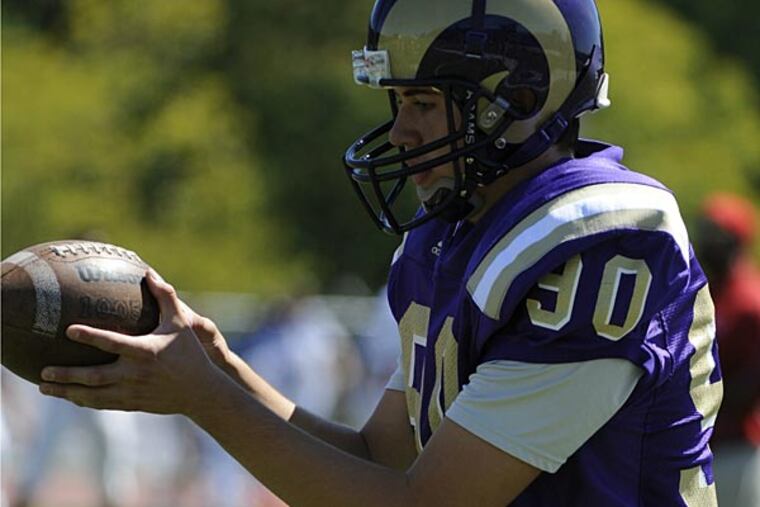
WEST CHESTER'S Rich Bruno is one of the best punters in the Pennsylvania State Athletic Conference. He's also a basically straight-A student who wants to become a physical therapist. And if that was all there was to his story, it would be enough. But there's more, even if he really doesn't want to make anything out of it.
"That's the best part about him," said coach Bill Zwaan, whose 9-0 Rams, ranked eighth in Division II, host No. 16 Bloomsburg (8-1) Saturday for the East Division title. "He doesn't think that what he's doing is special.
"That's just the way he is."
When Bruno was 7, he was diagnosed with Tourette's syndrome, a neurophsychiatric disorder characterized by multiple physical or vocal tics that affects between 0.4 and 3.8 percent of children 5 to 18. For most, the severity decreases as they pass through adolescence. But it still makes them, well, different, especially early on.
"The worst was during middle school," Bruno said Bruno, a redshirt junior from Council Rock South. "That's when [kids] can be mean. And that's when [Tourette's] is at its highest level, during puberty.
"High school, it got better. College has been the best. It seems like everybody has some complication. They accept anyone. It's just something you have. And in sports, as long as you're doing your job everybody's fine with it. And with you."
Still, there were times when life wasn't so easy.
"Sure, there's low points," Bruno said. "And you wonder, 'Why did this happen to me?' After a while you deal with it, and things start to change.
"I took medicine for a little bit. It was actually for epilepsy. But it made me tired, lackadaisical. I just wasn't myself. It started affecting my sports [he also played baseball and soccer]. I tried some diets, too. The no-yeast diet. I did some research on that, but I didn't like it. I haven't done medicine since the 10th grade.
"My doctor, he has [Tourette's], too. He knows what I'm going through, the options I had. I'm to the point where I'm able to control it now. Some have it a lot worse than me. They walk around and can't control what they say."
Bruno is averaging 42.7 yards on 28 punts this season, including seven that were downed inside the opponent's 20-yard line. He also kicks off, and is the holder on placements. Next season he'll be the placekicker.
"At first, I guess we thought about [him holding]," Zwaan said. "But we trust him."
Nonetheless, Bruno acknowledges that games do test his nerves the most.
"It's kind of tough sometimes," he said. "If you see me on the sidelines, I'm always moving around, trying to stay loose, keep warm. If I get too tightened up, I get all fidgety. That's a high-anxiety sitution. But when I'm out there punting, I'm in the zone. I know what I have to do. Nothing [bad] happens."
For him, it's never been about overcoming a handicap. This is who he is. So he lives with it, to the fullest.
"I had aspirations," Bruno said. "What I have is nothing too severe. It's not like I'm out there kicking with one leg or anything. I was never going to let it get in the way.
"If people are curious, I just tell them it's like I have an itch that I have to scratch type thing. We poke fun all the time. Or at least my close friends do. I know how to take it. It makes it better, actually. I'm one of them. If you don't talk about it, you never know what people might be saying. When I'm open about it, it's not a big thing. I don't want it to be.
"I've never heard anyone say anything on the field. And there's a lot of trash talking going on out there. I know a few professional athletes have it. Tim Howard, the [U.S. Olympic soccer] goalie. And there's a BMX rider. That's pretty cool. They call [Howard] Tweek [and Timmy Tourette's]. They called me Twitcher before. Pretty witty.
"I don't really think about it," he went on. "I see myself as a punter trying to help his team win and an aspiring physical therapist. If people want to associate me with [Tourette's] and that makes me stand out, that's up to them."
When Zwaan first approached Bruno about allowing someone to write about him, the response was a polite no. Zwaan asked him to think about it. And Bruno relented a few days later, albeit reluctantly.
Now, maybe not as much.
"It's become so second nature to me," Bruno said. "I honestly haven't had another person [with Tourette's] who wanted to sit down and talk about it. I'd be more than glad to help a young kid who came up to me, give them some advice. I've never met someone on campus who had it. But I know that can't be true.
"When you're younger, it gets to your psyche a little bit. But once you find out who you are and what you want to be, you know you can do anything as well as anyone. I just happen to fidget every once in a while. That feels like the norm to me.
"If I have a great game, and people want to talk about Tourette's first, I'm like, 'Why?' I guess it kind of comes with it. I'm coming to understand that. I'll gladly tell my story, educate them. But it is what it is. And I'm OK with that. I'm a punter on a real good team. Really, that's about it."
If only that were true.