Tales of Tarkanian, a coach who stood up to NCAA
Jerry Tarkanian put me on hold for a minute late one night in 1994, deadline fast approaching. Tark came back on the line. The UNLV athletic director who had helped oust him had just resigned.
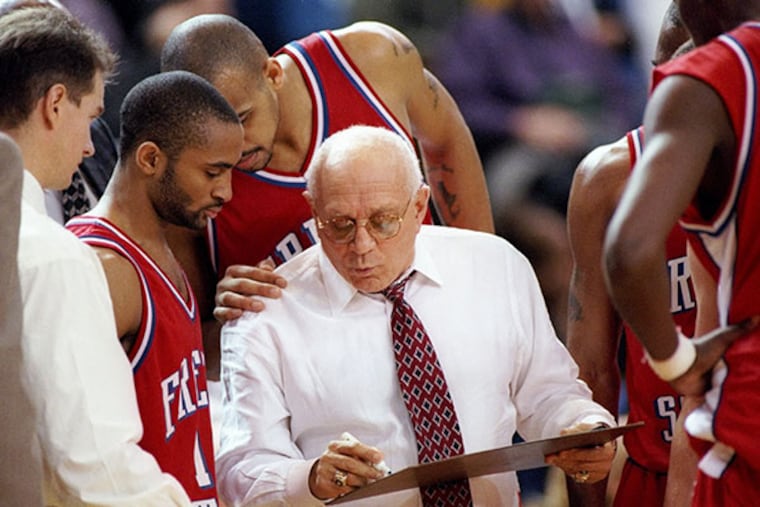
Jerry Tarkanian put me on hold for a minute late one night in 1994, deadline fast approaching. Tark came back on the line. The UNLV athletic director who had helped oust him had just resigned.
"All the rats are gone - isn't that wonderful," Tark said over the phone. "All the rats are gone."
I had been assigned to cover what turned out to be the endgame for Rollie Massimino, Tark's successor at UNLV. It took only one trip to Vegas to realize Massimino had virtually no chance of surviving. That was still Tark's town. In many ways, it still is, to the day he died Wednesday at age 84.
The stories were layups. As a reporter, you got off the plane, called some Tark buddy who had practically the first cellphone in Las Vegas. He'd be on the golf course but direct you to an Italian place where Tark's cronies would gather. Tark himself wouldn't be there. Usually among the most reachable coaches in America, he didn't get involved in this personally. I never talked to him while writing about Massimino. That late-night call was soon after Massimino was out.
The image of UNLV's place in the hoops landscape was of some house of ill repute. But all the power brokers in town had a stake. I remember talking to a casino honcho, to one person who eventually made it to Congress. The interim president at UNLV later was governor of the state. Everybody had to take a side.
In all sorts of ways, Tark had made Las Vegas important in the basketball world. Because of his ongoing fight with the NCAA and his colorful recruiting ways, which eventually did him in at UNLV, Tarkanian didn't always get his complete due as a basketball coach, for the four Final Fours and winning the 1990 NCAA title. He didn't make it into the Naismith Memorial Basketball Hall of Fame until 2013.
"Right after Dean Smith, wow," John Chaney said over the phone Wednesday when informed that Tarkanian had died. The two had always gotten along. Chaney was willing to take Temple to UNLV when few schools would. Tark returned that favor when the Liacouras Center opened in 1997, bringing his Fresno State team to open the building.
If Chaney and his assistant Jim Maloney were a pair on North Broad Street, Tarkanian and top assistant Tim Grgurich were a desert pair. Exchanges of information flowed in both directions.
"He's the one who talked about always establishing a low center of gravity and having a wide base," Chaney said of Grgurich. "Attacking the front foot."
Chaney remembers Tark calling him, asking if it was all right if Jim Maloney came out and helped them put in a defense at UNLV. That's how, Chaney said, one version of UNLV's famed Amoeba defense included principles from Chaney's equally famed matchup zone.
"He was one of the first guys in terms of scoring after you score, quick releases," Chaney said of Tarkanian. "A corner jump shot, the defender would release and go opposite."
Probably Tarkanian's best team, the 1991 Running Rebels were an iconic group, led by Larry Johnson and Stacey Augmon, undefeated until being upset by Duke in the 1991 national semifinals.
When the NCAA got him, Tarkanian didn't wilt. In 1992, he filed a lawsuit against the NCAA, questioning all sorts of enforcement tactics. Six years later, the NCAA agreed to a $2.5 million settlement. If you didn't remember that, Chaney sure did.
"He was one of the very few guys who fought the NCAA and won," said Chaney, who beat Tarkanian's team in the 2002 NIT, the last game of Tark's career.
Chaney also remembered the man who always wanted a joke or a line from Chaney when he saw him, and then always reciprocated. "The guy was just funny," Chaney said.
Some of Tark's sardonic and cynical one-liners are basically part of the history of the sport: "I love transfers because their cars are already paid for." . . . "The NCAA is so mad at Kentucky, they'll probably slap a few more years' probation on Cleveland State."
As it happened, Massimino landed at Cleveland State after he was banished from UNLV. The alleged reason was the discovery of a secret $375,000-a-year supplemental contract being paid to the former Villanova coach in addition to his $511,000 base salary. The reality: They just used that contract as the knife.
Other knives by other people were used against Tark, and when he ultimately landed at Fresno State, that school quickly picked up its own colorful cast of players. When the Bulldogs showed up in Philadelphia in 1997, Tarkanian told me he didn't really want to play Temple in the first game in the new building, then called the Apollo of Temple.
"I'd prefer to play the second game," he said the day before.
He went along with it when ESPN called. He knew that Temple was having a hard time finding an opponent.
"We couldn't get anyone to play us when we opened our new place at UNLV," Tarkanian said. "Finally, the state legislature made Nevada-Reno play us."
Temple smoked his group the next night. That should be part of the story, how Tark handled it all. He got out of town with no complaint. The night wasn't about him.
"He was a unique man," Chaney said over the phone, "and important to the game."