Chestnut Hill's Dexter Harris continues to play leading role
FOUR TIMES during the basketball season, the Philadelphia Area Small College Coaches Association holds a luncheon, at which time Sam Cozen Player of the Week awards are handed out to those who "embody the spirit" of the game at that level. When
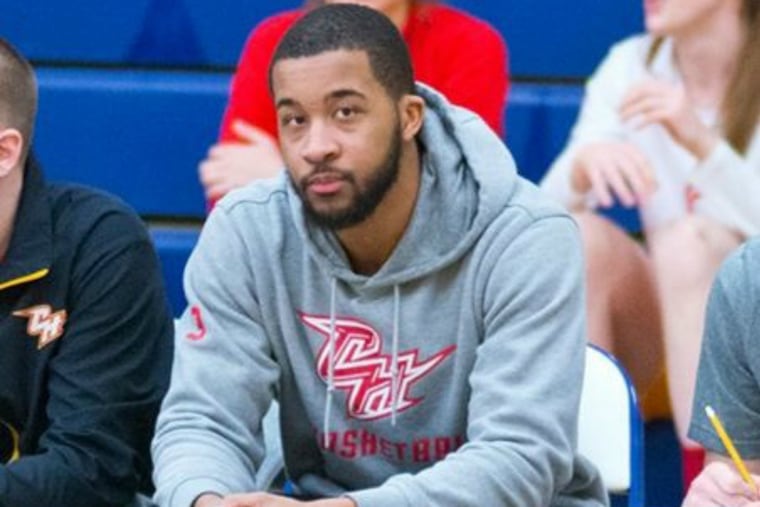
FOUR TIMES during the basketball season, the Philadelphia Area Small College Coaches Association holds a luncheon, at which time Sam Cozen Player of the Week awards are handed out to those who "embody the spirit" of the game at that level. When the recipients get to the podium, most of the time they say a few words and thank a few people. Sometimes, you get a little more. When Chestnut Hill's Dexter Harris was honored earlier this month, it was a whole lot more. His acceptance speech lasted a while. And the words came from deep inside him, touching everyone in the room.
He could have kept going and nobody would have objected. His story was different. Harris was singled out by Griffins coach Jesse Balcer not for what he's accomplished on the court, but for being there.
The 6-3 senior guard from South Jersey's Bishop Eustace High hasn't played in two years. Or ever since he was diagnosed with blood clots in his legs, a condition that means he will never play again. That hasn't stopped him from continuing to be a teammate.
"When (Balcer) told me what he was doing, I asked him what I was being recognized for," said Harris. "He said my leadership. I just said thank you. I was really surprised. We have a lot of leaders. I knew exactly what I wanted to say. I wanted to give people an idea of who I am.
"When I saw coach get emotional, it made me appreciate that he never forgot about me. He always makes me feel like I'm still part of it. It makes me want to live up to that . . . I mean, basketball hasn't done me anything wrong at all."
When Harris got the news that his career was over, Balcer said they "bawled" together in the hospital. "It was awful," Balcer remembered. "I could see how hurt he was. We miss having him out there. But he's a student-coach. He's found a way to get through it."
Harris isn't allowed to do anything that involves contact. So he lifts, runs and stretches with everyone else. He tries to mentor the younger kids. Once the competition starts, he has to watch. But if the loser has to run a "suicide drill," he does it with them. "But my team wins most of the time," he noted. He never misses a practice and is on the bench at games offering whatever he can.
"He obviously loves the game," said Balcer. "He's really close to the other three seniors. He said, 'These are the guys I came in with.' (The other players) listen to him. Watching him grow into an adult has been pretty cool . . .
"When he laughs, everyone laughs. Because he's got this real distinctive laugh, like an old lady."
Harris' problems began when he was in high school. As a junior he suffered from a strained right calf, which limited his playing time to short spurts as the pain worsened. He also struggled as a senior, as the injury affected his confidence. When he got to Chestnut Hill the leg became inflamed. Then the pain jumped to the other leg. Turns out he had Compartment Syndrome. One of the tests he had to undergo involved a large needle that he said felt way worse than getting a tattoo. He needed to have surgery.
But he came back ready to go. Until the pain returned.
One day, it hurt to put on his sweatpants. A doctor told him he had an infection. He was given antibiotics. An ultrasound finally detected Deep Vein Thrombosis. He had to be rushed to the hospital. "They were trying to figure out what happened," Harris said. "They thought I received some kind of trauma, like when people get in a car accident."
As he was starting to feel better the clots traveled up to his hip. Another emergency. A CAT scan revealed a pulmonary embolism, which can be fatal if it reaches the right artery. That necessitated more surgery, followed by a 43-day hospital stay.
"The odd thing was, I should have been in some kind of discomfort," said Harris, who averaged 3.6 points in 18 games as a soph. "But I didn't feel anything. They were amazed. The whole case was like abnormal.
"Finally my hematologist said I had a blood disorder. I clot more than the average person. It's not common in America. It's called Factor V Leiden, which is more (prevalent) like in Europe. They had hinted that I might not be able to play. But until they tell you for real . . .
"I cried for about 20 minutes. My mom kept telling me that basketball isn't everything, that you have a purpose on this earth. But I really wasn't trying to hear it. I was just depressed and distraught."
On Tuesday night the Griffins (12-14, 9-9 Central Atlantic Collegiate Conference) finish the regular season at Philadelphia University. They'll open the playoffs Saturday at Bloomfield. Harris will be with them. He's found his peace, and his place. But it's understandably taken time.
"At first I was in denial," said Harris, a psychology major with a minor in Spanish who's going to pursue a master's at Chestnut Hill the next two years. "I was only 21. You need a lot of support from your family, friends, everyone. I had teammates tell me they would switch legs with me, if that meant I could keep playing. That keeps you going. It gets to the point where you have to deal with reality. You can't let life pass you.
"I'm still here. Look at the big picture. I could have easily been fighting for my life. I should be happy for that. I want to become a sports psychologist. I feel I have a lot to offer, for people who get injured and don't have motivation. I can tell them I was once in their shoes. I tell guys to always play their hardest, because you never know when your time's up. So there's no excuse.
"Of course you ask why did this have to happen to me. But who knows what would have happened if it hadn't. In a sense, I'm kind of glad it did. It made me look at what's really important, what I want to do 10 years from now, instead of maybe using basketball for a couple (more) years and then asking myself what I want to do. I've matured a lot. I'm thankful for that."
As was everyone in the room that day, just for being there to listen.
@mikekerndn