Irving Penn, pushed photo boundaries
NEW YORK - Irving Penn, whose photographs revealed a taste for stark simplicity whether he was shooting celebrity portraits, fashion, still life or remote places of the world, died yesterday at his Manhattan home. He was 92.
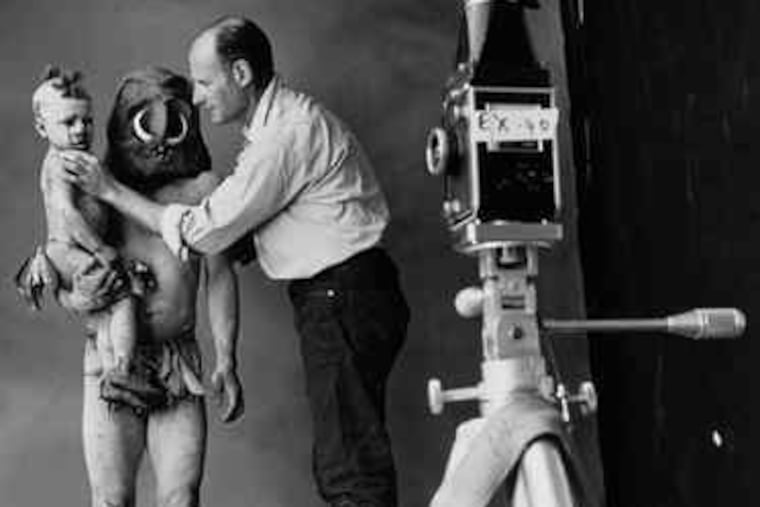
NEW YORK - Irving Penn, whose photographs revealed a taste for stark simplicity whether he was shooting celebrity portraits, fashion, still life or remote places of the world, died yesterday at his Manhattan home. He was 92.
The death was announced by his photo assistant, Roger Krueger.
"He never stopped working," said Peter MacGill, a longtime friend whose Pace-MacGill Galleries in Manhattan represented Penn's work. "He would go back to similar subjects and never see them the same way twice."
Penn, who constantly explored the photographic medium and its boundaries, typically preferred to isolate his subjects - from fashion models to Aborigine tribesmen - from their natural settings to photograph them in a studio against a stark background. He believed the studio could most closely capture their true natures.
Between 1964 and 1971, he completed seven such projects, his subjects ranging from New Guinea mud men to San Francisco hippies.
Penn, who studied in Philadelphia, also had a fascination with still life and produced a dramatic range of images that challenged the traditional idea of beauty, giving dignity to such subjects as cigarette butts, decaying fruit and discarded clothing. A 1977 show at the Metropolitan Museum of Art presented prints of trash rescued from Manhattan streets and photographed, lovingly, against plain backgrounds.
"Photographing a cake can be art," he said at the 1953 opening of his studio, where he continued to produce commercial and gallery work into the 21st century.
Thirteen of Penn's photos are being auctioned today at Christie's, including "Guedras in the Wind," a 1971 image of two Moroccan women, with an estimated pre-sale price of $40,000 to $60,000.
Penn's career began in the 1940s as a fashion photographer for Vogue, and he continued to contribute to the magazine for decades thereafter.
He stumbled into the job almost by accident, when he abandoned his early ambition to become a painter and took a position as a designer in the magazine's art department in 1943. Staff photographers balked at his unorthodox layout ideas, and a supervisor asked him to photograph a cover design.
The resulting image, on the Oct. 1, 1943, cover of Vogue, was a striking still-life showing a brown leather bag, a beige scarf, gloves, oranges and lemons arranged in the shape of a pyramid.
In subsequent photos for the magazine, Penn further developed his austere style that placed models and fashion accessories against clean backdrops. It was a radical departure at a time when most fashion photographers posed their subjects with props and in busy settings that tended to draw attention from the clothes themselves.
The approach made him a star at the magazine, where his work eventually appeared on as many as 300 pages annually. Penn believed his success depended on keeping the reader - rather than the model - in mind.
"Many photographers feel their client is the subject," he explained in a 1991 interview in the New York Times. "My client is a woman in Kansas who reads Vogue. I'm trying to intrigue, stimulate, feed her. . . . The severe portrait that is not the greatest joy in the world to the subject may be enormously interesting to the reader."
He left the magazine in 1944 to join the military - serving with the American Field Service in Italy and then as a photographer in India - but returned to Vogue in 1946, taking travel assignments in addition to his fashion work.
In the 1950s, Penn moved into portraiture. He photographed not only the famous - actors, musicians and politicians - but also ordinary people. He once said that his formula for capturing meaningful portraits was to photograph his subjects relentlessly, often over a period of several hours, until they were forced to let down their guard.
Born in Plainfield, N.J., in 1917, Penn studied at the Philadelphia Museum School of Industrial Art from 1934 to 1938, and worked as an assistant at Harper's Bazaar in 1939.