After decades of success, coach's career came to sad end
Joe Paterno, 85, Pennsylvania's most recognizable citizen and a Hall of Fame football coach whose golden resumé was tarnished by a child sex-abuse scandal that beclouded his final days, died Sunday at Mount Nittany Medical Center in State College, Pa.
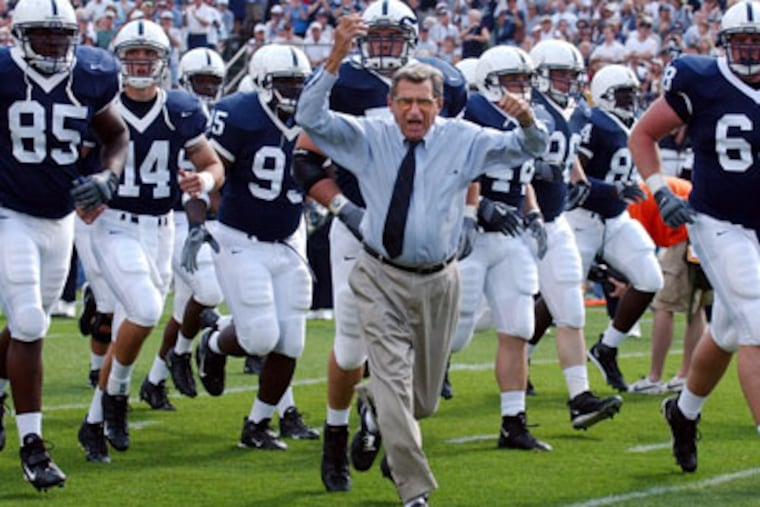
Joe Paterno, 85, Pennsylvania's most recognizable citizen and a Hall of Fame football coach whose golden resumé was tarnished by a child sex-abuse scandal that beclouded his final days, died Sunday at Mount Nittany Medical Center in State College, Pa.
His death, 21/2 months after he was diagnosed with lung cancer, came as an eerie fulfillment to a prophecy he made often in the later decades of nearly a half-century as Pennsylvania State University's head coach. When the University of Alabama's Paul "Bear" Bryant succumbed to a heart attack in 1983 just 28 days after his 1982 retirement as coach, a shaken Mr. Paterno absorbed the lesson.
"What else would I do?" he responded when the subject of his retirement arose. "I don't want to die. Football keeps me alive."
In what undoubtedly will be a disconcerting sight for many Penn Staters who knew no other coach, this autumn will be the first since 1950 without Mr. Paterno on the Nittany Lions' sideline.
The length of his tenure and the successes that filled it may never again be equaled in a college-football world increasingly marked by a headlong rush for financial gain, a trend Mr. Paterno both decried and mastered.
His Penn State teams won a record 409 games, 24 bowl games, two national championships, and a following so large and loyal that in his last seasons the football program regularly produced annual profits exceeding $50 million.
An Ivy League graduate who made his team's motto "success with honor," he graduated an astounding percentage of players, constantly stressed the role of academics in the college athletic experience, operated a program that was never punished by the NCAA, and donated a considerable portion of his relatively modest salary to Penn State's library.
But a career notable for its integrity and tranquillity ended suddenly in an almost unimaginable scandal.
Like a play whose three cheery, uplifting acts conclude with a bombshell horror just before the curtain falls, Paterno's noteworthy tenure ended amid accusations that he did too little to stop a former colleague from surrounding himself with and - if the accusations are true - abusing boys.
In his final days, the university that he helped transform more than any other individual into a research institution that rivals the best of the nation's state schools was beset by perhaps the gravest crisis in its 156-year history.
On Nov. 9, 2011, just four days after the arrest of longtime assistant coach Jerry Sandusky on child-molestation charges touched off a storm of criticism of Happy Valley, the university's board of trustees fired Mr. Paterno.
Though he was accused of no crime, the coach was widely condemned by those convinced he had ignored or, worse, covered up crimes against children to preserve his football program.
But in grand jury testimony and in a Washington Post interview published the week before his death, Mr. Paterno insisted he had been unaware of Sandusky's alleged behavior until 2002. At that time, as university guidelines required, he notified his superiors.
For those who had for years been urging the elderly coach to step aside and permit an orderly transition - a group that, at least as far back as 2004, included Penn State's top administrators - the incidents surrounding his dismissal confirmed their worst fear: that Mr. Paterno had lost control of the program.
In the immediate aftermath of the charges against Sandusky, Mr. Paterno seemed not to grasp the seriousness of the matter, issuing a statement that appeared to ignore the victims and then leading "We are . . . Penn State" cheers on the lawn of his home, where a crowd had gathered.
His many supporters saw it differently. They blamed the trustees. They wondered how a coach who had done so much for the school could be treated so callously, so hastily, and so harshly, especially since he had offered to step down at the end of the 2011 season.
On the night of the firing, thousands of Penn State students took to the streets of State College to protest the decision. Their reaction, and the shock, dismay, and round-the-clock media coverage the scandal generated, was stark evidence of the prominence of Mr. Paterno not just in his adopted state but throughout the nation.
With his death, the lingering questions about what he knew, when he knew it, and how he might have acted differently likely will remain unanswered.
For all the accomplishments Mr. Paterno's teams piled up on the football field, he was at least as well-known for an ethos he said was shaped by his idealistic father and by Aeneas, the Trojan hero of legend who inspired him as a high school student.
Mr. Paterno's oft-cited "Grand Experiment" was the belief that football and academics could coexist peacefully. He urged players to develop other interests. He frequently criticized the sport's win-at-all-cost philosophy and its increasing emphasis on money, and cemented his crusader's image by rejecting several lucrative offers from NFL and college teams.
And yet he was not entirely "St. Joe," the sarcastic nickname given to him by colleagues who found his penchant for preachiness sanctimonious.
He possessed a fierce competitive streak, a trait his brother would characterize as "a maniacal need to be first." Mr. Paterno drove himself, his assistants, and his players hard, and in doing so won more games than any coach in Division I history.
Mr. Paterno had a sharp tongue and, particularly during the demanding practices he conducted, could be hypercritical and dismissive of assistants and players.
"He's a lot like your parents," said Charlie Pittman, a star halfback at Penn State in the 1960s. "It's sometimes difficult to appreciate them until you've grown and become a parent yourself."
As Mr. Paterno aged, he grew crankier, more confrontational with reporters and referees. In 2002, Mr. Paterno chased referee Dick Honig following a loss and grabbed him from behind.
By then, the bespectacled Brooklyn-born coach was a legend, his milestones so numerous and impressive that he was named to the College Football Hall of Fame while still active, in 2006.
At Penn State since 1950, he had been the Nittany Lions' head coach since succeeding Rip Engle in 1966 - an almost unimaginable stretch of 548 games. He produced countless all-Americans, future NFL stars, and, as he liked to point out, scores of successful businessmen, lawyers, doctors, and even a concert pianist.
After the Nittany Lions won the 1982 national title, Mr. Paterno famously lectured the trustees about the importance of capitalizing on the moment by improving Penn State's faculty and academic standing.
That reformer's image was forever embedded in the public's mind in 1973 when he turned down an offer from the NFL Patriots to become football's first million-dollar coach. Over the years, he would also reject overtures from other colleges and at least a half-dozen NFL teams, including Leonard Tose's Eagles.
Mr. Paterno was, in many respects, a complex jumble of contradictions.
He was a Renaissance man thriving in a profession with an inherent anti-intellectual strain. He was a streetwise city kid who spent the bulk of his life in bucolic Central Pennsylvania. And though he counseled his players to use football as a means toward a fuller life, he himself was consumed by the game.
Still, his image was revered enough, especially in Pennsylvania, that Mr. Paterno, who described himself as a socially liberal and fiscally conservative Republican, was occasionally asked to run for public office.
Among those who made overtures was President Gerald R. Ford. Mr. Paterno delivered a speech seconding the nomination of Vice President George H.W. Bush for president at the 1988 GOP convention, and in 2004 introduced his son, President George W. Bush, at a rally.
Mr. Paterno's final November would prove to be the cruelest month of his long life. On Nov. 18, family members revealed that he had been diagnosed with what they termed a treatable form of lung cancer.
The chemotherapy and radiation treatments that followed cost him his trademark vitality and thick hair and, according to the lawyer representing him in the Sandusky case, produced occasional memory lapses.
Long a media favorite, Mr. Paterno gave the last of thousands of interviews to the Washington Post writer Sally Jenkins on Jan. 12 and 13. In it, the coach, his body and voice weakened by the illness, expressed concern for Sandusky's alleged victims, said he wished he had done more after learning of an alleged assault on a young boy in a football-building shower, and outlined the cold and terse details of his firing.
Joseph Vincent Paterno was born on Dec. 21, 1926, to first-generation Italian parents in Brooklyn's Flatbush section, a crowded, noisy neighborhood that by virtually any measurement was a million miles away from Happy Valley.
Mr. Paterno would never shed the nasal New York accent, and the attitude and aggressiveness he developed there. Even at 82, after more than 50 years in Central Pennsylvania, he said, "I'm a New Yorker. I'll always be a New Yorker."
His father, Angelo, was a New York Supreme Court clerk who studied nights and eventually earned his law degree. It was a lesson in perseverance his son never forgot.
Mr. Paterno would prove to be an amalgam of his parents' most notable qualities. While his father was an opera-loving Rooseveltian idealist, his mother possessed a more practical toughness, something her oldest child, always the brightest light in her eyes, also inherited.
"Mom never took a back seat to anyone, any place, any time," Mr. Paterno said. "If she couldn't be the head of the pack, she wouldn't go."
The oldest of three children - he had a brother, George, who died in 2002, and a sister, Florence - Mr. Paterno was a striver. An eager student and natural leader, he adopted those traits to play the sports that were a neighborhood passion. As a youngster in Flatbush, he liked to be the quarterback, the shortstop, the point guard, the coach.
At Brooklyn Preparatory School, he became a student leader and class salutatorian. He starred on the football and basketball teams.
It was at that Jesuit high school that he encountered the Aeneid. Virgil's poem about the idealistic hero who became the ancestor of the Romans transformed Mr. Paterno.
"I don't think anybody can get a handle on what makes me tick as a person, and certainly can't get at the roots of how I coach football, without understanding what I learned from the deep relationship I formed with Virgil," Mr. Paterno wrote in his 1971 autobiography. "Once a person has experienced a genuine masterpiece, the size and scope of it last as a memory forever."
Brooklyn Prep lost just once his senior year, to a St. Cecelia's team coached by a young Vince Lombardi. Mr. Paterno earned all-city honors. He graduated in 1945 and entered the Army.
By that time, through the efforts of a wealthy New York alumnus, he had earned a scholarship to Brown University.
At the Ivy League school, largely populated by the prosperous sons of Brahmin New Englanders, Mr. Paterno encountered a stinging rebuke.
Wearing a white sweater to his first fraternity party, the swarthy and bespectacled Italian freshman felt instantly out of place.
"I walked into a calm sea of blue blazers, sharkskin suits, and Harris tweeds," he wrote. "I knew I had blown something when all those cool-eyed faces turned toward me and my sweater. . . . I heard somebody whisper, 'How did that dago get invited?' They never asked me back."
It was at Brown, though, where he also encountered the man who would become his professional mentor. Charles "Rip" Engle, a silver-haired native Pennsylvanian, was the Bruins' football coach. He took a liking to the older of the two Paterno brothers on his team (George was a running back.)
By his senior year, Mr. Paterno, a ball-hawking defensive back, was the quarterback and Engle's representative on the field.
After graduation in 1950, Mr. Paterno intended to fulfill the promise he had made to his parents and enter law school. He had been accepted by Boston University and borrowed $1,000 from his father.
But that spring, Engle was hired to replace Joe Bedenk as Penn State's head coach. Though Engle hoped to install his beloved Wing-T offense there, none of the assistants he was contractually required to keep knew much about the scheme.
Unable to secure an additional hire for his staff, Engle turned to his graduating quarterback. Mr. Paterno reluctantly agreed to accompany Engle to State College as an assistant, but stipulated that his stay likely would be brief.
The men arrived in State College late on the afternoon of May 27, 1950. Mr. Paterno, then 23 and a bachelor, would spend the rest of his life as a resident of the Centre County college town.
At first he was not impressed by it. Unable to find a good plate of spaghetti or an opera, he called it a "cow town" and advised Engle to start looking for a replacement.
But coaching grew on Mr. Paterno quickly. He not only stayed, but over the next 16 years gradually became Engle's most trusted aide and heir apparent, as well as one of his key recruiters. Though his brashness did not immediately endear him to his fellow assistants, he won them over with his brains and his immense capacity for work.
The staff's closeness was fostered by a Thursday evening ritual. On that night, Mr. Paterno, the only bachelor, would join his colleagues and their spouses for drinks and dinner.
"We used to say, 'The hay's in the barn.' And we'd go out and relax. I got to like the people," he said. "I liked coaching."
He married Sue Pohland, a librarian, in 1962. They would have five children. In 1966, they purchased a four-bedroom ranch house on McKee Street adjacent to the campus that they never left.
That was the year the 60-year-old Engle announced his retirement. Mr. Paterno, as expected, was named his replacement, commanding a salary of $20,000 a year.
His work habits and intensity - both already at a high level - ratcheted up. His first team went 5-5, and when the '67 season began with a loss, his career record became 5-6. That was the last time it fell below .500.
With recruits like Ted Kwalik, Jack Ham, and Steve Smear - all from football-crazed Western Pennsylvania - things began to turn around. The '67 Lions rallied to finish at 8-2-1 and earned Mr. Paterno the first of his record 37 bowl appearances.
Penn State was undefeated in 1968 and 1969, and the reputation of the team and its quirky coach burgeoned. Many believed the all-American-laden '69 team should have been national champions. But after President Richard M. Nixon visited the University of Texas locker room and unofficially declared the team No. 1, the Longhorns took the final poll's top spot. The Nittany Lions were No. 2.
Mr. Paterno never forgave Nixon. When the coach delivered Penn State's commencement address in 1973, he referenced the slight. "How could Nixon know so little about Watergate," he asked sarcastically, "and so much about football?"
Thanks to his team's continued success and his own candor, Mr. Paterno's bespectacled face soon became one of the most recognizable in college sports. That fame expanded in 1973 after Monsignor Bonner High School graduate John Cappelletti became the first Nittany Lion to win a Heisman Trophy.
Cappelletti's acceptance speech, in which he tearfully dedicated the trophy to younger brother Joey, then dying of leukemia, became the subject of a popular made-for-TV movie and cemented his coach's saintly image.
So did Mr. Paterno's most serious flirtation with the NFL that same year.
New England Patriots owner Billy Sullivan wanted the Penn State coach badly. To get him, he offered a multimillion-dollar package that included cars, country-club memberships, and part-ownership in a team that 39 years later is valued at $1.4 billion.
Mr. Paterno initially accepted. But, after a sleepless night, he canceled a scheduled news conference in New York City and decided to stay at Penn State, getting a new long-term deal out of the flirtation.
In explaining why, Mr. Paterno pointed to a lesson he had learned from Aeneas.
"When you choose wrong, as Aeneas found out, life comes down on you with some terrible whacks," he said.
His Nittany Lions went 12-0 that season and finished No. 3 in the final polls. While Penn Staters were upset at the poll-voters' ongoing lack of respect, others pointed to a weak Penn State schedule filled with traditional Eastern rivals like Army, Navy, Syracuse, and Maryland.
Mr. Paterno saw wisdom in the criticism, and Penn State began scheduling national powerhouses such as Alabama, Notre Dame, and Nebraska.
Penn State finished 11-1 in both 1977 and 1978. Still, a national championship eluded Mr. Paterno.
The Nittany Lions could have won one, but in a 1979 Sugar Bowl matchup with Bryant's Alabama, a fourth-quarter goal-line stand saved the game for the Crimson Tide. Mr. Paterno, who never beat Bryant in head-to-head matchups, called the defeat the most painful of his career.
Penn State finally reached the pinnacle after the 1982 season, declared national champion after a Sugar Bowl victory over the University of Georgia and its star running back Herschel Walker.
That same January, Mr. Paterno made his first appearance before the group that nearly 30 years later would fire him, the university's board of trustees.
His talk there, an unvarnished appeal for the university to use the football team's title as a way to improve the entire institution, came to be known around State College as "Penn State's Gettysburg Address."
"It bothers me to see Penn State football No. 1 and then pick up a newspaper and find a report that many of our academic departments and disciplines are not rated up there with the leading institutions of the country," he told the board.
Penn State, he added, needed to raise more money, hire better professors, improve academic programs, and create new ones. Sports Illustrated's Rick Reilly would later joke that the speech undoubtedly marked the first and only time "a coach yearned for a school its football team could be proud of."
Four years later, following a taut Fiesta Bowl triumph over the University of Miami, a star-studded renegade program that in many ways was the antithesis of Mr. Paterno's, Penn State won a second national championship.
Though he would field another unbeaten team in 1994, Mr. Paterno's Nittany Lions never captured a third national title.
All that success did not obscure the things that rankled Mr. Paterno's critics, most of whom disliked what they saw as a "holier-than-thou" attitude.
Asked once whether he might pursue a career in politics, Paterno famously responded: "What . . . and leave college coaching to the Switzers and Sherrills?", referring to the University of Oklahoma's Barry Switzer and the University of Pittsburgh's Jackie Sherrill, successful but controversial rivals.
"People inside college football and outside, like me, felt there was a huge dose of hypocrisy in his ramblings about athletics and academics," said Murray Sperber, the author of several books about college sports' excesses.
"Sure, he wanted real students on his team. Every coach does. But most of all, like every coach, he wanted to win. He belongs in the same sentence as [Knute] Rockne and Bear Bryant, and if you read their lives, you will see that they also were totally obsessed characters who wanted, above all, to win."
Throughout his career, Mr. Paterno's coaching staff remained remarkably stable. Assistants such as Sandusky, Fran Ganter, Larry Johnson, and Ron Vanderlinden stayed for decades, often spurning offers to be head coaches elsewhere.
Sandusky was as responsible as anyone for Penn State's reputation as Linebacker U., even writing a book on how to develop them. If there was a theme linking Mr. Paterno's 46 teams, it was that most had at least one outstanding linebacker.
Players like Ham, Shane Conlin, Greg Buttle, Andre Collins, LaVar Arrington, Paul Posluszny, Sean Lee, and NaVorro Bowman were not only all-Americans but high NFL draft picks.
While Mr. Paterno's players were not immune from trouble - especially in his last decade as coach - Penn State managed to maintain its reputation as one of the most upright among the big-name football powers.
There were no NCAA sanctions and, at Mr. Paterno's insistence, the Nittany Lions refrained from taunting and on-the-field celebrations. Their famously plain uniforms also contributed to the squeaky clean image.
His teams wore virtually unadorned white or blue-and-white uniforms, white helmets with a single blue stripe down the middle, and black shoes - though in the '90s a tiny Nike swoosh would be added to the jerseys.
Mr. Paterno himself kept the same game-day look for decades - the horn-rimmed glasses, the khakis with rolled-up cuffs, the black cleats. He always attributed the look to a boyhood glimpse of the crisp and simple pinstripes of the New York Yankees, an outfit that for him symbolized power and efficiency.
As times changed, he remained proudly behind them, especially when it came to technology. He scorned computers and cellphones, and once called Twitter "Tweedle-Dee."
"I couldn't download a jar of peanut butter," he said.
Over the years, Mr. Paterno earned countless coaching honors, honorary degrees, and awards. In 1986, Sports Illustrated made him its sportsman of the year.
It was about that time that Penn State administrators, realizing that replacing a coach who cast such a large shadow would not be easy, began to ponder a future without Mr. Paterno, then 60.
The coach frequently said that he probably would retire in "five years or so." But the more logical and imminent that possibility seemed, the harder he appeared to fight it. Finally, his mantra became, "As long as I enjoy it and we're having success, I'm going to keep coaching."
He briefly held the position of athletic director. But as that job, and college sports in general, grew more complex and financially driven, he yielded the reins. Not surprisingly, the ADs who followed, like longtime friend Jim Tarman and ex-Nittany Lions ball boy Tim Curley, all had strong Paterno connections.
Beaver Stadium was expanded at least six times in his coaching tenure, reaching its current capacity of 106,572. As it grew and the budget rose, it became increasingly imperative that coaches win and tickets sell.
By 2011, Mr. Paterno was earning more than $1 million a year - though that still left him in the lower ranks among coaches at big-time schools. Penn State, meanwhile, spent $116 million on athletics, an amount greatly ameliorated by the $52 million profit football generated.
His final decades were consumed by the school's move to the Big 10 in 1993, by his pursuit of coaching milestones, and by fund-raising. Given his pristine image and the persuasive powers he had displayed on the recruiting trail for decades, Mr. Paterno was a formidable fund-raiser.
Though exact totals do not exist, it's widely believed he collected hundreds of millions of dollars in contributions for the university. He and his wife donated nearly $5 million of their own money, most notably to update the campus library that now bears their name.
Up until his final months, the worst stretch of Mr. Paterno's career had been in the early 2000s. During that time, dozens of his Nittany Lions were arrested for fighting, sexual assaults, and drinking offenses on and off campus. On the field, his teams endured unprecedented struggles.
The Lions went 26-33 from 2000 to 2004 as calls mounted for the aging coach to step aside. But whenever the outrage intensified, it seemed, Mr. Paterno and Penn State would agree on a contract extension.
The subject of how much coaching Mr. Paterno actually did in those and later years remained a contentious one. Some said he had delegated so many responsibilities that he essentially was a figurehead. Others insisted that the old coach still studied as much game film as anyone and was instrumental in each week's game plan.
All agreed, though, that in his last decade, Mr. Paterno, who always had been a dogged and persuasive recruiter, once able to persuade mothers throughout the East to entrust their sons to him, did not do nearly so much bird-dogging.
After a 2004 season when Penn State went 4-9 and struggled to score points, university president Graham B. Spanier, Curley, and trustees chairman Steve Garban visited Mr. Paterno at home and attempted to have him ensure an orderly transition. They wanted the coach to name his replacement early in 2005, coach that fall, and then retire at season's end.
Mr. Paterno refused.
"If you think that I'm going to back out of it because I'm intimidated, you're wrong," he said at the time. "If you think I am going to stay when I think I am not doing a good job, you are wrong. Those things have to develop and have to evolve. Right now, I think we can get this thing done and do a good job."
He was right. If not for a last-second loss at Michigan, his 2005 team would have gone unbeaten. As it was, the Lions went 11-1, tied for the Big Ten title, and defeated Florida State in overtime at the Orange Bowl.
Penn State erected a statue of Mr. Paterno outside Beaver Stadium, a sculpture that seemed to symbolize the immovable force he had become. No individual was powerful enough to budge him.
But trouble began to catch up with Mr. Paterno and his program. In 2008, ESPN calculated that since 2002, 46 Penn State players had faced 163 criminal charges. TV cameras showed him cursing angrily at Rutgers coach Doug Graber following a 1995 game.
Mr. Paterno's candor and Depression-era outlook also occasionally got him into hot water.
When wideout Tony Johnson was arrested for drunken driving in 2003, Mr. Paterno cautioned reporters not to "blow it out of proportion. . . . He didn't do anything to anybody." Incensed officials of MADD blasted his comments.
Then, before the 2006 Orange Bowl, he seemed to excuse a Florida State player who had been accused of rape, in remarks that invited an angry response from women's organizations nationwide.
"There's so many people gravitating to these kids. He may not even have known what he was getting into," Mr. Paterno said. "A cute girl knocks on the door. What do you do?"
As the victories piled up, he passed Bryant, Bobby Bowden, Amos Alonzo Stagg, and others in the record books. On Nov. 6, 2010, he won his 400th game, with a comeback from 21-0 over Northwestern.
With a win over Illinois on Oct. 29, 2011, his 409th, Mr. Paterno passed Grambling's Eddie Robinson as Division I's all-time winningest coach. It would be his last victory.
Among those watching that game from a Beaver Stadium luxury box was Sandusky, who had retired in 1998 and founded a charity that aided at-risk children. Few thought anything of his presence at the time.
After the game, Spanier and Curley honored the then-84-year-old Mr. Paterno. Within two weeks, all three men would be gone from their positions.
On Nov. 5, Sandusky was indicted on 40 counts of child sexual abuse. The incidents, involving at least eight boys, dated back more than a decade.
One of the alleged assaults, spelled out in horrifying detail by a grand jury report, claimed that then-graduate assistant Mike McQueary had seen Sandusky engaging in sex with a young boy in the showers at the Lasch Football Building, where Mr. Paterno had his office.
McQueary testified that he had told Mr. Paterno, who in turn notified athletic director Curley and administrator Gary Schultz. Those two men were charged in the case with attempting to cover up Sandusky's actions.
Days of chaos and criticism followed. Many believed that while Mr. Paterno might have followed the letter of the law in contacting his superiors, he violated its spirit by not doing more.
Critics wanted to know how Mr. Paterno could have worked alongside Sandusky for decades and known nothing about his alleged activities. Was he showing the effects of old age? Or was he covering up to protect his program?
The pressure mounted, and Mr. Paterno finally announced that he would retire after the season - something it appears he may have been planning to do anyway.
But on the night of Nov. 9, after canceling the coach's weekly news conference, the beleaguered trustees asked Spanier to resign and, with a terse phone call, dismissed Mr. Paterno as coach, though he remained on the faculty.
Stunned students poured into the streets, overturning a TV van and blaming Mr. Paterno's firing on trustees they believed had been cowed by an outraged media that knew no more about the case than they did.
Defensive coordinator Tom Bradley was named interim coach, and the Nittany Lions dropped two of their last three games, including a bowl loss to Houston.
Angry alumni demanded to know why the trustees had acted so hastily and harshly. Mr. Paterno, they insisted, deserved a kinder fate, regardless of his role.
Then on Nov. 18 came more shocking news. Mr. Paterno's family announced that the coach had lung cancer. He began undergoing radiation and chemotherapy treatments. He also had been hospitalized for complications resulting from a broken pelvis.
These ailments followed a series of well-publicized injuries. A sideline collision at Wisconsin in 2006 left him with a broken leg. He injured a hip and had it replaced a few years later. Then came severe digestive problems that left him looking weak and frail. At times, he was forced to coach from the press box.
As alumni unhappiness mounted, three January meetings with new Penn State president Rodney Erickson were scheduled to address lingering questions about the Sandusky case and Mr. Paterno's firing. Though Erickson was asked over and over for details of the dismissal, he said ongoing legal investigations prevented him from providing them.
With Mr. Paterno's death, with the hiring of New England Patriots offensive coordinator Bill O'Brien and with the dismissal of Mr. Paterno's son Jay as a Nittany Lions assistant, the Paterno Era is over.
But with at least five ongoing investigations into the Sandusky matter and doubts about the viability of the troubled program, it could be years before the clouds lift in Happy Valley.
And Joe Paterno, for better or worse, will be remembered forever.
In addition to his wife, son, and sister, Mr. Paterno is survived by sons David and Scott; daughters Diana Giegerich and Mary Kay Hort; and 17 grandchildren.
Arrangements for services were incomplete. Donations may be made to Special Olympics Pennsylvania, 2570 Boulevard of the Generals, Suite 124, Norristown, Pa. 19401, or Thon (Penn State IFC/Pan-Hellenic Dance Marathon), 210 HUB, University Park, Pa. 16802.
Read his blog, "Giving 'Em Fitz," at www.philly.com/fitz