Bernard Fernandez: PATERNO AT PEACE
STATE COLLEGE - It's almost as if Joe Paterno were speaking from beyond the grave, even if the 85-year-old former Penn State coaching icon, who died Sunday of complications from lung cancer, has yet to be interred.
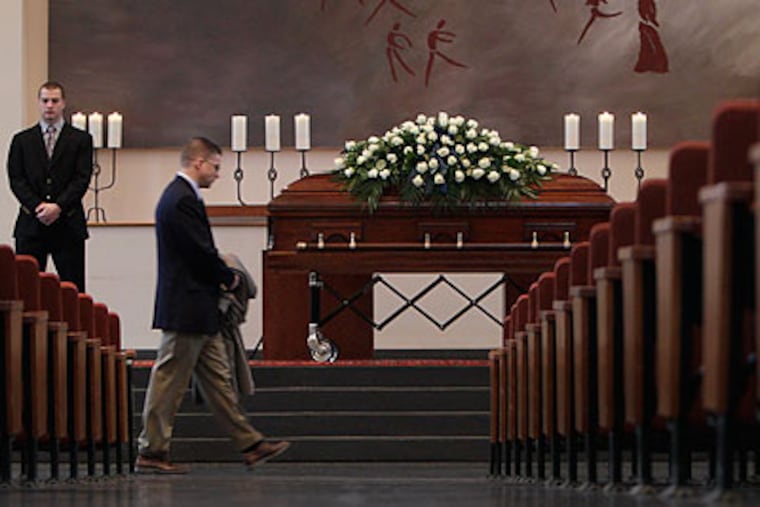
STATE COLLEGE - It's almost as if Joe Paterno were speaking from beyond the grave, even if the 85-year-old former Penn State coaching icon, who died Sunday of complications from lung cancer, has yet to be interred.
The private burial won't take place until this afternoon in this college town he so came to love. But for those not among the select few family members and close friends who can gain entry to the cemetery, there were public viewings yesterday and this morning at the Pasquerilla Spiritual Center on campus. There will be a public memorial service at 2 p.m. tomorrow in the Bryce Jordan Center.
Those fortunate enough to have had access to Paterno in the last few days of his remarkable life are telling mourners to dry their tears, because he wanted it that way. If some of JoePa's many admirers feel they have reason to be bitter at the way his 62-year employment at Penn State was terminated on Nov. 9 in the wake of the Jerry Sandusky child sexual-abuse scandal, that's on them. Joe Paterno left this world content and at peace with himself and what he accomplished, in stark contrast to those who suggested his firing by the Board of Trustees left him a heartbroken and disillusioned man.
That's the joyous and hopeful message a dying Paterno conveyed to his children and to Sports Illustrated senior writer Joe Posnanski, who is working on a book about the winningest football coach in Division I history that will be published in September.
In a piece he authored for the Jan. 30 issue of SI, Posnanski, who spent several weeks interviewing Paterno after the firing, describes someone who harbored no hard feelings toward anyone, even those who choose to portray him as somehow culpable concerning the heinous acts allegedly committed against underage boys by Sandusky, his longtime former defensive coordinator.
Excerpts of Posnanski's SI article can be found on SI.com, and read thusly:
In the moments after Joe Paterno died, it became common for people to write and say that he died of a broken heart. He did not. Joe Paterno died of lung cancer and the complications it caused. He did not die a bitter or broken man.
I know this because I spent time with Paterno in his hospital room during the last weeks of his life. I am writing a book about Paterno. We spoke different times about many things - from his days playing stickball in the streets of Brooklyn, to his time in the Army after World War II, through his playing days and his many coaching days, to, yes, the day a graduate assistant coach told him about seeing Jerry Sandusky in the shower with a young boy - and what stood out above everything else is that Paterno refused to be bitter or sad about the way it all ended.
"In every life," he told me, "there have to be some shadows. Look at me. My life has been filled with sunshine. A beautiful and caring wife. Five healthy children. I got to do what I loved. How many people are that lucky?"
Posnanski also writes that until his health took an irreversible turn for the worse, Paterno planned to treat his wife of nearly 50 years, Sue, to a 6-week "honeymoon." The idea was to make up for the abbreviated, 3-day getaway to Virginia Beach, Va., they took when they got married, which was briefly interrupted when he dropped in on a potential recruit along the way. Sadly, that won't happen now.
Lest anyone believe that Posnanski - who wrote a lengthy and quite moving SI article in the Oct. 26, 2009, issue on the positive influence JoePa's father, Angelo, had on him from childhood on - is blowing, uh, sunshine to help sell copies of his yet-unpublished book, Paterno's children are telling similar tales of a father who faced death with the same cheery outlook he held fast to throughout his life.
"My father did not have a broken heart," Paterno's daughter, Mary Kay Holt, told Posnanski. "His heart was too strong. It couldn't be broken."
Added son Scott Paterno, to the Associated Press: "Even at the end, when it was clear that he passed a line of no return, [there] was never a moment of bitterness. He was serenely calm, even right up to the end."
Scott told AP a story about his dad's hospital room. There were no flowers or balloons in the room, probably given away by Sue Paterno to other patients.
The only memento was a Penn State sweatshirt.
"His life is Penn State, through and through," Scott Paterno said. "He understood that, and it never once occurred to him to be bitter toward Penn State."
And this from Jay Paterno, who served as his father's quarterbacks coach, to "Today" host Matt Lauer: "This was an incomparable life. He really lived up to the values that he espoused . . . One thing that Joe always told us is that there's a difference between success and excellence. Success is how people perceive you, but excellence is something very personal. It's a standard you uphold, and throughout his entire life, he's always done what he believed was right, given the facts that he had in front of him at the time."
That striving to do what he thought was right also guided Paterno to take what information he had about Sandusky and to pass it along to higher-placed university officials, who apparently did not act on it. If you are among those who believe JoePa dropped the ball on that one, well, he understood that reaction. He second-guessed himself a lot about his most crucial misstep, probably more so than he ever did about anything.
"I made a lot of mistakes in my life," Paterno told Posnanski. "But I thought people could see that I tried my best to do the right things. I tried to do the right thing with Sandusky, too."