Former Temple star Hal Lear to have number retired
HE WAS one half of what many if not most Philly hoops authorities still consider to be, even more than a half-century later, the best backcourt the Big 5's ever seen. And those same folks will tell you that lead guard Guy Rodgers remains the player everybody else has to be measured against.
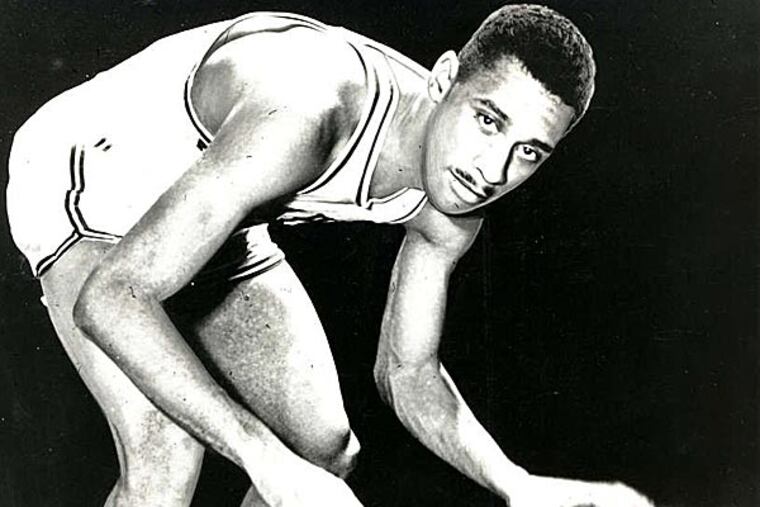
HE WAS one half of what many if not most Philly hoops authorities still consider to be, even more than a half-century later, the best backcourt the Big 5's ever seen. And those same folks will tell you that lead guard Guy Rodgers remains the player everybody else has to be measured against.
You could certainly argue for Tom Gola, who did his thing at LaSalle before there was a Big 5. Either way it's a legit debate.
"Oh God, Guy was so unbelievable," said his Temple teammate for one season, Overbrook High's Hal Lear. "He had such strength and quickness. He would drive into the basket, dribble and go up in such a way that he'd shoot the ball before the other guy had the chance to jump. He already had it on the backboard."
But Lear had game, too. As a senior in 1955-56, they led Harry Litwack's Owls to the Final Four. Temple would make it again 2 years later with sophomore Pickles Kennedy playing alongside Rodgers.
Lear averaged 24 points a game his final season, after averaging 22 as a junior. Rodgers averaged 18. The Owls lost in the semifinals, 83-76 to Iowa, which would then lose to defending champion San Francisco.
"I think we had the best shot at beating Bill Russell," Lear said. "Because we played against Wilt all the time. You couldn't press Guy. We played a 2-3 zone. Both of us were pretty quick. We took advantage of people who didn't pass the ball correctly out front.
"I think they did a number against us in the Iowa game. They called seven charges on me and Guy. Took away seven baskets. We'd go up for a layup and a guy would run under you. It's why they had to change the rule."
In the consolation game, Lear closed out his college career with 48 in a 90-81 win over SMU. It was an NCAA Tournament record that's been bettered only seven times by five players: Oscar Robertson, Bill Bradley, Elvin Hayes, Austin Carr (three times) and David Robinson. Some company. And only Bradley also did it at a Final Four (in another third-place game).
Temple has retired just four numbers: Rodgers, Bill Mlvky, Mark Macon and Marilyn Stephens. On Wednesday night at the Liacouras Center, a banner bearing Lear's No. 6 will join them in the rafters, along with those representing Hall of Fame coaches Litwack and John Chaney and Lear's friend Al Shrier, the university sports-information fixture for the last 6 decades who recently received his honor.
"He took me under his wing when I got there," Lear recalled. "He wasn't much older than I was. But he made sure I was OK . . . That was a long time ago."
It seems only fitting that Lear and Rodgers, who passed away in 2001, will now stay forever linked for all future generations to see. It's probably been long overdue.
"Guy would create, like only he could," said one of their contemporaries, Sonny Hill, who had Lear on for all 2 hours of last Sunday morning's weekly radio show on 94WIP. "Hal was the finisher. Guy would get him the ball, and something good would happen. Hal had that 15-foot jumper down. It was beautiful."
Lear, who will turn 78 on Thursday, has lived in Scottsdale, Ariz., since retiring in the mid 1990s. A number of his seven children and 20-some grandkids will be on hand for the ceremony.
"I think it's going to be awful cool," he said. "There's a lot of good memories. You take pride in that. I feel like I left it all on the court. That's a comfortable feeling . . .
"So many things go through your mind. They come right out and look at you. My chest will be bursting, no question. Every time I see Al, I can't help but think of me and him and Guy, running around schoolyards almost 60 years ago. My shot's not as good as it used to be. But I go to the gym four or five times a week, so I look like I did when I was 70. I used to say, 'Maybe I can get to the point where I could jump to the rim again.' Then I thought, 'What happens if I pull something?' No, I'll leave that in the past."
He already knows what he's going to say to the crowd when it's his time to take the microphone.
"Lifting that jersey is a representation of what a whole lot of people did to get it there," Lear acknowledged. "One of the things you learn as you get older is, you begin to find out that you didn't do it by yourself. My mother went to my junior high school in the 1940s and told the teacher, 'My son's going in the academic course.' Then they had all the African-Americans going in Shop. That's how they got jobs. The next year, I was taking Latin. I would not have been able to go to Temple, if I hadn't taken an academic curriculum.
"It's funny how things happen. My coach in high school, Sam Cozen, he just picked me up by the scruff of my neck and sent me to Temple. No issues. It's humbling. I just happened to be there with Guy. Amazing. But I can't tell you how high the bar in Philadelphia was during that time. It was the center of basketball. We're talking Tommy Gola, he was my hero, [Penn's] Ernie Beck, it was just a laundry list of talent. So you had to really work to play, at the schoolyard level. I remember coming up to play in the Northeast, and we had this little skinny kid. Back in those days, people in the Northeast barely ever saw black people. Well that kid was Wilt. You should have seen that."
It's a lifetime worth celebrating.