Can new Big East stick to lofty goals?
NEW YORK - The thinnest of lines has always separated the best and worst of big-time college sports, and Vince Nicastro has had a closer, clearer view of that truth than most of us ever get.
NEW YORK - The thinnest of lines has always separated the best and worst of big-time college sports, and Vince Nicastro has had a closer, clearer view of that truth than most of us ever get.
Nicastro has been Villanova's athletic director for 14 years, an administrator there for 20, and he had a window seat on a wild ride: the rise and fall of the old Big East, a league that in recent years attempted to reestablish itself as the dominant force on college basketball's landscape only to claw itself to pieces chasing football and its never-ending revenue stream.
He was here at Chelsea Piers on Wednesday for the formal introduction of a new era of Big East basketball - a league of 10 private schools, nine of which have Catholic affiliations, none of which regards football as the St. Edward's Crown of its athletic program. To Nicastro, there was comfort in this makeup.
"The composition of the league," he said, "is coherent."
This will be a basketball-first conference, adding Butler, Xavier, and Creighton to the seven Catholic schools from the old Big East. Ostensibly, its members are aspiring to strike that delicate balance between two oft-contradictory goals: using athletics as a vessel for money and identity and keeping it in its proper perspective. And there was so much talk at the league's media day about shared values and commitment and broader aims beyond basketball that it seemed as though the schools regard the mere absence of football as a cleansing agent.
"I don't know if it's cleaner," Nicastro said. "I think it's our way of doing it."
Now, Villanova and these nine similar schools can have what Nicastro called a "more singular focus," without the worry that a Syracuse, a Pittsburgh, or a Louisville might bolt for something bigger, and maybe there's less chance of a conference-wide arms race that inevitably leads to corruption. Maybe.
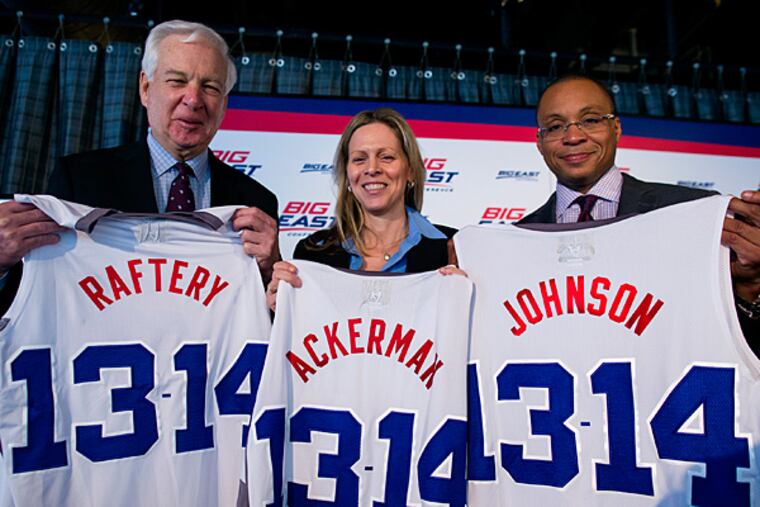
"It eliminates a sport that brings an awful lot of benefits to the schools where it's a big deal, in terms of bringing communities and campuses together," Big East commissioner Val Ackerman said. "At many other places, it's a pretty big investment, and it can be a distraction that can siphon off focus and energy. And our schools, for the most part, were never in that business."
The "Catholic 7" of the Big East's previous iteration had been preparing for this year's split for a long while. They could see what was ahead - that they'd never be able to keep up with the resources of their football-sponsored competitors - and on Wednesday they seemed happy to have left those headaches behind them.
Ackerman said she wants the member schools to pilot youth basketball initiatives in their 10 home cities, to draw on the urban texture and social vibrancy of their campuses to launch outreach programs to the poor and disadvantaged.
"That sort of ideology, that coherence of view, is what our schools have," she said.
Nevertheless, although it's dwarfed by football, basketball can have a pull on a campus that's still so powerful. That's what makes these programs' laudable aims so difficult to reach, their integrity so difficult to maintain. No one's immune from the excesses. In 2002, as one example, St. Bonaventure didn't need to have its own high-profile football program or to compete in a league loaded with football schools to try to sneak a 6-foot-8 center with a welding certificate into school and onto the basketball team. That temptation never goes away. It is only intensified over time, and it warps the entire system. Hell, it's intrinsic to it.
Fox Sports' Gus Johnson greeted those players, coaches, administrators and reporters who gathered here Wednesday by reminding everyone that the Big East doesn't "have to worry about football and all the money [it's] wasting." The line was a crowd-pleaser, but it was also a hollow, hypocritical criticism. Such gluttony, after all, is not to be confused with the half-billion dollars Fox Sports paid for the right to televise the conference's men's basketball games over the next 12 years - a sum that signifies nothing if not prudence and forbearance, right?
Like it or not, the first important measuring stick for the new Big East won't be how many academic all-American players it produces, but whether Villanova-Georgetown sells out the Wells Fargo Center this season, whether the game draws high enough ratings to widen the eyes of ESPN executives. No one is so naive to think otherwise, despite the earnestness of everyone's intentions.
"It's about really competing in a sport we all have great tradition and history in," Nicastro said. "It's in the fabric of the institutions. It's about the holistic development of our students."
At its best, yes. Yes, it is. But the worst never seems too far behind.
@MikeSielski