Phil Sheridan: Phillies' Perlozzo teaching and learning
CLEARWATER, Fla. - The balls sail in one after another, all chest-high, all popping the glove held like a target by Phillies coach Sam Perlozzo. After each catch, Perlozzo rolls the ball to the edge of the grass in front of second base.
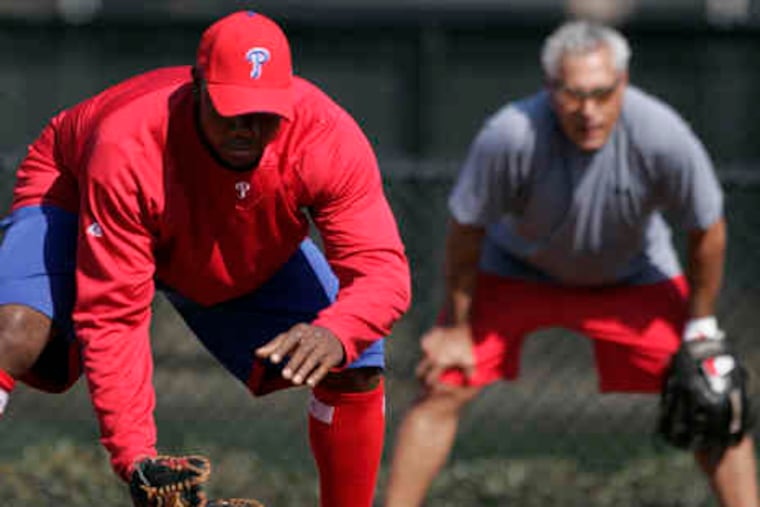
CLEARWATER, Fla. - The balls sail in one after another, all chest-high, all popping the glove held like a target by Phillies coach Sam Perlozzo. After each catch, Perlozzo rolls the ball to the edge of the grass in front of second base.
When the collection of balls grows to about a dozen, Perlozzo calls over to the player laboring to field grounders and throw darts at that target.
"You getting bored?" Perlozzo says, and Ryan Howard laughs appreciatively.
This is a high compliment, a way of saying that Howard's throws are so consistent, there is no sign of the problem he's out here working on in the first place.
"He's been as receptive as you can possibly be," Perlozzo says a couple of hours after the intensive private tutorial. "All I asked him to do is trust me. He's been great. His aptitude to pick up things right off the bat has been tremendous."
The defensive master class has been going on for more than a week on the half-field in front of the Carpenter Complex. Howard, runner-up for what would have been his second National League MVP Award last season and recent recipient of a $54 million contract, could have been lying on a beach or hitting clubs in Manhattan, L.A. or South Beach.
Instead, the slimmed-down slugger has been here, fielding grounder after grounder and making throw after throw. Howard practices underhand tosses to first and double-play starters to second. Perlozzo switches roles, now covering first like a pitcher and then darting to second like a shortstop, all the while critiquing Howard's footwork and body positioning.
There are two positives here. The first is Howard's dedication. Sure, major-league players should be willing to work hard on their game, but the reality is that Howard is going well above and beyond the norm.
"What it tells me is he's a tremendous competitor," says Perlozzo, who didn't know Howard before the sessions commenced. "He's not satisfied just being an offensive player, and he has enough pride in himself and the ball club that he wants to help the team."
The other positive? Perlozzo, who knows something about the subject, thinks Howard's defensive skills are just fine.
"I went into [coaching] Ryan open-minded, not really wanting to see films or anything like that," Perlozzo says. "I wanted to see what I saw. I didn't want any preconceived negative thoughts. Basically, what he showed me was that he needed some sort of comfort zone. The skill level was still there.
"First day, I said, 'I see part of the problem.' All we did - he's a big guy, so all we did was spread him out and get him pointed toward his target. . . . He's proved to himself that he can do it in practice. Anybody who can do it in practice can do it in a game if they just allow themselves to do it."
The Phillies hired the 57-year-old Perlozzo in November as a replacement for third-base coach Steve Smith. He arrived with decades of coaching and managing experience after a playing career that Charlie Manuel inadvertently helped bring to a close.
After a brief stint with the Minnesota Twins, Perlozzo played in Japan for the Yakult Swallows in 1980.
"I played the one year and [Manuel] became available," Perlozzo says. "I think they went after the 40-some homers instead of my 15. I came back to the States. I was trying to get one more shot so I could walk away and feel good about it."
After a player-coach stint with triple-A Tidewater, Perlozzo accepted an offer to manage in the Mets' minor-league system. He moved to the big leagues as a coach in 1987 and did tours with several teams before landing in Baltimore in 1996. His tenure with the Orioles peaked with a 286-game-stint as manager.
Perlozzo will coach the Phillies' infielders throughout spring training. He'll also use the exhibition season to prepare himself for the often thankless role of coaching third base.
"The biggest compliment a third-base coach can have is that the press never talks to him," Perlozzo says.
That usually happens after a mistake, sending a runner who is thrown out at the plate or holding one who would easily have scored. The key to the job, Perlozzo says, is to "think along with the manager. You don't miss signs from him because you're thinking along with him."
Perlozzo will have to learn the baserunning abilities of the Phillies, as well as the arm strength of National League outfielders. Then he'll have to make those snap judgments that are so easy to second-guess when they turn out wrong.
For now, though, the most important part of his day is the half-hour or so he spends with Howard, helping one of the game's biggest stars become one of the game's best all-round players.
Read his recent work at http://go.philly.com/philsheridan.