McNabb and Kolb face same challenges
Before you can become an Eagles quarterback, you must survive a verbal blitz. And before you can play, you must endure a barrage of actual blitzes that only the Luftwaffe could have matched.
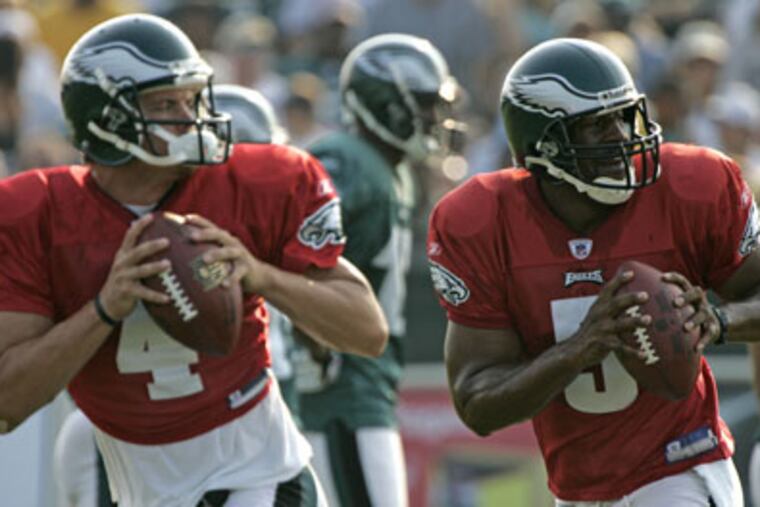
Before you can become an Eagles quarterback, you must survive a verbal blitz.
And before you can play, you must endure a barrage of actual blitzes that only the Luftwaffe could have matched.
The Eagles, under coach Andy Reid, have drafted four quarterbacks in 11 years. The first one has overcome almost every single obstacle thrown his way - except a very large one. And the last one hasn't had very much to contend with, except the impediment the first one has presented.
Donovan McNabb and Kevin Kolb enter the 2009 season with those very obstacles still in place - the starter has yet to win a Super Bowl, and the backup has yet to supplant the starter. And just to make things interesting, the Eagles threw another hurdle in their path.
Last month the team acquired Michael Vick. McNabb gave his blessing, even said it was his idea. But what happens when the 11-year pro falls into a funk and the fickle Philadelphia fans lobby for the lefty?
Kolb, on the other hand, is the No. 2 in name. But what happens if McNabb gets hurt, and the options are a former Pro Bowler who has played in a conference championship and a third-year guy with no career starts and one shaky relief performance?
"There's no threat to me," McNabb said. "There's no threat for Kolb. It's an opportunity for us to add another weapon to our offense and to our team."
Those problems might seem rather tame compared to the mind-teasers Reid and his lieutenants would often pose to aspiring NFL quarterbacks during the interview phase.
There's an oft-told anecdote about the time McNabb, during one such meeting, faced wave after wave of rapid-fire questioning from then-quarterbacks coach Brad Childress. The intent was to confuse and frustrate. But the young Syracuse grad returned every serve with just as much pace and, in the end, Childress was the confused one.
It was all part of The Plan, as Reid called it then, that he honed in Green Bay under Mike Holmgren's tutelage and as Brett Favre's quarterbacks coach. When he came to Philadelphia, however, he intensified the blitz portion of instruction, with the initial interview as just the first phase.
"I thought one of the things that a young quarterback needs is work against the blitz in the NFL," Reid said. "That's the biggest difference. In college, they're becoming more sophisticated with what they do defensively, but the defensive [coordinators] in this league are bringing everybody plus the peanut vendor."
Reid enlisted the late Jim Johnson, the blitz vendor himself, to cook up all kinds of schemes to rattle McNabb as a rookie. A decade later, coach and player agree: It served its purpose.
"The important thing for any of the young quarterbacks is not to second-guess," McNabb said. "If you see it, go with it. And if you see it, and it's the wrong thing, you'll at least know what you're seeing and be able to react to it."
When Reid decided eight years later to draft another quarterback, his teaching methods remained the same, and the special blitz period was still a part of the lesson. But the game had changed in terms of drafting quarterbacks.
The Eagles famously plucked the one gem in the 1999 draft by carefully and thoroughly scouting McNabb. But the stakes got higher - along with the contracts - as far as investing a top draft pick in a quarterback. Even though Reid's selection of Kolb in the second round of the 2007 draft was considered a surprise, the Eagles did exhaustive research on the Houston product.
"We spent a lot of time with Kevin - I mean, a lot of time," Eagles general manager Tom Heckert said. "We sent guys out there to work him out, privately. We went to the regular workout, brought him in here. Again, we spent a lot of time with Kevin. If you're drafting a quarterback, you have to do that."
Reid shadowed McNabb before his first draft, but he had the luxury of knowing about the kid years beforehand. Syracuse coach Paul Pasqualoni would visit the Packers to learn their pro-style offense and would pitch his quarterback to Reid. When Reid joined the Eagles, college director Mark Ross already had McNabb listed as his top prospect.
"When Mark said that, I said, 'That's awesome. Let's go,' " Reid said.
Even though Kolb played in a gimmicky offense in college, he was accurate, and he was smart - the two qualities the Eagles value most in their quarterbacks. But that didn't stop offensive coordinator Marty Mornhinweg and quarterbacks coach Pat Shurmur from putting Kolb through a rigorous trial.
"When they came and worked me out, they had me do some of their throws, some of their sliding to get the ball out," Kolb said. "They wanted to see the arm at different angles, throwing on the run because that was my strength in college. They wanted to make sure I had that, firsthand."
Kolb, though, had the luxury of learning under McNabb, and he was not brought in to start right away. Indeed, he may never start because he and McNabb are signed for two more seasons. But the intention was to have a contingency plan, and it may still work out that way.
"I was bringing in [backups] that were here for a year and then gone. I got tired of it," Reid said. "So I said, 'Listen, I'm going to bring in a young guy, and maybe I could train him in our system here for a couple of years. If Donovan gets banged up, that guy can develop into a quality starter."
Kolb went through the requisite blitz exercises, but he said the biggest adjustment was the Eagles' system of requiring a precise number of steps in the drop back with each particular play or route run by a receiver. At Houston, it was whatever Kolb felt comfortable doing. The Eagles had their way and they bombarded Kolb until his footwork became robotic.
"They have a system [with a quarterback] of 'Hound him, hound him, hound him,' " Kolb said. "And then let him be comfortable to play the game like he knows how to play the game. Now that I've been here two or three years I can see that's what they do."
To be an Eagles quarterback, you don't have to have a cannon for an arm, and you don't have to run like the wind. But you have to be accurate, and you need superior eye-hand coordination. But most of all, you have to think quickly on your feet and not let the carnage going on around you affect your ability to make plays - like McNabb.
"He has a knack for not letting that stuff bother him," Heckert said. "He can keep his eyes downfield and guys are running around him, hands on him. That's something you can't teach."
When it comes to drafting and developing quarterbacks, maybe the scouting is more important than the teaching.