Vick faces a financial challenge
Football fans are not the only ones waiting to see Michael Vick get on the field today for the Eagles.
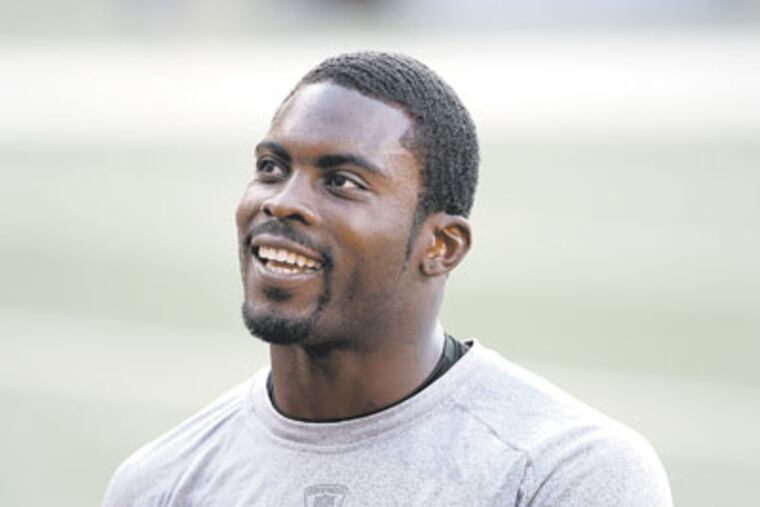
Football fans are not the only ones waiting to see Michael Vick get on the field today for the Eagles.
The bankrupt backup quarterback, once the highest-paid player in the NFL, is expected to be in uniform for a regular-season game for the first time since 2006. Vick now owes a lot of people a lot of money after his 18-month prison stint.
His creditors will be watching to see if Vick is anywhere near the pre-prison form he showed when he was named to the Pro Bowl three times.
"I'm an Eagles fan, now," said Ross Reeves, a Virginia attorney who represents unsecured creditors in Vick's bankruptcy filing.
In 2004, Vick signed a contract with the Atlanta Falcons that could have paid him $130 million if he and the team stayed together through the length of that deal. Endorsements brought more cash.
But that contract and much of Vick's wealth went away when he went to Leavenworth after he pleaded guilty to
federal dogfighting charges.
As part of his Chapter 11 bankruptcy plan approved last month, Vick has liabilities of $20.4 million and has begun liquidating assets worth $9 million. Glance through some of the hundreds of court documents involving Vick and you'll find a picture of a wealthy man who was "not a sophisticated investor," as Vick said of himself in one civil court filing. He made bad choices on spending and whom he would trust with his finances.
Three homes, seven cars, and two boats are among the things Vick has had to sell - or try to sell in a down real-estate market - to pay creditors. He certainly wanted to take care of the people close to him. Vick - and the friends and family he tried to outfit in automobiles - drove Land Rovers, Cadillac Escalades and Mercedes-Benzes, among others. His eight-bedroom, 11-bathroom, gated-community home on a lake in Duluth, Ga., remains for sale, listed at $3.45 million.
Vick's various attorneys formed several limited partnerships, including MV7 L.L.C. and Divine Seven L.L.C., playing off his uniform number 7, but the businesses - often started with or for friends and relatives - sometimes faltered or failed. Seven Charms Farms and the horses involved did not work out for Vick. A rental car franchise and janitorial company withered.
By his account, he also went through a slew of financial advisers of varying qualifications, often giving them powers of attorney, including when he was in prison. As a result, Vick claimed, many of his investments evaporated, and sometimes money and other holdings disappeared without his knowledge.
In his bankruptcy filing, Vick listed 13 potential targets for his own civil litigation - including five former financial advisers, two insurance agents, a former business partner, and his former personal assistant.
Meanwhile, a former marketing agent, Andrew Joel - hired and let go before Vick ever played an NFL game - successfully sued Vick over a contract under which Vick was supposed to pay him 25 percent of his marketing deals. That suit helped push Vick into bankruptcy. Joel is now one of Vick's biggest creditors, owed over $4.5 million.
Bonus money targeted
The Atlanta Falcons also wanted their bonus money back for the years of Vick's contract when he didn't play. In 2004, he signed a 10-year deal but played just two seasons. Originally, the Falcons looked for roughly $20 million to be returned. They've completed negotiations and the final figure is less than $5 million, according to a source familiar with the case.
Under the bankruptcy plan, Vick gets to keep a house near Newport News, Va., where he grew up. As for cars, he hangs on to a 2007 Land Rover driven by his fiancée and mother of his two daughters, Kijafa Frink; a Lincoln Navigator driven by Tameka Taylor, the mother of his son; and a 2007 Infiniti. He can keep "certain personal property," and a pension plan.
Vick has to file monthly budget statements to the court for at least two years. His fiancée and his mother also are required to deliver financial statements. He is supposed to live on an annual budget of $300,000.
In other words: about what a player making the NFL minimum, after taxes, lives on.
Vick told the Eagles he would answer football questions last week, but no non-football questions. Friday, he took no questions at his locker.
"I'm happy it's over - I can move on with my life," Vick told reporters in Virginia on Aug. 27, when the bankruptcy plan was approved. "I think my lawyers did a great job. I commend the job. I commend the creditors' committee, everybody. We finally got it all together. I'm just happy we can move forward."
The creditors have a choice just ahead of them. They're going to have a six-year window to get approximately $20 million from Vick as part of the bankruptcy agreement that should be finalized later this year when a trustee is appointed by the court.
That bankruptcy trustee will set the clock on Vick's payments, starting with either his 2009 or 2010 income. The bankruptcy trustee can include Vick's $1.6 million salary from the Eagles this season, or gamble that he's got six better financial years ahead of him after this one. Next season, for instance, Vick is due to make $5.2 million from the Eagles, with incentives that could raise it. Reeves said that option was put in "to prevent any gaming of the system. . . . It's just a back door, to make sure we haven't made a mistake by passing up 2009."
Reeves said creditors have an interest in two things.
"One, as he goes along, is that Michael is careful enough with his money to make the payments he must make to the trust each year," Reeves said. "At the end of the year, there is a big settling up."
The second interest is a bit more complex.
"It's important to any plan that deals with this much of a time lag, that Michael Vick is a responsible member of the NFL community," Reeves said. "We're very interested in Michael Vick, in all aspects of his character."
Good conduct and positive community involvement have merit on face value, but such conduct will also help Vick stay in the NFL longer, perhaps at a higher salary, which helps creditors.
Among the creditors is the Royal Bank of Canada, which wants $2.5 million for a loan on which Vick defaulted. He owes about $3.6 million in fees to attorneys and others who represented him and a creditors' committee during the bankruptcy process.
Vick agreed to pay creditors on a sliding scale, based on his income. On everything below $750,000, he pays 10 percent. Then he will pay 25 percent of income between $750,000 and $2.5 million, 30 percent for between $2.5 million and $10 million, and 40 percent of anything above $10 million.
There also is a plan in place to go after some of the money he claims has been misappropriated. The plan states that the trustee for the creditors can go after any money that has been misappropriated. If the trustee and creditors decline to do so, Vick himself may sue at his own expense, with 20 percent of any recovery going to the creditors.
'A good plan'
"It's a good plan for Michael and it's a good plan for the creditors," Reeves said. "We're trying to build in there sufficient incentives for him to make more and more money. We want for him to have every motivation to have a vastly successful career."
Vick said he met Mary Wong of Omaha, Neb., in May of 2007 through a former Falcons teammate, Demorrio Williams.
"In the beginning, she was trying to do some type of PR damage-control because of all the media that I was taking, so she didn't come off as a financial adviser," Vick said in a bankruptcy deposition last year. "She came off as a person trying to help me."
In October 2007 - before Vick went to prison and during his home confinement in Virginia - he gave Wong power of attorney.
"I had business in Atlanta, Georgia, and things wasn't going right with some people that was working within the business," Vick said in a court document. "I had her go and retrieve certain documents, and, basically, she needed power of attorney."
Asked if Wong gave him investment advice, Vick said, "Yeah, because I invested some money with her in July of 2007 - $500,000 - and she told me it would be invested in some type of bank investment. . . . What was promised was a 10 percent return. It was never put in writing, but that's what she told me."
Vick said he never received any of that $500,000 back. A civil suit filed in January 2009 also alleges that Wong made a transfer of $650,000 from Vick's bank account into a company account she controlled. A sum of $125,000 has been returned by Wong and the company to Vick and placed in an escrow account, the suit says.
"Mary Wong categorically denies that she has ever wrongfully taken one penny from Michael Vick," Wong's then-attorney, James Mitchell, told the Associated Press in November 2008.
The suit also named Williams & Bullocks, L.L.C., the company owned and managed by Wong and named for three NFL players - Williams, now with the Kansas City Chiefs, and twins Josh and Daniel Bullocks. Josh is with the Chicago Bears, Daniel with the Detroit Lions. All three played at the University of Nebraska.
The suit also said Wong failed to disclose her 2007 disbarment from the New York Stock Exchange for misappropriating customer funds.
Last month, Wong was indicted for allegedly stealing $3 million from eight victims in a Ponzi scheme. It was not clear from the indictment whether any of that money came from Vick or the other football players.
Brad Manson, an attorney for the other three players, told nfl.com that Wong ended up stealing their money and that they were unaware Wong received money from Vick.
Clarence Mock, Wong's attorney when the indictment was handed down, could not be reached for comment.
Dispute with another adviser
After he went to Leavenworth Prison to begin his sentence, Vick met David Talbot. Vick's younger brother, Marcus, was a friend of Talbot's son, and Marcus made the introduction before Talbot visited Vick in prison, Vick said in a deposition.
According to Vick, Talbot came to see him alone and said, "he could help me with some services and basically telling me he could get me released from prison. And from that point, we just developed a relationship."
Vick said Talbot never spoke again about an early release. Asked what Talbot said his background was, Vick said, "I think he was a doctor. That's about the most he told me. . . . Not really a financial adviser, but kind of like just assisting me in certain financial situations."
Vick said he gave Talbot power of attorney. Asked if he ever paid Talbot, Vick said, "I never paid Dave. He only told me he needed a retainer to pay [one of Vick's attorneys] and it would cost about $35,000, so he took $50,000 from my foundation account."
Vick said it was his idea to give Talbot his Mercedes - "I told him he could keep it as services rendered because I was in no condition to pay him cash."
Vick was still in prison at the time of this deposition.
In August, Talbot was accused of committing securities fraud in New Jersey. Originally, Talbot had been named as "the responsible person" helping Vick in his bankruptcy case, but when Vick's attorneys heard about the fraud charge, they got that changed. A responsible person is designated for such duties as collecting and paying taxes.
Talbot appeared before bankruptcy judge Frank Santoro on Sept. 5, 2008. The judge and other attorneys asked Talbot questions about whether he had a medical degree, whether he had filed for bankruptcy, and whether his statements on an affidavit were truthful. According to the transcript of the hearing, Talbot asserted his Fifth Amendment right to decline to answer the questions.
Talbot apparently was familiar with bankruptcy procedures. He reportedly had filed for bankruptcy protection himself in 2002.
Problem friends
Vick didn't just lose money to preying strangers.
In 2006, he invested $40,000 in a Jani-King franchise. Jani-King bills itself as the largest commercial cleaning business franchise company in the world.
"It [was] basically ran into the ground by one of my friends," Vick said in his bankruptcy filing, and he reported the franchise stopped operating that same year.
Vick also said he took out a loan for $2.08 million in 2007 for a Payless Car Rental franchise in Georgia, with a partner, Art Washington. On Aug. 24, 2007, 1st Source Bank placed the note in default and accelerated the loan. On April 30, 2008, the parties entered into a consent judgment agreeing that Divine Seven L.L.C., the company set up to own the franchise, and Vick would be jointly liable for the sum of $461,486.04. On June 25, 2008, 1st Source filed a partial satisfaction of judgment in the amount of $12,192.50 when a vehicle that served as collateral for the loan and had been reported as stolen was recovered and sold at auction. The bank remains one of Vick's creditors.
Washington also went in with Vick on a horse farm in Conyers, Ga. Vick said he invested $200,000 in the horse farm. According to Vick's bankruptcy filing, he held a 60-percent interest in the farm, but the farm was sold at a tax-lien foreclosure sale in September 2008. Washington gave him no notice of the sale, said Vick, who was in prison at the time.
Then there was D&Q Ventures, a janitorial business that Vick said was owned by his cousin "and one of my close friends." Vick said he invested $34,000. That business is now defunct.
So is another business, owned 100 percent by the quarterback: Mike Vick Kennels. Vick's filing reported that business "has no assets or liabilities."
Vick was apparently looking out for friends until he went to prison.
The Atlanta Journal-Constitution reported that from Aug. 27, 2007, the day Vick pleaded guilty on the dogfighting charges, until Nov. 19, when he reported to Leavenworth, Vick "shelled out" $3,627,291. The paper reported that Vick bought a $99,000 Mercedes the day he went to jail.
Rebuilding the portfolio
Estimates of how much money Vick lost have ranged as high as $200 million. In addition to lost football wages, Vick found his endorsements canceled, the largest with Nike, but also with AirTran Airlines, Rawlings, and Radtke sports.
There was no chance of keeping those after the indictment, which related how two friends and Vick "executed approximately eight dogs that did not perform well in 'testing' sessions . . . by various methods, including hanging, drowning and slamming at least one dog's body to the ground."
"He would have to do some enormous rebuilding of his credibility and favorability to even get sniffs from certain brands," Paul Swangard, director of the University of Oregon's Warsaw Sports Marketing Center, said in a telephone interview the day after Vick signed with the Eagles.
The bigger question is how much can Vick earn on the football field, and for how long. With 39-year-old Brett Favre still going, that question clearly is uncertain. Among the creditors are some experts on salaries, including the Falcons, a marketing agent, and banks that lend to other ballplayers.
"It's all a crapshoot, anyway," said Reeves, the attorney for the creditors. "If you had done an expert analysis, what can an expert possibly tell you? The minimum salary is $750,000. A backup quarterback averages $2 million. We know Peyton Manning signed a 10-year contract for $98 million, but what does that really mean?"
Even with Vick's Eagles contract, Reeves pointed out there are plenty of variables. Reeves was allowed to see an addendum on bonuses and achievements. It wasn't put into evidence, but Vick was told by the court to share it with creditor representatives in confidence. It went on for 12 pages, Reeves said.
Besides, even a brilliant analysis of all quarterbacks couldn't mean much in Vick's case.
"There are not too many like him out there - with his particular talent, combined with such a bizarre background," Reeves said.