Celebrations a fact of life in NFL
There are pitfalls to celebrating a big play in the NFL, and DeSean Jackson is familiar with just about all of them.
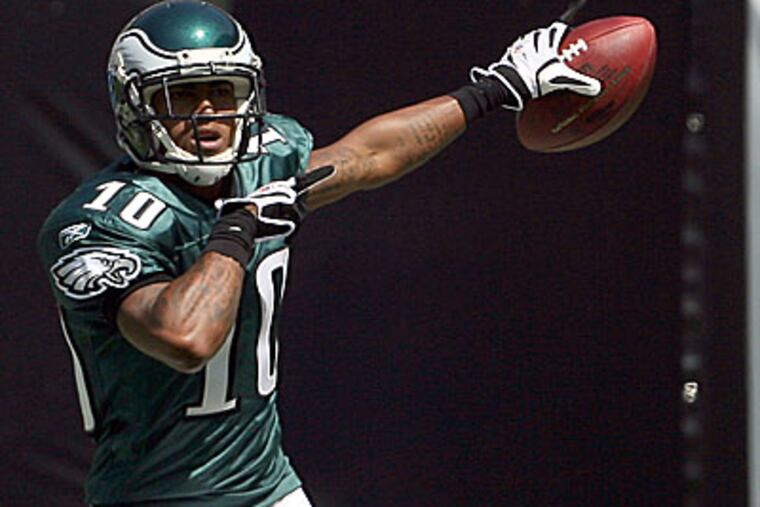
There are pitfalls to celebrating a big play in the NFL, and DeSean Jackson is familiar with just about all of them.
A player can be fined. That's already happened to him twice, said Jackson, the Eagles' second-year wide receiver. A player can be penalized 15 yards for unsportsmanlike conduct. Jackson was assessed such a penalty in the season-opener at Carolina.
And then there are the most embarrassing celebrations, the ones without any repercussions from the league.
They aren't needed when, say, cornerback Dre' Bly starts prancing at midfield after an interception with his San Francisco 49ers down by 25 points, only to have an Atlanta receiver come from behind and strip the ball.
Or when Jackson lets go of the football before crossing the goal line to prematurely start a celebration during a Monday Night Football game.
"It definitely don't look good," Jackson said.
So why does it still happen?
"You've been playing this game forever and you want to have fun," Jackson said. "That's what you do."
And generally, the more outrageous a celebration is, the more attention it receives.
That may be why, no matter how much the league has fined players (as much as $30,000, which was assessed to New Orleans receiver Joe Horn in 2003 for pulling a cell phone out from underneath the goalpost and pretending to make a call after a touchdown) or extended the jurisdiction of the personal-foul penalty, it hasn't stopped the excessive celebrations.
Or the ones that backfire.
"If he did that, maybe something like that would spark guys on the team," Eagles safety Quintin Mikell said of Bly. "Obviously, it didn't work out that way."
After picking off a Matt Ryan pass in the third quarter with San Francisco trailing by 35-10, Bly was near midfield when he put his right hand to his helmet, a la Deion Sanders. He left the football unprotected in his left hand. Falcons wide receiver Roddy White knocked the ball loose from behind. Atlanta scored three more points seven plays later.
After the game, Bly was unapologetic and said he had done nothing wrong. "Dre's going to be Dre'," he told reporters. A day later, Bly took the podium during coach Mike Singletary's weekly news conference and apologized.
"I'm a prideful guy," Bly said. "I like to have fun. I got caught up in the moment and was wrong."
It's the competitive nature of athletes that can lead to a desire for celebration. And when the craziest celebrations - like those of Terrell Owens' Sharpie and Chad (Johnson) Ochocinco's putt-putt with a pylon - draw so much attention, it only reinforces in some athletes the need to celebrate excessively, said Paula Parker, a certified consultant for the Association for Applied Sport Psychology and an assistant professor of sport management at East Stroudsburg University.
"For athletes, getting their name out there, getting fans to hear about it, it's part of the game," Parker said. "You want to be marketable. You want people to know who you are so you can sell your jersey, so agents can ask for more money."
Jackson said he wished the NFL would rescind its rules so there were no penalties. Parker said she wasn't sure the rules made a difference. No matter what the league does, as long as the celebrations gain attention, they will remain excessive, she said.
Jackson, who once attempted a flip into the end zone during a high school all-star game but landed short of the goal line, was fined $10,000 earlier this season for falling to the ground during a celebration of a Brent Celek touchdown against Carolina. Five other Eagles were each fined $10,000 for their roles, too.
Celek handed the ball to center Jamaal Jackson as players huddled around. Jackson spiked the ball, and DeSean Jackson fell on his back.
"It was just something that happened," Jackson said. "We all just came together and ended up doing something."
The NFL does not keep track of how many personal-foul penalties are assessed for an "illegal demonstration." Those fouls fall under unsportsmanlike conduct, which can be a variety of offenses.
Jackson said Eagles coach Andy Reid delivered a stern warning after the Carolina celebration. Two weeks later, Jackson executed his front flip (in the end zone this time) and landed in a split after scoring a long touchdown against Kansas City. Reid laughed that one off at his postgame news conference.
"I'm not really big into the whole celebrations," Reid said this week. "I always say, 'Act like you've been there.' "
But . . .
"But at the same time, it is a little exciting," the coach continued. "I've got some guys who think they're gymnasts. They do pretty creative things. But I'm not here to give them a 10 or whatever. I'm not here to grade them on that."
Robert Thompson, a professor at Syracuse and director of the Bleier Center for Television and Popular Culture, hardly sees the phenomenon of wild celebrations as society's decline into egomania.
"I could see if people started doing these victory dances and struts at a bank every time you land a new client, then I could see people saying, 'OK this is inappropriate,' " Thompson said. "But to talk about doing a victory dance at a football game? This is a venue where people up in the stands have their shirts off, and are painted the colors of the team. It's a sporting event. This is something that comes out of the tradition of Roman gladiators."
Mikell, who has never been fined for a celebration in his seven-year career, said sometimes it was part of the game. A player needs to throw something back in the face of the opponent, he said.
"It doesn't bother me," Mikell said. "If you score a touchdown, celebrate as much as you want to. You don't get to do it all the time, so why not? If I get a pick, I'm going to celebrate. I'm going to have fun. Don't let me score a touchdown because I might get a fine."