Rich Hofmann: Eagles' clock miscue is embarrassing
ON THE MORNING after Andy Reid accomplished the impossible - getting a delay-of-game penalty after calling a timeout in a crucial spot on the goal line - he tried to have it both ways.
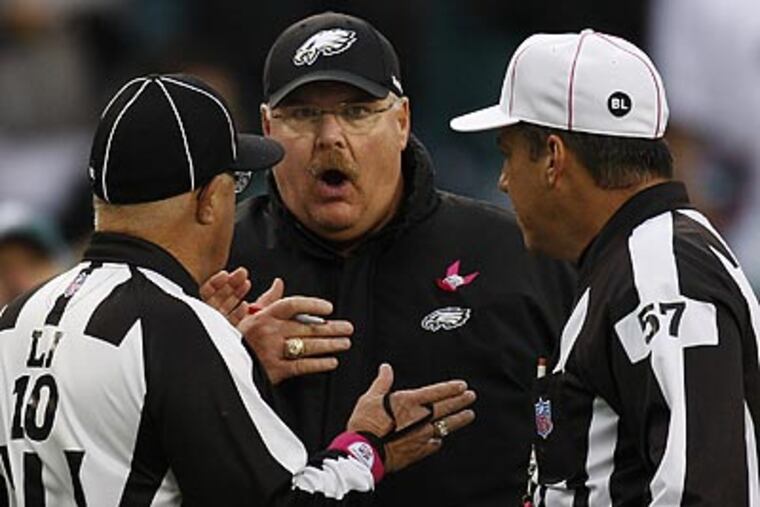
ON THE MORNING after Andy Reid accomplished the impossible - getting a delay-of-game penalty after calling a timeout in a crucial spot on the goal line - he tried to have it both ways.
On the one hand, he tried to imply that the officials mishandled the situation, saying, "Listen, I would love to tell you everything, but I'm not going to do that. That would be an expensive answer."
Meaning that the NFL would fine him for criticizing the officials. On the other hand, Reid tried to claim it was all on him, saying, "Listen, I'm taking it as my fault and I'm just going to leave it at that and go with it."
So which was it?
And why does it matter?
Because this looks terrible for Reid. It just does. He has a reputation as a serial clock-misuser already. Some of it has been overstated nit-picking, frankly, but this is not. This is really bad, unless the officials indeed ignored their standard practices and somehow put the Eagles at an unfair disadvantage.
On the Fox broadcast, Troy Aikman, the former Cowboys quarterback, was Reid's rather vocal defense attorney, saying the officials failed to use "common sense" in the situation. He absolved Reid of any responsibility.
But yesterday, in reply to a question from the Daily News, an NFL spokesman explained the officials' actions during the situation and expressed no problem with how it was administered. All of which leaves us back where we began.
That is, this looks really bad.
There are two issues. The first concerned the spot of the ball near the goal line, which Reid claimed was moved back from right near the goal line to nearer the 1-yard line, causing him to want to change his play-call. The second issue concerned the end of the timeout and the starting of the 25-second play clock, of which the Eagles' sideline seemed to be completely unaware.
Rewatching the play, you see LeSean McCoy called down short of the goal line. One official seems to have his foot about 6 inches from the goal line to mark his spot, while the opposite official is nearer to 12 inches away. On the television replay, you do not see the ball being spotted. Then, the booth upstairs calls for a review, and referee Al Riveron goes over to the way-back machine for a look at whether McCoy scored.
It is a long review by Riveron. Fox goes to a commercial, comes back, and dances around for almost another 3 minutes as Riveron tries to decide what to do. At one point, in the middle of that deciding, a Fox camera pans to the field where players and officials are milling around, waiting. They show the spot of the ball. It is not 6 inches, or 12 inches from the goal line. It is hard to tell exactly, but it looks to be closer to 24 inches from the goal line.
I am not here to argue about whether that distance was meaningful to the play-call; Reid says it was, and that's his business. I am not here to argue about whether it was a good spot, either. All I'm here to say is that the spot was well-established throughout what might have been the longest replay review in the history of replay reviews.
Good, bad or indifferent - this should not have been a surprise to the Eagles' sideline (or, certainly, to the squadron of well-paid coaches who sit in the booth that overlooks the field). If the difference in the distance was meaningful, everybody had the ability to know that distance for several minutes before the thing blew up in their faces.
Which it did.
Reid called timeout a few seconds after the completion of the replay review and immediately asked Riveron why the ball was moved back - even though the ball had sat in the same spot for several minutes, at least. That discussion went on for a while, it seems - after which, the Eagles appeared to have no idea that the 30-second timeout had ended and that Riveron had started the 25-second play clock. The Eagles called a new play and, the next thing we knew, quarterback Kevin Kolb was jogging back onto the field and reaching the huddle with only 10 seconds left, too little time to get the play called and the team lined up. The Eagles took a 5-yard penalty for delay of game and kicked a field goal instead of trying for a touchdown.
After the game, Reid said, "Normally when you get into those situations, they don't jump-start the play clock as fast as they did. It was a bad situation there." Aikman's feeling was that, given the conversation about the spotting of the ball, the Eagles should have been given time to get Kolb back into the huddle with the new play.
The NFL, meanwhile, says the Eagles were treated fairly.
From a league spokesman, via e-mail:
"The instant replay review was to determine if the ball broke the plane of the goal line. Replay confirmed the ruling on the field, so the original spot - just inside the 1-yard line - stood. In terms of the delay of game and the mechanics of re-starting play, the referee blows his whistle, makes a physical and verbal signal to the bench area, and then gives the signal for the play clock to begin. This is what took place in Sunday's game."
A whistle, a physical signal, a verbal signal and then the familiar raising and lowering of the referee's arm - yet nobody on the Eagles' bench was aware that the play clock had been restarted.
If that is indeed how it went down, there are no excuses. And in a season in which there is a huge imperative to win games - why else go to Michael Vick as your quarterback, after all? - it's just embarrassing. *
Send e-mail to
or read his blog, The Idle Rich, at
http://go.philly.com/theidlerich.
For recent columns, go to