Castillo brings South Texas work ethic to his new challenge with Eagles
SOUTH TEXAS - The hands that washed the toilets now are manicured and jeweled. The feet that bled on cinders now nestle in handmade Oxfords.
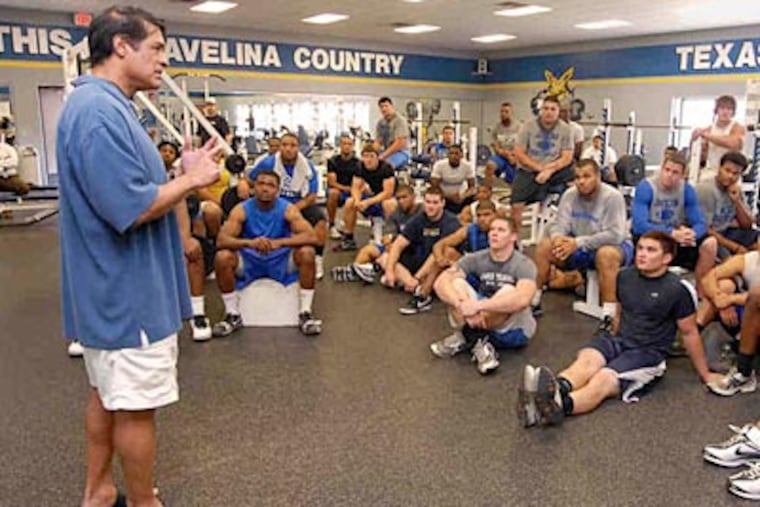
SOUTH TEXAS - The hands that washed the toilets now are manicured and jeweled.
The feet that bled on cinders now nestle in handmade Oxfords.
Juan Castillo, first-generation Mexican-American, stands before almost 1,000 of his people, resplendent, accomplished, nearly regal.
Any defensive coordinator in Texas, where football is religion, ranks as aristocracy. Any NFL defensive coordinator is nigh unto royalty.
Even a new coordinator, one step removed from 2 decades of coaching the offensive line.
Even one from Philadelphia.
Juan Castillo lives in Philadelphia. Juan Castillo is of here.
His character is part Kingsville, the ranch town where he played; and part Port Isabel, the fishing village where he grew; and all work with little chance at reward.
Incessantly, Castillo worked. Grandly, he was rewarded.
On a sultry March night, in front of hundreds in an auditorium at Texas A & M-Kingsville, formerly Texas A & I, Castillo wears his trophies tonight.
His NFC championship ring. A $6,000 watch, the cheapest of three timepieces his offensive linemen have presented him after their Pro Bowl appearances. A $1,500 suit, tailored to his trim, 51-year-old frame, another lineman's gift after Castillo coached him to a monstrous contract.
His wife, a statuesque local beauty named Zaida, sits in the first row with the youngest of their four sons and her parents, Butch and Norma Garcia. Castillo's family, and his audience, hang on every word.
Philadelphia was shocked, mystified, why Andy Reid would move Castillo from the offensive line to run the defense. Castillo was weaned on defense, but that was not explanation enough, and Castillo knows he will face more scrutiny than perhaps anyone in the league this season. He painted his eager, happy face on it in February, but now, in March, with his people, he admits his fear.
"This is probably the toughest thing I've ever had to face in my life," he tells the audience, silent, rapt. "But every time I come home I get motivated. It's not about Juan Castillo. It's about South Texas. The Valley. All my race."
Stopping traffic
for a Chicano
Castillo returned to Kingsville last month as a featured speaker in the school's lecture series. Over 2 days he spoke to 700 grade-school students, a few dozen Boy Scouts, the assembled A & M-Kingsville coaches - all sports - the football team, and, finally, the public.
He revels in his roots.
His mother, Juanita, snuck over from Mexico in the trunk of a car when she was 14 with her little sister, and joined her mother, whom she had not seen in almost a decade. Juanita died of a stroke in 1997.
"It was just my second year with the Eagles. The bad thing was, I never had the money to help," Castillo says. "If I could've just taken her shopping once. Just one $1,000 splurge."
His father, Gregorio, was 15. He walked across the Rio Grande and joined his older brother.
"You know how they talk about wetbacks? My dad was, but he told me they didn't have to swim," Castillo says. "They walked across the river."
Gregorio fell overboard during a shrimping trip. Juan was 12, Sofia, 10, Janie, 6.
Juanita never again turned on the television.
"It is how she mourned," Castillo says. They watched at relatives' homes.
For years Castillo could not believe he made it out of Port Isabel, much less to the NFL. He joined the Eagles in 1996 as a quality-control coach, then coached tight ends, then the line.
For the first few years, when the Eagles made their annual trip to Texas Stadium, Solomon's Temple for Cowboys faithful, Castillo spent hours wandering through the building, conscious of how unusual it was for a Latino to be walking on holy ground without a broom in his hand.
"A mejicano from Port Isabel?" Castillo asks. "In Texas Stadium? You kidding me?"
This, of course, after Castillo rode to the stadium perched on the front seat of the last team bus as it rolled into the stadium.
"I like the police escorts. I think that's pretty cool," Castillo says. "They're stopping traffic for a Chicano, man. Can you believe that?"
Believe it.
Faster barefoot
Castillo and Port Isabel lost in the regionals his senior year of high school, a game played in Alice, about 160 miles north of home. In shock, Castillo simply walked off the field. Through the parking lot. Past the team bus, right on down the road, in full gear. Helmet, shoulder pads, cleats, the works, clack, clack, clack
.
"What am I going to do?" he thought. "It's over."
After an unremarkable junior season Castillo had vowed to make all-state, and he did, but no one recruited him. His coach let him walk for about a mile, then made him get on the bus.
The next year Castillo found a perch at Monterrey Tech in Mexico. He couldn't run with the school's legions of rich kids and the competition level was, in his estimation, laughable. Miserable, he quit after one season. He walked on at A & I that spring.
"He got here, he couldn't hardly speak a lick of English," says "Dirty" Dan Sutton, part of the Kingsville linebacker corps that called themselves the "Border Bandits."
Barely multilingual, barely good enough, Castillo began as the sixth-string linebacker. He was sixth-string for just a few months, before injuries to his teammates and his maniacal devotion earned him a backup spot and a scholarship.
Castillo did his quarter-mile training runs in bare feet, on a cinder track. Blood seeped from his soles as he bent over and caught his breath.
"He thought he ran faster barefoot," says Sutton, now a plant operator an hour northeast, in Corpus Christi. "He was nuts."
Castillo, burdened with 4.8-second speed in the 40-yard dash, stayed back at the dorm when his more talented teammates, who routinely ran the dash in 4.5 seconds, went to dinner. Once they were gone, Castillo snuck back to the track for extra sprints.
"I was still running 4.8 in the fourth quarter," Castillo says. "They weren't running 4.5's in the fourth."
He enrolled in ballet classes to improve his flexibility and endured waves of ridicule that linger today.
"Uh, yeah," snorts Stuart Isdale, an offensive lineman at Kingsville through 1979 and now a career adviser at the school. "I sure didn't take no ballet classes."
Castillo did, and he started his last two seasons, ahead of vastly more talented defenders.
Still, there was no NFL for Castillo. Starting at a Division II school, even a national title team, one that routinely produced NFL talent (Hall of Famers Darrell Green and Gene Upshaw), is nothing like playing in the NFL. Castillo spent two seasons scrapping for time in the USFL.
"I didn't play in the NFL. That broke my heart," Castillo admits to the current Kingsville players as he lectures them in their weight room. "At least I can say, 'I worked my ass off. I just wasn't good enough.' And that's hard to say."
Castillo hopes his love for work is hereditary. He takes precautions just in case it is not.
'I train 'em like dogs'
Upon landing in the Bahamas on a family vacation 3 years ago, Castillo herded his family into a waiting limousine. He asked the driver to take them straight to the nearest high school track.
Before they checked into their hotel, Castillo put Gregory, his oldest son and then a high school junior, through the first of daily hour-long workouts.
Castillo might be a little scared about this coordinator's job, but clearly his greatest fear is that his sons will feel entitled. He buys each of his boys a car when they get their licenses, but he expects them to study and to work out.
"The hard thing is training your kids," Castillo says. "I give 'em everything. But how am I going to teach them to understand the meaning of hard work?
"So I train 'em like dogs."
Can this training replace real work?
As a young boy, in summertime Castillo joined his mother and aunt in the workers' line outside the fish house at 2 a.m. Work began at dawn, when the first shrimpers came in. Until dusk, little Juan would pop the heads off shrimp two at a time.
"You get used to the smell," Castillo says. No, you don't.
On the weekends during the school year, Castillo joined his mother and walked across a bridge to South Padre Island, a popular spring-break beach. She was a maid, charged with cleaning rooms often left disgusting, if not destroyed, by partying college kids. Often shorthanded, his mother would let him work alone.
Juan Castillo was 8 years old.
"I can make up a room. Spring break, that [stuff] would get nasty," Castillo says with a grimace. "I try not to let my wife know; I can clean a toilet, bro."
The four Castillo boys might never clean toilets. They will, at least, know that rewards demand a price. Exacting that price from privileged suburban youth can breed resentment.
Playing at Iowa, where football is a business, Greg now realizes, says Castillo, " 'They're doing the same things with him that Dad did when I was small. Dad did the right thing for me.' "
Now, Castillo and his eldest boy speak daily. They discuss defensive strategy.
John, a runner at Villanova, has yet to come around.
"I still call him, text him every day," Castillo said. "Tell him that I love him."
He does not always get a reply.
When Castillo finished his first day of speaking engagements in Kingsville, he took the Nintendo DS from the hands of his youngest son, Antonio, and told him to put on his sneakers.
Then Castillo watched as his son ran the stadium steps at Javelina Stadium. Ten times.
Antonio Castillo is 8 years old.
'It was embarrassing'
Already, Castillo has begun re-learning defense.
He visited Leslie Frazier in Minnesota in February. He spent a day with Ron Rivera at the NFL scouting combine in Indianapolis. In Indy, Castillo often directed the drills the prospects ran.
The owners have locked out the NFL players, so it might be the only chance Castillo gets to actually coach defense for a while.
Of course, Castillo planned to use this offseason as a testing ground for his defenses. He already has installed his packages against two-back formations and against three-receiver sets.
He hoped, by now, to see them in practice at the team's minicamps.
But with no players on the grounds, all Castillo can do is watch tape in his office and practice the calls he will make. Over. And over. Sometimes, 20 hours a day.
It is what he was doing yesterday morning at 9 o'clock, and had been doing so for 5 hours.
"I'm taking myself through the mental gymnastics," Castillo said. "You just simulate."
Don't scoff. Jon Gruden never called a game until he became the Eagles' offensive coordinator. Gruden built three playoff offenses for three different teams in his first 8 years as a coordinator.
"All great coaches, all great coordinators," Castillo said, "they all had to call their first game."
Really, there isn't much about defensive theory that Castillo does not know. Almost daily, Castillo jousted with Jim Johnson, the blitz master who made Eagles defenses fearsome things from 1999 until he died in the summer of 2009. Castillo would have replaced Johnson then, instead of young Sean McDermott, but Reid could not find an offensive-line replacement for Castillo.
Howard Mudd, one of Castillo's offensive-line mentors, came out of retirement, which enabled Reid to finally move Castillo to defense, where Castillo had begged for years to return.
It was a long road back just to cross the line of scrimmage.
Travelin' man
Castillo stayed in Kingsville for 13 years after his playing days ended. First he coached linebackers at A & I, and that is when his odysseys began.
In the offseason, Castillo traveled to Florida State, Louisiana State and Florida to be tutored in defensive technique and philosophy: What school of footwork should defensive backs use? How should linebackers attack gaps?
Castillo moved to defensive line in 1985, dramatically, fanatically. The day he got the job, he took stock of his roughneck linemen and decided he needed to show them what tough really was.
He took them into the weight room and challenged them to a boxing match. All of them.
The fifth one tackled him and sprained Castillo's ankle. That ended the sparring, and, soon thereafter, Castillo's first coaching job. Ron Harms, the Javelinas' head coach, called Castillo into the office and fired him.
A lousy student as a player, Castillo had earned his undergraduate and master's degrees as an assistant at A & I, and he was fortunate to have done so. Castillo got a job at Kingsville High as the defensive coordinator. He taught health class during the day.
In the summer, unpaid, Castillo borrowed head coach Pete Murray's Suburban and drove it all over Kingsville, picking up football players morning and night to lift weights at the school. Often he would score dinner at one of the kids' homes.
Harms' son played for Castillo and reported Castillo's devotion to his father. Impressed, in 1990 Harms contacted Castillo and asked him to return to his staff.
The problem: No defensive positions were available. The only job Harms had was offensive-line coach. Another problem: Castillo had an offer at Texas Tech to be a graduate assistant, but for virtually nothing.
The A & I job paid only $30,000. Castillo wanted back in as a college coach, and needed the money. His oldest son had been born. To make ends meet Castillo worked nights at H.E.B, a local grocery store, as a bag boy, sometimes bagging groceries for the same kids he taught during the day.
"It was embarrassing," Castillo says.
It was not as embarrassing as failing as an offensive-line coach at his alma mater. Anything, to not fail.
"It's who knows you"
Castillo contacted some of the best minds in the business: Tom Bresnahan with the Buffalo Bills, Bobb McKittrick with the San Francisco 49ers, Tony Wise with the Dallas Cowboys, Jim Hanifan with the Washington Redskins, Joe Moore with Notre Dame and Jerry Hanlon with Michigan.
He asked if he could learn from them, at their leisure, at his expense.
"People say, 'It's who you know.' Bull . . ." Castillo tells the Kingsville football team. "My first language is Spanish. I didn't know anybody. I never asked for anything; not gear, not a job, nothing. Besides, it's not about who you know. It's about who knows you."
Castillo made himself known by seeking knowledge himself.
Harms gave his coaches spring-break week off. Castillo begged for the week before, too, and got it.
Then, every year, Castillo went to a local banker and asked for a small loan to supplement the traveling stipend Kingsville allowed. After the fourth year the banker, Armando Martinez, went to Castillo's father-in-law.
"Butcho," Martinez asked, "is your son-in-law into something shady? Every year he comes to me, at the same time, and borrows money. Is it drugs?"
It was not, but Zaida hardly could have been less pleased. Was handsome Juan really being tutored?
"Why do you have to go? Why?" she asked.
Castillo could not explain. Certainly, he was in no position to do much besides learn. He would land in Indianapolis, rent a car and use it as transportation and bedroom.
He would drive to Michigan, to Buffalo, to Washington, to South Bend, Ind. At Notre Dame he would sleep in the parking lot outside of the student center, then shower in the center come morning. At the other spots he would find a Holiday Inn and shower at the pool, or pay $5 and get a workout and shower at a Gold's Gym. He ate for $10 a day at McDonald's.
He always was prompt, always was respectful, always was thankful, always was knowledgeable.
"And they all thought I was their protege," Castillo says. Or so he thought.
He took a little from each and hybridized their teachings into his style. Sometimes, Castillo used a different technique for each player; whatever fit, he used.
Finally, as Castillo prepared Earl Dotson, Jermane Mayberry, Jorge Diaz and Kevin Dogins for NFL careers, mainly by honing their pass-protection skills at a running school, Castillo's mentors took notice. Castillo recalled how Moore, reviewing film of Castillo's line during one of his visits, stopped the tape and called Wise.
"We've got to get Juan a job in Division I," Moore told Wise. "He's too good for Division II."
By then Castillo had interned under Mudd in Seattle. Suddenly, doors began to crack open.
Marty Schottenheimer needed a defensive-line coach for his Kansas City Chiefs. Mudd recommended Castillo. Castillo was a candidate for the offensive-line coach job at Wisconsin in 1994 - a position that came available when Bill Callahan joined the Eagles' staff and Brad Childress became the Badgers' offensive coordinator.
Finally, Castillo's godfathers conspired to land him a job as an offensive assistant with the Eagles in 1995. McKittrick vouched for him to Ray Rhodes, then the Eagles' coach. So did Hanifan, to defensive coordinator Emmitt Thomas. Mudd made a call.
Castillo was in the NFL.
Crying in football
Somehow, he stuck. He and Zaida, a teacher, made about $60,000 in Kingsville, and that's about what the Castillos lived on his first year with the Eagles, since she stopped working. Of course, it's about three times costlier to live in New Jersey than in South Texas.
Castillo got a small raise the next year, then became tight-ends coach the following year. He took over the offensive line from Callahan in 1998 when Callahan left with Jon Gruden for the Raiders.
Rhodes was fired after that season. Famously, Castillo drove overnight to Green Bay, his rebuilt left leg, broken in a freak accident at Veterans Stadium, aching every mile. Castillo actually hoped to latch on with Mike Holmgren, the Packers' head coach who was quitting Green Bay and heading for Seattle.
Instead, Castillo wound up in front of Reid, pitching himself to remain with the Birds. Reid said no. A few phone calls later - one from Mudd, of course - and Reid reconsidered.
Castillo since has coached Mayberry, Tra Thomas, Jon Runyan, Shawn Andrews and Jason Peters to Pro Bowl berths. Castillo made the most maligned unit in Eagles history into a strength.
Eventually.
The Colts destroyed the Eagles' protection when Mudd and the Colts visited in 1999. After the game, Castillo, humiliated in front of his mentor, walked to the middle of the field toward Mudd.
Tears streamed down Castillo's face.
"I'm sorry, coach," Castillo told Mudd as the pair embraced. "I let you down."
'I don't want to come back'
Kingsville might be a fine place to live, but it is, most assuredly, a good place to leave.
It is the spawn of King Ranch, where they claim to have created the first U.S. breed of beef cattle, crossing an Indian Brahma bull with a British Shorthorn to create the Santa Gertrudis, but King Ranch makes most of its money these days growing cotton in Texas and Minute Maid's oranges in Florida.
The old oil refinery, the Naval Air Station and the university all have been shrinking. Kingsville's population in the 2010 census was 24,054.
It is just hours before Castillo's last, big presentation. He sits on a couch in a silk shirt, shorts and flip-flops. He has to go to his in-laws' house to change into his finery for the finale.
"I love it here," Castillo says. "But I don't want to come back."
He wants Antonio to know Uncle Shon, 78, and Aunt Pablita, 72, who still live in Port Isabel. They connect the Castillos to their past. Uncle Shon is Gregario's younger brother; Aunt Pablita is Juanita's younger sister.
He wants his children to be as proud as he is of his sister, Janie, now 45. She is a doctor. Occasionally, Castillo calls her and lists symptoms. They are fake symptoms.
"I just like to hear her diagnose me," he says.
He likes to see the Juan Castillo corner of the Port Isabel Historical Museum. July 4, 2009, was Juan Castillo Day in the town, and he received the key to the city.
Before Castillo spoke at the podium last month, Stuart Isdale introduced him as "the personification of the American dream."
Castillo entertained questions from the crowd after he spoke. A middle-aged man with a light Spanish accent finished the session with this:
"You are one of us. You're from Port Isabel. The Valley. We are so proud of you."
The man sat down.
In his perfect suit, wearing his fancy watch, standing in shiny shoes, Juan Castillo could be naked and never be richer. *