NFL owners approve pact, await players' vote
ATLANTA - NFL owners overwhelmingly endorsed a new labor deal Thursday night that could end their lockout and bring America's most popular sport roaring back to life within days.
ATLANTA - NFL owners overwhelmingly endorsed a new labor deal Thursday night that could end their lockout and bring America's most popular sport roaring back to life within days.
But uncertainty still reigned late Thursday after players refused to vote on the plan, citing questions about some of the details. That left the league only part way to ending the lockout that began March 12.
Owners hailed the plan, approved in a 31-0 vote with one abstention, as one that would help both sides and bring football back without any games missed. They released a time line that raised the prospect of players reporting to facilities across the league on Saturday, with trades, free agency, and training camps beginning as soon as Wednesday.
"I think we've crafted a long-term agreement that can be good for the game of football," NFL commissioner Roger Goodell said after the vote in Atlanta. "We really are anxious to get back to football."
That goal, though, hinges on players approving the deal, too, and it appeared that the long-running labor strife was not quite over.
"There is no agreement between the NFL and the players at this time," NFL Players Association executive director DeMaurice Smith wrote in an e-mail to 32 player representatives after the owners' vote. Players cited concerns that they had not seen all of the details in the owners' final proposal, a 10-year plan with no opt-out clause.
Players held a conference call but did not vote Thursday, though there was hope that they could do so Friday.
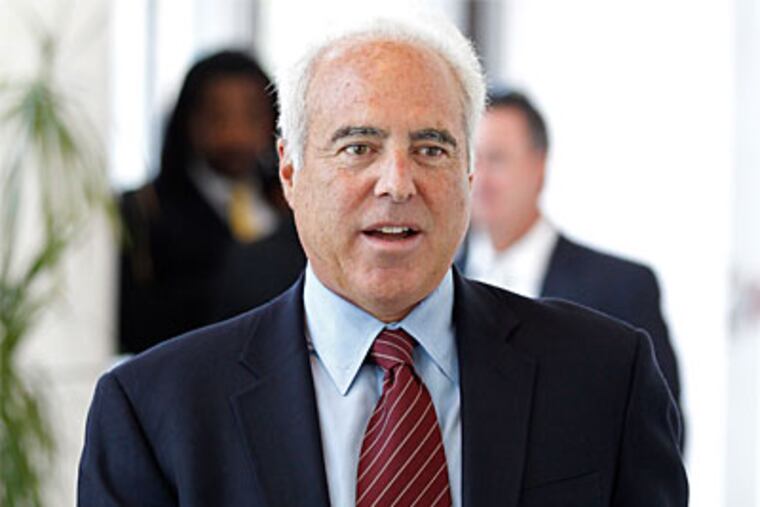
Eagles owner Jeffrey Lurie and president Joe Banner each praised the proposal, saying it would provide certainty for years to come.
"In sports you just don't see 10-year collective bargaining agreements, and it's so important with the NFL thus far at its peak of popularity to be able to say you're now stabilizing the sport," Lurie said. "It gives you all the opportunity in the world to do what's best for the sport, the fans, and what we're all in it for."
He said the team would be able to hold training camp at Lehigh, its traditional site. Initial plans call for opening camp July 27, 28 or 29.
One of the Eagles' first moves, when allowed, will almost certainly be dealing backup quarterback Kevin Kolb.
"We do know there's a lot of interest. So, we'll see if the interest is what we think it is," Lurie said of Kolb. "It's not our intention to delay; we want to be decisive and move forward and see what's best for the Eagles."
Only the Oakland Raiders abstained from supporting the deal, but Eagles officials joined other league leaders in praising it.
"We've completed a deal that we believe both sides will affirm is something that works well enough to get back to playing football without missing any games," said Banner. He said it "provides an opportunity to grow and enhance the game. That's a positive outcome."
Under the owners' initial timetable, teams could sign their own free agents on Saturday and extend offers to undrafted rookie free agents. Free agency would open at noon Wednesday, when teams would also be permitted to make trades.
Players could begin reporting to facilities Saturday for voluntary conditioning, training, and classroom instruction, and training camp rosters would increase to 90, up from 80. Those dates may change without a player vote Thursday.
"Hopefully, we can all work quickly, expeditiously, to get this agreement done," Goodell said.
Goodell announced that the Hall of Fame Game in Canton, Ohio, scheduled to be played Aug. 7, was canceled.
The Eagles' first preseason game is set for Aug. 11 and should be unaffected if a deal is finalized soon.
The potential deal includes some victories for both sides.
NFL owners would get a larger share of league revenue, their main goal when they opted out of the last collective bargaining agreement, but not as much as they originally sought. The players' take will drop to around 46 to 48 percent of league revenue, down from roughly 50 percent.
Growth of the salary cap, which determines total player pay, will slow, though some teams will be forced to spend significantly more to meet an elevated salary floor.
Top draft picks will take one of the biggest hits. Compensation for top 10 picks will be drastically reduced. Quarterback Cam Newton, the top pick in April's draft, could make roughly half of what last year's number one selection got.
In another significant win for owners, oversight of the CBA will shift away from federal courts, which the league felt sided consistently with players.
Players won increases in minimum pay, improved injury protection, and up to $1 billion in added benefits for retirees. They also got concessions that will reduce the number of offseason practices and the amount of hitting allowed at training camps.
The regular-season schedule will remain at 16 games until at least 2013.
"It was a negotiation. I don't mean to sound negative," said Cowboys owner Jerry Jones, "but it isn't exactly like Christmas has come along here."
Despite optimism from some quarters, the deal also wasn't exactly done.
The NFL's New Deal
If approved by the players, the NFL's new deal would cover the 2011-20 seasons and the 2021 draft. It would include the following key terms as released by the NFL:
Economics
Salary cap plus benefits of $142.4 million per club in 2011 ($120.375 million for salary and bonus) and at least that amount in 2012 and 2013.
Beginning in 2012, salary cap to be set based on a combined share of "all revenue," a new model differentiated by revenue source with no expense reductions. Players will receive 55 percent of national media revenue, 45 percent of NFL Ventures revenue, and 40 percent of local club revenue.
Also beginning in 2012, annual "true up" to reflect revenue increases or decreases against projections.
Clubs receive credit for actual stadium investment and up to 1.5 percent of revenue each year.
Player share must average at least 47 percent for the 10-year term of the agreement.
League-wide commitment to cash spending of 99 percent of the cap in 2011 and 2012.
For the 2013-16 seasons, and again for the 2017-2020 seasons, the clubs collectively will commit to cash spending of at least 95 percent of the cap.
Each club will be committed to cash spending of 89 percent of the cap from 2013 to 2016 and 2017 to 2020.
Increases to minimum salaries of 10 percent in Year 1 with continuing increases each year of the agreement.
Player and health safety
Reducing the offseason program by five weeks, reducing organized team activities from 14 to 10.
Limiting on-field practice time and contact.
Limiting full-contact practices in the preseason and regular season.
Increasing number of days off for players.
Opportunity for current players to remain in the player medical plan for life.
An enhanced injury protection benefit of up to
$1 million of a player's salary for the contract year after his injury and up to $500,000 in the second year after his injury.
No change to the 16-game regular-season/four-game preseason format until at least 2013; any subsequent increase in the number of regular-season games must be made by agreement with the NFL Players Association.
$50 million per year joint fund for medical research, health-care programs, and NFL Charities, including NFLPA-related charities.
Retired-player benefits
Over the next 10 years, there will be additional funding for retiree benefits of between $900 million and $1 billion. The largest single amount, $620 million, will be used for a new "Legacy Fund," which will be devoted to increasing pensions for pre-1993 retirees.
Other improvements will be made to post-career medical options, the disability plan, the 88 Plan, career transition and degree completion programs, and the Player Care Plan.
Draft and free agency system
An annual draft of seven rounds, plus compensatory picks for teams that lose free agents.
Unrestricted free agency for players after four accrued seasons; restricted free agency for players with three accrued seasons.
Free agency exceptions for franchise and transition players.
Entry-level compensation system
All drafted players sign four-year contracts.
Undrafted free agents sign three-year contracts.
Maximum total compensation per draft class.
Limited contract terms.
Strong antiholdout rules.
Clubs have option to extend the contract of a first-round draftee for a fifth year, based on agreed-upon tender amounts.
Creation of a new fund to redistribute, beginning in 2012, savings from new rookie pay system to current and retired player benefits and a veteran-player performance pool.
2011-12 transition rules
Special transition rules to protect veteran players in 2011. All teams will have approximately $3.5 million in what would otherwise be performance-based pay available to fund veteran player salaries.
Each club may "borrow" up to $3 million in cap room from a future year, which may be used to support veteran player costs.
In 2012, each club may "borrow" up to $1.5 million in cap room from a future year. Both these amounts would be repaid in future years.
Other
No judicial oversight of the agreement. Neutral arbitrators jointly appointed by the NFL and NFLPA will resolve disputes as appropriate.
Settlement of all pending litigation.