Phil Sheridan: Scrutiny on the Saints' bounty
CLEARWATER, Fla. - Roger Goodell's NFL spent three years investigating allegations the New Orleans Saints gave players bonuses for injuring opponents.
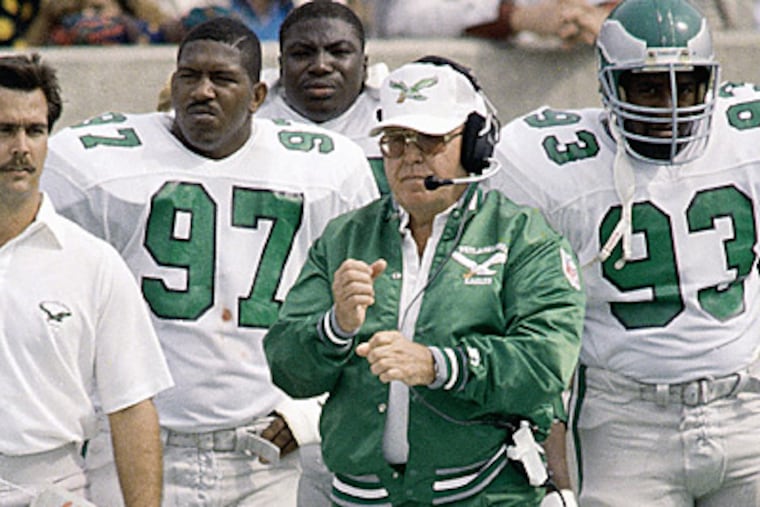
CLEARWATER, Fla. - Roger Goodell's NFL spent three years investigating allegations the New Orleans Saints gave players bonuses for injuring opponents.
Paul Tagliabue's NFL spent 17 days exonerating Buddy Ryan for the same thing.
Times have changed. Maybe even football coaches will be smart enough to understand that after Goodell levies the expected heavy punishment on the Saints, head coach Sean Payton, former defensive coordinator Gregg Williams, and whoever else deserves it.
Of course, maybe times would have changed a little faster if Tagliabue's office hadn't rushed to whitewash Ryan's behavior after the so-called "Bounty Bowl" back in 1989. It was funny, all these years later, to hear ESPN Radio host (and then-Eagle) Mike Golic acknowledge Ryan's bounty program with a chuckle. Funny in a sad way.
The Bounty Bowl will get revisited as the Saints scandal plays out, but my mind drifted instead to another of the Ryan-era games. In November of 1990, a year after the Bounty Bowl game, the Eagles played Washington in a Monday night game at the Vet. As the story went, one Washington player lying on the turf waiting for the medics to get there heard an Eagle taunting him: "You guys need any more body bags?"
The Eagles injured eight Washington players that night, including both quarterbacks. Rookie running back Brian Mitchell wound up finishing the game at QB. From then on, that was known as the Body Bag Game.
Talk of body bags isn't so hilarious when you remember Eagles safety Andre Waters, who later shot himself in the head. Researchers examining the connection between concussions and later dementia and depression found evidence of severe chronic traumatic encephalopathy in Waters' brain. They also found it in the brain of former Chicago Bears safety Dave Duerson. Duerson shot himself, too, only he aimed at his chest so that his brain could be studied.
Connect the dots:
Williams worked for Ryan. The guy who just hired him, Jeff Fisher, played and coached under Ryan. Waters and Duerson, two men whose brains were destroyed by football, played for Ryan.
The point is not that bounties killed Waters and Duerson. It's not that simple. But the mind-set that glorifies and rewards brain-rattling collisions and broken opponents did contribute to their demises.
When Duerson was a rookie, Bears head coach Mike Ditka ordered him to take a run at Detroit Lions kicker Eddie Murray. Duerson did as he was told, and Murray left the game with a separated shoulder.
"Dirty" Waters, a nickname Andre relished, was an undrafted free agent from Cheyney State who was barely clinging to a roster spot when the Eagles hired Ryan in 1986. Waters thrived under Ryan because he treated himself as a human missile. He'd launch at the other guy, but he'd get blown up, too.
In August of 1989, three months before the Bounty Bowl, Phoenix Cardinals special teamer Ron Wolfley told reporters the Eagles had placed a $200 bounty on him. He learned this, he said, directly from Reggie White at the Pro Bowl that year. Tagliabue's crack investigators evidently didn't have access to newspapers.
After Dallas kicker Luis Zendejas accused the Eagles of having a bounty on him in that Thanksgiving Day game - an allegation supported by the fact that rookie linebacker Jessie Small sprinted directly toward Zendejas and launched himself at the little kicker - Tagliabue sent his director of security to interview Ryan and special teams coach Al Roberts. Zendejas claimed Roberts had warned him about the $200 bounty (the same amount Wolfley cited).
On Dec. 8, two days before the Cowboys and Eagles played again at the Vet, Tagliabue announced there was no evidence that the Eagles had bounties on players.
"There were bounties in that game," Golic said on ESPN Monday.
Golic stressed that the Eagles defensive players received bonuses for "big plays" such as interceptions, fumble recoveries and big hits. But he acknowledged there was extra money if the opposing player had to be helped off the field. The bonuses were less about the money, he said, then being acknowledged in front of teammates during film review on Monday mornings.
Some of those very players are now among those suing the NFL for damage done by concussions during their careers. That makes it all the more galling that players would seek to injure each other at a time when the league is taking long overdue action to protect them and make head shots a thing of the past.
Goodell has had mixed success policing the split-second, high-speed decisions players make on the field. Here, he has an opportunity to punish premeditated, ongoing activity that continued even after the Saints were warned. Suspensions, fines, and the forfeiture of draft picks will send a strong message to coaches all around the league.
Times have changed. It's time to change.