From the Eagles, the anatomy of an interception
There was the interception that Michael Vick threw across his body and the off-balance, sidearm pass that deflected off Jeremy Maclin's hands. There was the one when Vick tried to locate the ball between two defenders and the one when he couldn't circumvent a crowd of three defenders. And that doesn't even include the interceptions Vick nearly threw.
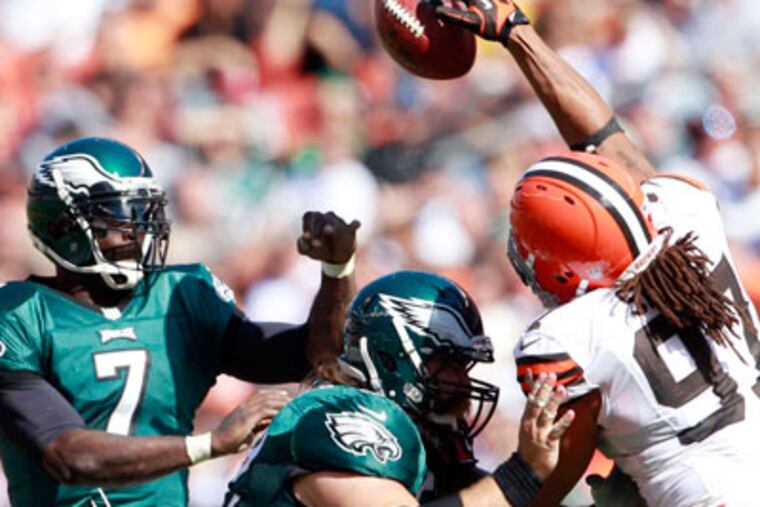
There was the interception that Michael Vick threw across his body and the off-balance, sidearm pass that deflected off Jeremy Maclin's hands. There was the one when Vick tried to locate the ball between two defenders and the one when he couldn't circumvent a crowd of three defenders. And that doesn't even include the interceptions Vick nearly threw.
Vick's four passes that finished in the hands of Cleveland Browns defenders last Sunday were rivaled only by the four swiped by Eagles defenders against Browns quarterback Brandon Weeden. The narrative after the game included condemnation of Vick and praise for the Eagles defenders, raising the question of whether an interception is the by-product of an offense's error or a defense's domination.
"I think it probably depends on the media and how you all take it," Eagles defensive coordinator Juan Castillo joked.
The question is relevant leading up to Sunday's game against the Baltimore Ravens. Vick shoulders the responsibility for the interceptions he threw, because that's what quarterbacks tend to do.
Yet whether it was a way to spin Vick's performance and defend the beleaguered quarterback, or simply good-faith intentions to inform outsiders, the stance out of the NovaCare Complex has been that interceptions require collective responsibility - from the play call to the protection to the route to the pass. And sometimes a defender simply makes an extraordinary play, players will remind you. Cornerbacks tend to like that reason.
Throughout the week, multiple characters around the Eagles revealed exactly what goes into an interception, a play that often dazzles but includes more than what you can see on the television screen. The answer varies, depending on whether you're talking to someone walking out of an offensive meeting room or walking into a defensive meeting room.
Offense
Even in Eagles coach Andy Reid's defense of Vick last week, when he listed the "combination of things" that go into an interception, he admitted, "It comes back to decision-making." That's fundamental to any discussion of interceptions, because the quarterback is the one who throws the ball. And an analysis of Vick's picks starts with the decisions he made.
"One thing you can't do in this league is you can't force throws and you can't try to stick a ball in a tight spot when a guy is not really open and try to make something happen at that given time," Vick said. "You just have to work your way down the field and take what the defense gives you. Play keep-away and keep it simple."
Offensive coordinator Marty Mornhinweg noted how important it was for Vick to go through his progressions - almost like a mental checklist of his targets on each play. Vick's interceptions were not the by-product of poor passes as much as poor decisions.
Approach reserve quarterback Trent Edwards about interceptions, and he reluctantly agrees to speak. "I don't like talking about them too much," joked Edwards, who has thrown 30 in his career.
"It starts with the quarterback, obviously, knowing where everybody is, where the defense is," Edwards said. "And your protection. A lot of times, it can be a misread, poor mechanics on the quarterback, forcing the ball into tight windows. The other thing, it could be the receiver's fault. He can be running a man route when it's zone, and vice versa. Could be a tip pass in the air. And the defense could make a good play."
So even though an interception appears on the quarterback's statistics, it is often representative of the entire offense. Tight end Clay Harbor explained that if a pass catcher cuts his route at 10 yards and he was supposed to run 15 yards, the miscue disrupts the entire play. Vick would expect another second on the route, but instead the defense uses that second to collapse on the target.
Harbor also said Vick sometimes needs to make a pass without even seeing the receiver, trusting instead the timing pattern. So if the route is not precise or the receiver was bumped at the line, the whole play could break down. In Sunday's game, Harbor said, a trend was timing issues between the quarterback and the pass catcher and Vick's needing to react in a hurry.
"That's why it's so important to have that timing down in practice, and you have the feel of where he'll be in every situation," Harbor said. "It's a lot more than the guy's open and you're sitting back there in 7-on-7 throwing interceptions."
Defense
The tune is different from defensive players. Kurt Coleman, who had two interceptions last week, said a pick forced by the defense starts with the pass rush. If the quarterback is pressured, he has what Coleman called "happy feet," and the quarterback is forced to throw the ball quickly off his back foot.
When this happens, the ball rises and is easier to intercept. The quarterback could also be forced to scramble to a particular side, thus reducing the amount of space on the field to which he could effectively throw.
The other key for interceptions is disguising coverages. The quarterback diagnoses the defense before the snap and can identify the most likely target even before the route begins. If he cannot read the coverage, he is forced to guess.
"If you disguise it well," Coleman said, "he doesn't know what you're in, and he has to diagnose while the pressure is in his face, which leads to a bad-thrown ball."
Then, Coleman said, the defender must find the ball at its highest point and understand the receiver's route concept. Cornerback Curtis Marsh noted that the quarterback is never throwing the ball to a defensive player, so the catch is often difficult to make, and the defensive players must remain alert. This is also why time is invested in practice on passes that are difficult to catch, whether they shoot out of a machine or come out of tip drills.
The Eagles' man-to-man coverage must "really be blanket coverage" for an interception to occur, Marsh said. But the likelihood of an interception increases if the cornerback can keep the quarterback in sight. One way this happens, Marsh said, is with "bail techniques" - when the cornerback turns his body toward the field instead of backpedaling.
"You can kind of anticipate what he's doing," Marsh said.
Marsh said the offense is more prone to creating interceptions than the defense is in forcing them. A quarterback's throwing across his body often leads to an interception. A high pass allows the cornerback to identify it and find it.
That was what happened on one of Rodgers-Cromartie's interceptions, when he ran stride-for-stride with Cleveland wide receiver Travis Benjamin and outleaped him. That pick drew universal praise in the locker room. Even though the ball had air under it, Edwards said it was a good pass and Rodgers-Cromartie deserves the credit. The cornerback said the play was the result of a week of studying and a body blessed with rare athleticism.
"When you're watching [Weeden] on film, he doesn't really throw the back-shoulder fade," Rodgers-Cromartie said, "so the main thing is turn your head and just go get it."
Offense or defense
It is part of a quarterback's unwritten job description to publicly take responsibility for interceptions. If objectively assessed, Edwards said, the quarterback is often, but not always, to blame.
"I think it's definitely over 50 percent," Edwards said, "but I don't think it's 75."
Coleman said the defense - not the offense - is responsible for interceptions, because quarterbacks who remain in the pocket could obliterate a defense if the defenders do not make him uncomfortable.
Wide receiver Jason Avant said both could be responsible, depending upon the situations and the personnel on the field. Nnamdi Asomugha, who has 14 career interceptions, said the only time the cause of an interception can be undoubtedly ascertained is when a ball is tipped. Coleman, for example, caught a pass that deflected off two players, while another ball was overthrown.
"Depending on the play, you won't know who made the mistake," Asomugha said. "It could have been the offense, the receiver, the quarterback. And if the defense made the play, maybe they just read it."
The question now for the Eagles is how to rectify the interceptions on offense and continue recording them on defense. Vick said decision-making could be drilled into his head during the week of practices, but the truth is revealed only on Sundays. And for all the discussion about interceptions, the answer often comes back to a player doing something agonizing or astonishing on the field.
"When the bullets are flying, that's when you have to be at your best," Vick said. "Over the course of my career, I've done a good job at that. It's just getting back to that. And I will."