Dawkins: Future Hall of Famer
SOME MEN ARE meant to lead. They are meant to nurture, to take the first steps so others may follow.
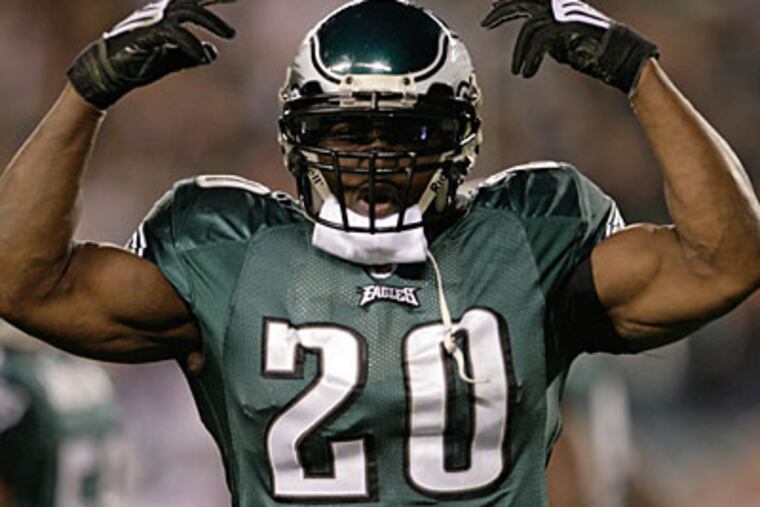
SOME MEN ARE meant to lead. They are meant to nurture, to take the first steps so others may follow.
Brian Dawkins always was such a man.
When the Eagles retire his No. 20 jersey Sunday night they will honor 13 seasons of class and character, of a well of talent and integrity exploited to its final drop.
Seldom do athletes merit this sort of honor. Consider some of the group that Dawkins joins.
There is No. 15, running back Steve Van Buren; a champion, a finisher, perhaps the greatest of all Eagles; a man whose death in August reminded us of the quality of his play and the depth of his character.
There is No. 60, linebacker/center Chuck Bednarik, the last of the two-way players, who, even today, commands every room he enters.
There is No. 92, Reggie White, the greatest defensive end who ever played, a man so possessed of generosity and goodwill that his heart burst at age 43.
And now, Dawkins. Probably, the least of the talents; possibly, the best of the men.
Dawkins, a second-round pick in 1996, learned how to lead in the NFL from Troy Vincent, who was the perfect teacher for the moment.
A Trenton native with a remarkable intellect, Vincent played Big Ten football for Wisconsin, arrived, much ballyhooed, as a first-round pick in Miami, then came back to the cauldron that is Philadelphia.
So, when Dawk met Troy, Troy already was a man of the world, eager to have a protégé.
He and Dawkins starred first for head coach Ray Rhodes and defensive coordinator Emmitt Thomas, the latter a Hall of Fame cornerback. Both Rhodes and Thomas played defensive back in the NFL when the position usually cost a man a few teeth.
Vincent played that way, too.
Before he died, Jim Johnson, the crusty and brilliant defensive coordinator who succeeded Thomas, worshipped Dawkins. He let Dawkins blitz, disguised coverages around Dawkins, let Dawkins freelance. He turned Dawkins into the Eagles' most feared player.
Johnson was a compulsive truth-teller.
These are the men who molded Dawkins, and he became of them.
In turn, Dawkins found kindred souls in Quentin Mikell and Sheldon Brown. They continued the tradition of tough, clean play and straight, clean living after the Eagles let him go to spend his final three seasons in Denver.
Dawkins' neck and his knees finally gave way after last season, his third in Denver. Dawkins retired in April.
Now, Dawk will take care of his own.
Dawkins will finish raising his four children in Denver, along with his high school sweetheart, Connie.
Brian Jr. is a sophomore cornerback at Valor Christian High, where Dawkins coaches the defensive backs. Dawkins is dipping his toe in the broadcast waters as a TV analyst in Denver, an occasional analyst on ESPN, a regular voice on 97.5 The Fanatic in Philadelphia.
They are lucky to have him.
Like perhaps no other player in the NFL, Dawkins understands every offense from the past 30 years, understands every offensive player's strengths and weaknesses. He knows how to rattle Tom Brady, how to scare Eli Manning, how to baffle Aaron Rodgers.
He is willing to share the knowledge. He carries no baggage.
There were no embarrassments for Dawkins. So, there are no vendettas. There was no surly elitism, so he will mesh with the media as gracefully as he once entertained it, in the most poisonous of environments.
Dawkins lived through Allen Iverson's squabbles with teammates and coaches, and Iverson's graceless, fumbling apologies afterward . . . which always preceded another incident, and another.
Dawkins watched Donovan McNabb obfuscate through fiasco after fiasco: the NAACP, Rush Limbaugh, the Super Bowl drive, the Terrell Owens confrontation.
Dawkins saw Eric Lindros and Mike Richards scorn a press corps and a fan base willing to love them without condition. He witnessed Chase Utley and Pat Burrell ignore the people who hungered for heroes; they were too cool to hero up.
Not Dawkins.
He embraced who he is, and what was expected of him, and he delivered.
"I always feared doing something outlandish. Dumb," Dawkins said. "Something my wife and kids would have to listen to, about the dumb things Daddy did."
Most of the aforementioned Philadelphia stars earned reputations as nightlife legends. Not Dawkins.
He quit drinking in college to ensure that he never wound up on a police blotter for driving drunk or for fighting in a bar or for getting thrown out of a strip club.
In an era known for its Pacman Joneses and its Rae Carruths, Dawkins is a Roger Staubach. No doubt Dawkins would cringe at the Cowboy comparison, but, like Staubach, Dawkins stands for something more than pro football excellence; he stands for leadership in its most heroic sense.
In 5 years Dawkins should stand alongside Staubach in Canton, Ohio, wearing his own gold jacket.
Contact Marcus Hayes at hayesm@phillynews.com