Kelly-Roseman: The dynamics of a dynamic duo
Chip Kelly and Howie Roseman have had a utopian start to their relationship. They've agreed on every player, haven't butted heads on the direction of the Eagles, and uniformly see the big picture, according to Kelly. Roseman has been similarly enthusiastic about their working dynamic.
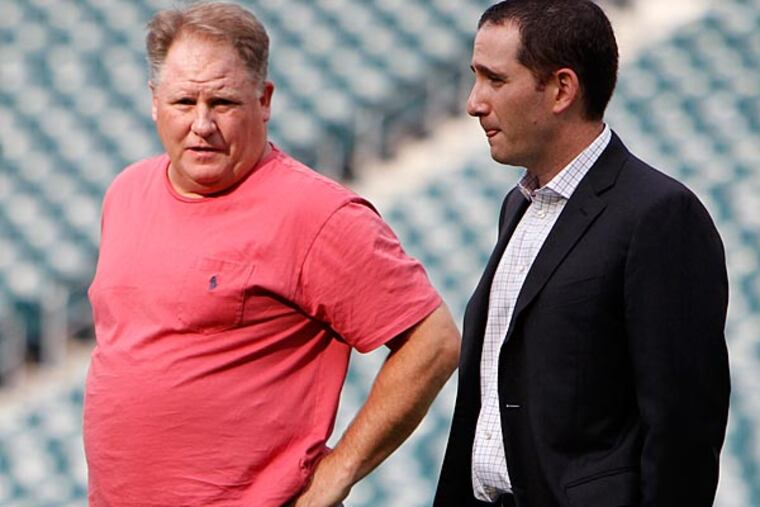
Chip Kelly and Howie Roseman have had a utopian start to their relationship.
They've agreed on every player, haven't butted heads on the direction of the Eagles, and uniformly see the big picture, according to Kelly. Roseman has been similarly enthusiastic about their working dynamic.
Considering the self-confidence NFL head coaches and general managers must have to reach such heights, it's remarkable the two have yet to have a disagreement. On the other hand, the Eagles of the Kelly-Roseman era have yet to play a game.
But since it was Kelly who offered up a picture of marital bliss, he was asked if he anticipated the two always being in agreement.
"No, it's utopia," Kelly joked two weeks ago. "It will always be on the same page."
For the relationship to last, Kelly and Roseman must be at least on the same chapter. The balance of power requires it.
According to Eagles owner Jeffrey Lurie, he gave Kelly final say over the 53-man roster to even the scales and "to empower them both," which would suggest that Roseman captained the draft and free agency.
Lurie has spent the last two years altering the power structure in the front office. From 2010 to 2011, coach Andy Reid had final say on football matters, but team president Joe Banner and Roseman had certain responsibilities.
Assigning blame or credit for decisions made during that span has been elusive, but Lurie felt compelled to take Banner out of the equation following the 2011 season and give Roseman a more prominent seat at the table. Banner, in turn, stepped down.
Reid remained in charge. When he was fired and Kelly hired in January, Lurie's transition to an organizational flow chart that had coach and GM share personnel responsibilities was complete.
It's a rare arrangement, especially since Roseman is in only his fourth year as GM and Kelly has never coached in the NFL. According to an NFL.com report in which 29 teams were polled, 24 GMs or other front-office executives have final say on personnel.
Roseman's influence has grown considerably, however, since he was promoted to GM following Tom Heckert's departure. He said his job has changed "significantly" in that he is more of a decision-maker than an "information-gatherer."
"I started out and I was a young GM and I was around extremely experienced, capable people and I was able to learn a lot from them," Roseman said. "I feel like it was time for me to have a role where maybe I could put more of my imprints on the team. I feel like it's a fresh start."
Good on paper
Roseman has done his best to distance himself from the decisions made during his first two years as GM. Though it is hard to imagine Reid and Banner ceding much control to a 34-year-old first-timer, Roseman was involved in crafting the draft board and handled many of the trades and free-agent acquisitions in those years.
Lurie absolved Roseman of blame for the disastrous 2010 and '11 drafts, though. It will be the owner's opinion, ultimately, that matters most when it comes to the GM's job stability. Roseman was given a four-to-five-year contract extension in June 2012.
The last two drafts look good on paper, but the Eagles are a few years from drawing any conclusions. So while the team has gone from 10 to eight to four wins in Roseman's three years as GM, the addition of a new coach has likely bought him time.
Roseman was deeply involved in the coaching search. Lurie trusted his judgment, but he wanted him involved because a productive relationship between the general manager and the new coach was vital, in his mind, to having success.
Roseman first met Kelly in 2009, when he was on a scouting trip and Kelly had just been named Oregon's offensive coordinator. Roseman said he had never heard of him before. They met two other times before the Eagles first interviewed Kelly on Jan. 5.
"You spend seven or eight hours with someone and - I like to say - free agency and hiring a coach a lot of times, it's almost like arranged marriages," Roseman said. "You don't get a lot of chances to date and have a courtship, and you're relying a lot on instinct and word of mouth. . . . But since he's been here, I think he's outweighed even my expectations."
Roseman lauded Kelly's skills as a talent evaluator. But it was Roseman's staff that spearheaded the offseason, with specific instructions on the types of players Kelly wanted for schemes on both sides of the ball.
When Lurie hired Reid in 1999, Tom Modrak ran the Eagles personnel department. But two years later he was forced out. Reid was given primary control, and his first draft in 2002 was a winner. But the next 10 taken as a whole were mediocre at best.
Reid forfeited final say when he took the Chiefs job and said that he felt as if a load had been lifted. Even if Kelly were to someday want more say over personnel, Lurie could be reluctant to give a coach that much power again.
For now, there is no power struggle. There aren't "two guys . . . standing on soapboxes," according to Kelly. The true test of their bond will come once games are played. Among the traits Kelly and Roseman share is an intense competitiveness.
"When you're competitive, you just want to win," Roseman said. "When you've gone through what we've been through here in the last few 24 months, after the success we had, you realize this is about winning games and it's about building a good football team.
"Credit doesn't matter when you're winning."
But what happens if the Eagles lose?