Eagles 'D' coordinator Davis' journey from offense to defense
It used to be Bill. Then it was Billy. Now it's back to Bill, even if Chip Kelly likes to call him Billy.
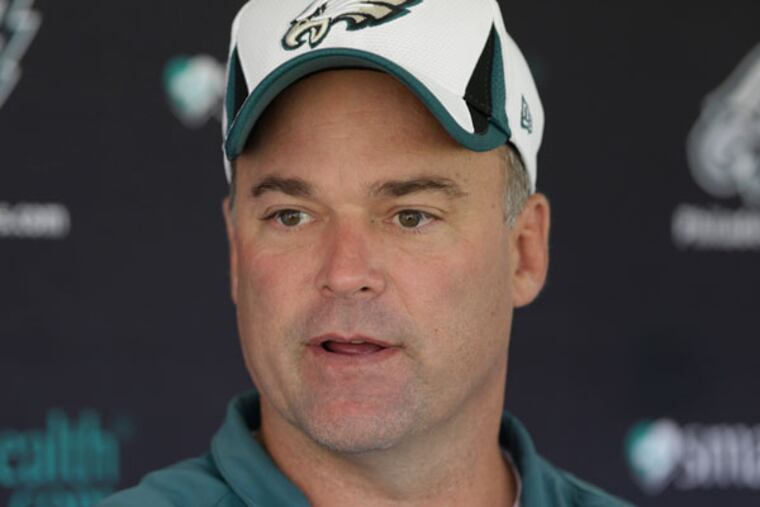
It used to be Bill. Then it was Billy. Now it's back to Bill, even if Chip Kelly likes to call him Billy.
The story of how Bill Davis became Billy Davis is the story of how a former quarterback came to coach defense.
The Eagles once had a former college quarterback turned defensive coordinator. Jim Johnson, like Davis, was a relative unknown before coming to Philadelphia - a journeyman assistant looking to capitalize on another opportunity to lead a defense.
Davis is a long way from being mentioned in the same breath as Johnson and his mentors, Dom Capers and Dick LeBeau. But after a rocky start, the new Eagles defensive coordinator has shown steady improvement, however marginal.
Anyone with a fair bone in his body didn't expect greatness in Year 1. Davis was transitioning from a 4-3 scheme to a 3-4 without a full deck of suitable personnel. And yet, the Eagles held a high-powered Cowboys offense to 17 points - Johnson's barometer for success - in last Sunday's loss.
"The defense we ran against the Cowboys is the same defense we ran at the beginning of the year, when we were much maligned," Kelly said Wednesday. "But Billy has conviction in what he's doing. He's sound in how he approaches things. I think he has answers."
In the first four games, the Eagles allowed 31 points a game - excluding two special-teams touchdowns against the Broncos - and 6.0 yards a play, and forced only five turnovers. In the next three games, the defense held offenses to 19.3 points and 5.2 yards a play and caused seven turnovers.
Again, the improvement has been incremental, and the sample size isn't large enough to make sweeping statements. And there's always the possibility the defense could regress. But Davis has proved at the least that he isn't in over his head.
Kelly called him an "outstanding teacher" and an "effective communicator." Linebacker Connor Barwin concurred and said that the players relate to Davis because he "treats you like a man, like a pro, which guys respect."
After two previous stints as a coordinator, the 47-year-old Davis could be down to his last chance.
Johnson and LeBeau, it should be noted, didn't become recognized defensive geniuses until both took advantage of second chances in their late 50s. Former Eagles coordinator Sean McDermott is heading one of the best defenses in the NFL in Carolina.
Their successes don't necessarily mean Davis will thrive here, but sometimes all it takes is the right confluence of events.
Stuck on defense
Davis' first coaching job in the NFL was with the Steelers in 1992. It was Bill Cowher's first year as head coach, and Davis was hired as a low-level assistant.
"I was going by 'Bill' when I first hit the league, but I was with Bill Cowher. So he got mad that everybody was calling [him] every time they called for me," Davis said. "So he said, 'We'll just call you Billy.' "
Hired as a quality-control coach, the former University of Cincinnati quarterback and wide receiver arrived in Pittsburgh expecting to coach on offense.
"It's the first day of training camp, and Cowher was like: 'Give me your background one more time,' " Davis said. "I was like, 'Oh, offense. Quarterbacks, receivers, running backs - whoever you want me to work with, I'll work with.' He's like, 'I need you on defense breaking down opposing offenses. Here's Dom Capers and Dick LeBeau - go over with them.'
"I wasn't going to say no. I was stuck."
Davis spent the next three years as Capers' right-hand man, breaking down film of opposing offenses for the Steelers defensive coordinator. But he still pined for a job on offense. When Capers got the head coaching job with the Panthers, he asked Davis if he'd come along.
"I said, 'Can you put me back on offense? Can I get receivers?' " Davis said. "And he said, 'No, I need you on defense. You're outside linebackers.' So I was, 'OK, I'm not going to turn down a full-time job.'
"So then it stuck."
Davis said he became immersed in learning how to stop offenses. He worked under coordinator Vic Fangio until Capers was fired in 1998. He then bounced around the league as a positions coach for the next six years, cribbing ideas from coordinators as he fine-tuned his vision of a defense.
In Green Bay, he worked with Ed Donatell. In Atlanta, he worked with Wade Phillips. And then in 2005, Mike Nolan called. He had just been named head coach of the 49ers and he needed a coordinator.
The 39-year-old Davis jumped at the chance. But Nolan never handed over the reins. He coached the defense through walk-throughs and called the plays on game day. The unit finished 32d and 26th in yards and 30th and 32d in points over two seasons, and Davis was unceremoniously fired.
He returned to coaching linebackers in Arizona, and then in 2009 got another chance at coordinating when the Cardinals promoted him. This time, Davis got to call the shots.
The Cardinals won the NFC West in Davis' first year behind a defense that was ranked 20th in yards and 14th in points. But the following season the team finished 5-11 and Davis' group was abysmal. The defense was 29th in yards and 30th in points and he was fired yet again.
Molding the defense
Back to being a linebackers coach in Cleveland, Davis said he didn't lose his thirst to coordinate.
"It's such a fun chess match," he said. "Defense, I think, is harder than offense, in that we have to react, we have to be prepared for anything that can come at us. Offensively, they align, they employ, they manipulate how they want to run a play. They're in control."
The Eagles were the only team to interview him as a coordinator last offseason, though. Kelly said the Eagles did extensive research on Davis' background and put him through several interviews.
"We were pretty thorough in how we went about that," Kelly said. "I don't know if you guys remember that, but I think a lot of people were concerned that we took a long time hiring a defensive coordinator because we weren't just going to hire the first guy."
Aside from those who remembered him through his father, Bill, who was an Eagles assistant in the mid 1970s and director of personnel in the late 1980s, Davis arrived with little fanfare.
Kelly had already hired most of his position coaches, all of whom were former college defensive coordinators, and many dismissed Davis because of his two failed stints as coordinator.
"I don't think he gets enough credit," Barwin said. "It's not easy to take [former] coordinators and have one coordinator and make them all position coaches. He's done a really great job of molding the defense to where it is, to fit the type of players he has and also the type of coaches he has."
Rather than force pieces into the 3-4 scheme he adopted from Capers, Davis has tried to coach to his players' strengths. The goal is still to become a two-gap 3-4, but Davis is making do for now. Kelly doesn't appear to be in any rush.
"Billy's what I thought he was going to be," Kelly said, adding: "He's a really, really smart guy, and I'm really happy we've got him right now."