Second-guessing of Seahawks may never end: Why didn't they run?
GLENDALE, Ariz. - Within seconds after Malcolm Butler intercepted Russell Wilson with 20 seconds left in Super Bowl XLIX, many were calling the Seahawks' decision to throw on second and goal at the 1-yard line, rather than running the ball, the worst play call in NFL history.
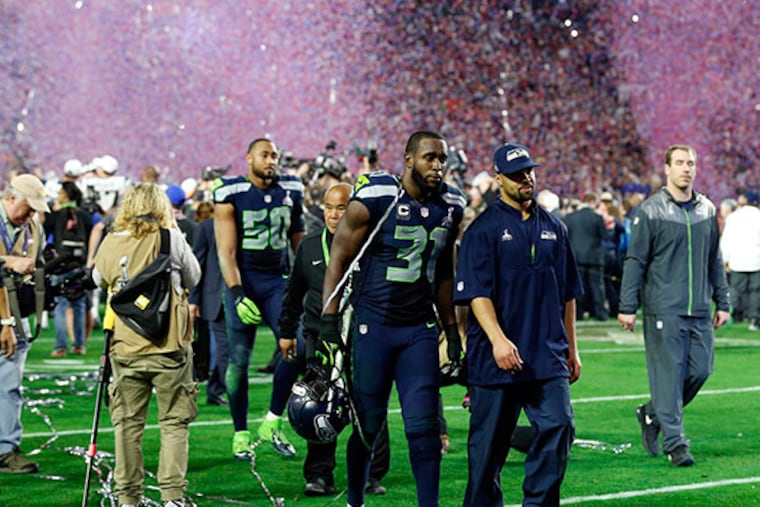
GLENDALE, Ariz. - Within seconds after Malcolm Butler intercepted Russell Wilson with 20 seconds left in Super Bowl XLIX, many were calling the Seahawks' decision to throw on second and goal at the 1-yard line, rather than running the ball, the worst play call in NFL history.
That's a lot of football to cover, but one thing is for certain: With the NFL's popularity at an all-time high - as evidenced by Sunday night's game being the most viewed Super Bowl ever - Seattle's decision to pass rather than handoff to bulldozing running back Marshawn Lynch will be the most discussed play call ever.
They were inches from a second straight championship, but now Seahawks coach Pete Carroll and offensive coordinator Darrell Bevell will be second-guessed for a lifetime. The Patriots, behind quarterback Tom Brady's valiant fourth-quarter comeback, did enough to earn a 28-24 victory, but it's hard to argue the notion that the Seahawks gave this one away.
Carroll defended the call on the numerous times he was asked after the game. But it wasn't just Seahawks fans or the millions who watched around the world or the media who questioned the choice. Some Seahawks players, obviously still smitten after a remarkable turn of events, publicly criticized the decision.
"Best back in the league, and the 1-yard line?" linebacker Bruce Irvin said to NFL.com. "It wasn't even the 1 - it was like half a yard. I will never understand that."
Carroll's explanation made logical sense, but practically speaking, the Seahawks simply outsmarted themselves. They thought about what could go wrong if they had run the ball on second down with one timeout remaining rather than put the game in the hands of their best offensive weapon.
They ignored Occam's razor - the problem-solving principle in which the simplest explanation is the most plausible one. Hand the ball off to Lynch and you likely score. Instead, Carroll was thinking one and two steps ahead, which is what every coach should do. But he should have circled back to the obvious.
"We have everything in mind," Carroll said, "how we're going to do it, we're going to leave them no time, and we had our plays to do it."
A circus catch by receiver Jermaine Kearse advanced Seattle to the Patriots' 5-yard line with 1 minute, 6 seconds left. After a Seahawks' timeout, Lynch rushed 4 yards to the 1 with 1:01 remaining. Seattle then let 35 seconds tick off the clock, perhaps expecting New England coach Bill Belichick to call a timeout.
He didn't.
"We would have used our timeouts if that had been a running play on the interception," Belichick said. "We might have done that."
It wasn't a running play, of course, but it likely would have been a run had the Patriots matched the Seahawks' "11" personnel (three receivers) rather than staying in their goal-line defense, which had eight defenders in the box and three cornerbacks to cover the receivers man-to-man.
"It's not the right matchup for us to run the football, so on second down we throw the ball really to kind of waste that play," Carroll said. "If we score, we do, if we don't, then we'll run it in on third and fourth down."
Both Carroll and Bevell said they were concerned about leaving too much time on the clock for the Patriots had they scored on second down. The Seahawks scored a touchdown on a 31-second drive before the half, but even Brady would have had a hard time getting into field-goal range for at least a tie in 20 seconds.
The Seahawks were lined up in a packed formation with Kearse and receiver Ricardo Lockette stacked to the right. Kearse was inside Lockette and blocked corner Brandon Browner, hoping to pick Butler, who was playing about 6 yards off, for a slanting Lockette.
The ball was snapped to Wilson in the shotgun with 26 seconds to go and he fired almost immediately to Lockette. But three things happened: Wilson's pass was a shade too far inside, Lockette eased up slightly on the route, and Butler made an excellent read and play on the ball.
"I thought he made a great read, from what I was told upstairs, and he put a good throw on it as well," Bevell said. Lockette "could've done a better job at staying strong through the ball, but you know the kid from New England made a great play."
Butler, an undrafted rookie out of West Alabama, said he knew the play and recognized the route because he had once been beaten on it playing on the scout team in practice.
"I just knew they were going to throw," Butler said. "My instincts, I just went with it, just went with my mind and made the play."
Butler made a beeline for the ball, upended Lockette, and intercepted the ball at the 1-yard line. The game, in essence, was over. The criticisms and second-guessing began almost immediately.
What were the Seahawks thinking? Why didn't they just hand off to Lynch?
For the record, Lynch was 1 of 5 on touchdowns running from the 1-yard line in the regular season. Wilson was 2 of 2 when he kept it and ran. And when he threw, Wilson completed 1 of 2 passes for a touchdown. Still, Lynch had run for 102 yards on 24 carries until that point. Most would take him with the game on the line against a goal-line defense with five Vince Wilforks stacked along the front.
Even if you agree with throwing the ball there, was the first read one in which Wilson could have either thrown the ball away or where only his receiver could have gotten it, like on a corner fade?
"I put the blame on me," Wilson said. "I'm the one who threw it."
While Bevell calls the plays and reiterated that after the game, Carroll took responsibility.
"I made the decision. I said, 'Throw the ball,' " Carroll said. He added: "There's really nobody to blame but me."
It may be too much for one man to bear.
@Jeff_McLane