Eagles' Ed Marynowitz says he's not a yes man
The new vice president for player personnel says he'll work in collaboration with head coach Chip Kelly.
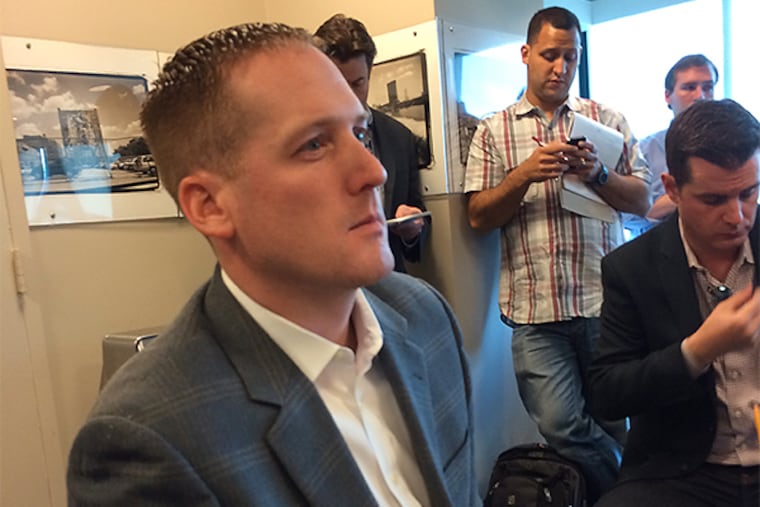
IN THE SUMMER of 2001, Dave Dunn was a first-year head football coach at Paul II High School in Boca Raton, Fla., when he got a notice from his homeowners' association: His roof was dirty and moldy. He needed to power wash it.
So at preseason practice, Dunn asked his players if anybody wanted to make some money. Ed Marynowitz, Dunn's senior projected starting quarterback, jumped at the opportunity.
"I said, 'Hey, we can make that happen for you,' " Marynowitz, now the Eagles' vice president of player personnel, recalled yesterday, at the end of several rounds of interviews held in anticipation of the April 30 start of the NFL draft.
"That's just how he was," Dunn said recently.
Now that Marynowitz is a prominent NFL exec at age 31, "I'm glad I tipped him well," Dunn added.
Dunn and Marynowitz recalled that at some point during the power-washing - something Marynowitz had never done before, he said - the proceedings took an unexpected turn.
"He tried to spray in this crevice, and there was a raccoon living in there, and he had to jump off the roof, and didn't get hurt," Dunn said. "Right then and there, he showed me he was fairly athletic."
Marynowitz recalled it more as a desperate scramble than a leap.
"He's being very complimentary. Athleticism was never my strong suit."
But being the guy the coach can depend on pretty much has been Marynowitz's strong suit, from Paul II to La Salle University, through a transfer to Central Florida when he started hearing La Salle might drop football, to working in coaching and recruiting for UCF coach George O'Leary after he graduated, to an entry-level NFL job with the Bill Parcells-led Dolphins, to directing recruiting for Nick Saban at Alabama, to working under Howie Roseman and Tom Gamble in Eagles personnel, to essentially replacing Gamble and Roseman, when Chip Kelly decided in January that the coach should have dominion over personnel, and that Marynowitz should run that operation for him.
"Watching his career and knowing him, it came as no surprise to me, the success that he's had," said Dunn, now head coach at Catholic University in Washington. "He's a great person. He was an extremely hard worker, like to the point where you really had to almost sit him down and tell him to take it easy at times. Completely committed to what you were trying to get done.
"He was really tough. He wasn't the biggest quarterback, he was a little bit on the thinner side, but he was the type of young man, he would dive for a first down on a scramble without any regard to his personal safety. He was just the type of person who would do whatever it takes to win. I think that's the same approach he has in terms of how he works with the ballclub now, no different than when he was at Alabama.
"He just knew he was gonna make a play or create something that was gonna help us win. He was a captain, he was a great leader."
Marynowitz, in his first exchanges with reporters yesterday since taking the job, left no doubt that he is completely committed to what Kelly wants - while also asserting that he would argue a contrary opinion if he felt the coach needed to hear it.
"I told him I'm just here to support the head coach," Marynowitz said, when asked about the discussion that led to his hiring. "It's my belief, in terms of our philosophy, that everybody in the organization is here to support his vision. My responsibility and my role is to do it in the player personnel area.
"That doesn't mean I'm going to agree with Chip - I know that's a common thing everybody throws out [in questioning the new setup]. 'Is this guy just a yes man?' . . . I'm never one to agree just to agree. To support the head coach, I don't believe that [role] is just to tell him he's right in everything he says. You're not going to disagree just to disagree, either. But I've never been afraid to voice my opinion."
Marynowitz added that disagreements have been rare. He said that with O'Leary, Parcells and Saban, he worked under mentors who had similar philosophies to Kelly, in terms of what they were looking for in players.
"I've always been around prototype-driven personnel operations," Marynowitz said. "Defer to size and speed and try to get guys that look the same and have the same skill set."
Marynowitz said Kelly "is very open-minded. He wants collaboration."
Marynowitz's voice occasionally betrayed a hint of nervousness, but he seemed largely unfazed as he navigated a series of NovaCare media interactions, the first a sitdown with about 30 print/online journalists in a conference room behind the cafeteria.
"Chip's done a great job of supplying the vision to the entire organization, to the coaching staff and the personnel department, of what he's looking for in order to build a football team," Marynowitz said. "It was a very height-weight-speed-specific operation [at Alabama]. This is a size-speed league. We believe the SEC is a size-speed league . . . There's a certain prototype. Our goal there was that although there may be varying degrees of players in terms of ability . . . when the starters come off the field and the backups come in, they all look relatively the same . . . We try to build the same thing here."
As a player, Marynowitz would not have fit those criteria. O'Leary remembered Marynowitz as "a walk-on quarterback here, but a very bright individual."
"Once he left [grad assistant] coaching here, I put him in the recruiting room. Within a short time, he got the director's job of recruiting. Very detailed guy," O'Leary said. "He could spot talent. He didn't go to books and look at two stars or three stars or four stars . . . he could evaluate tape, and evaluate tape very well.
"It didn't surprise me when he went to Miami or Alabama. He knows what it takes to win. He knows the kind of players you're going to need to win. I think he understands the loyalty factor. I think that's always been big with me, as far as you trusting people who are working for you, that'll work and do the job."
At Central Florida, Marynowitz never got on the field - O'Leary said he was "not talented enough to play at this level" - but he used his time there to earn a bachelor's in business management, plus masters' degrees in business administration and sports business management.
He also encountered the first blot on his record.
In 2010, UCF went on two years' probation because of "improper" phone calls and texts Marynowitz and another assistant had made to recruits who hadn't yet signed letters of intent. By the time the sanctions were announced, Marynowitz was at Alabama.
"He was being over-rambunctious," O'Leary said. "He made some phone calls he shouldn't have made for other coaches. That's something you aren't allowed to do. He owned up to it. It was something that a coach would say, 'Call this kid while I'm in a meeting, [tell him] I'll get back to him later.' He didn't have the ability to make phone calls to recruits, in that position."
Marynowitz said yesterday he just wasn't aware of the rule at the time. "Most of it was just answering the phone."
O'Leary said there were no hard feelings on his end. The sanctions didn't slow Marynowitz's rapid ascent.
Lou Russo, now director of player personnel for the Philadelphia Soul, entered La Salle as a wide receiver the same year Marynowitz arrived. Russo was asked if it's odd to think that his old classmate is already in charge of an NFL personnel department. Isn't Marynowitz a bit young?
"To be honest, yes, but if there is someone who is willing and able to accept the challenge and succeed with it, I think Ed is the guy for it," Russo said. "He's always been someone who's been able to achieve what he's put his mind to."
"Age is not a factor, in my opinion," Marynowitz said. "I think if you look across all different professional sports, there's been a lot of people that have been either my age or younger that have been in some good roles. To me, it's more about the experiences you've had, the people you've been around, the habits that you've formed. To me, those are the traits and qualities that make you successful in this role.''
Marynowitz got the job after at least a couple of other candidates declined, or were denied permission to interview, because the job didn't include final say over personnel. Last month, Kelly said Marynowitz was the last candidate he and team chairman Jeffrey Lurie interviewed.
"I think he blew both of us away," Kelly said. "It was like, 'Wow, this guy is extremely organized, extremely detailed, has a real good vision of what we are trying to get accomplished,' and I thought he was outstanding."
Marynowitz said that in January, when Roseman was taken out of football operations and Gamble was dismissed, he didn't waste time worrying about what would happen to him, and he didn't formally apply for the promotion.
Marynowitz said when the shakeup occurred, "I told Chip, 'Hey, I'm here to help.' It's a huge undertaking for a head coach to take over personnel responsibilities at that time in the process . . . I just caught him up to speed [on what had been done in terms of scouting] and let him know I was here to support him in any way. I did not ask to be interviewed for the job, or anything like that. They came to me later in the process and said they wanted to visit with me."
It sounded as if Marynowitz saw from the start how it might be perceived, a coach who'd just been handed ultimate power hiring a young, relatively inexperienced personnel chief.
"The most important relationship in the building, to me, is the one of the head coach and whoever is the personnel director. There's got to me mutual trust and respect . . . I told that to Chip, we had that conversation before I accepted the position," Marynowitz said. "I've got no problems speaking my mind. I've done the work. I'm confident in my preparation, and that's what Chip wants - he wants checks and balances, he wants to hear the opinions. We're in this together."
Dunn, O'Leary and Russo all spoke of Marynowitz's attention to detail.
"My parents are like that. I think I was raised the right way in terms of work ethic and being detailed and just kind of handling yourself the right way," Marynowitz said. "I've been fortunate to work with a lot of great people," he said, first citing Dunn, O'Leary and Parcells. "I worked hand-in-hand with [Saban] for four years, three full seasons. The majority of what I believe in terms of how to build a championship-caliber football team, how to work, how to manage people, really was developed through him."
Blog: ph.ly/Eagletarian