Mark Sanchez is still the better option to back up Sam Bradford
Though his performance in Eagles' preseason opener was worrisome, numbers show Chip Kelly can bank on Mark Sanchez.
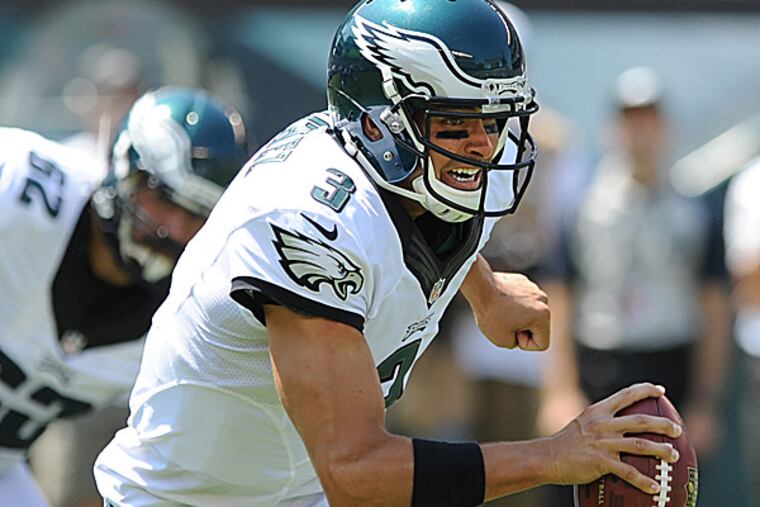
IN CASE you haven't heard, the Eagles have the opportunity to back up Sam Bradford with a Proven Winner. A guy who won nearly 90 percent of the games he started in college. A guy who never lost a bowl game. A guy who has won a game in the NFL playoffs. Think about it: If you needed a quarterback to step in and lead a team to victory, whom would you rather have, Mark Sanchez, or a guy with extreme accuracy and consistency problems who hasn't won anything over the last two years?
Relax, just checking to make sure you're still awake. This is not a Mark Sanchez vs. Tim Tebow think piece. It also isn't an argument that Sanchez at quarterback is an ideal scenario for any NFL team. It is, however, an argument that the scenario is better than any of the other ones Chip Kelly could have concocted this offseason. And to evaluate it without such context - i.e., without considering all potential outcomes other than Sanchez - would be like evaluating a restaurant in North Korea without considering that the chef's only available ingredients were a sack of potatoes and a pallet of government cheese.
It's fair to say that Sanchez' performance in Sunday's preseason opener did little to quell concerns about the Eagles' situation at their most important position. If Bradford misses significant time for a third consecutive season - or if he struggles with pass rushers in his face the way he did at times in St. Louis - Kelly's next best option is a guy whose career has been plagued by bouts of inaccuracy similar to his channeling of Chuck Knoblauch against the Colts. Thing is, that concern was going to exist with any of the decisions the coach could have made this offseason, and there is a reason he decided to give Sanchez a contract that includes more guaranteed money than any other veteran backup quarterback in the game.
Fact is, Kelly's offense worked better under Sanchez than Nick Foles last season. In the seven games Foles started and finished, the Eagles scored on 35.2 percent of their drives, with a touchdown on 19.3 percent and a field goal on 15.9 percent, and a turnover on 19.3 percent. In Sanchez's eight weeks as starter, they scored on 41 percent of their drives, 24 percent resulting in touchdowns and 17 percent resulting in field goals. They turned the ball over on 15 percent of their drives. Also, Sanchez completed 64.1 percent of his passes, while averaging 7.8 yards per attempt. Foles completed 59.8 percent of his passes while averaging 7.0 yards per attempt.
The exception was turnovers - Sanchez was picked off on 3.6 percent of his attempts, with seven fumbles, while Foles was picked off on 3.2 percent of his attempts, with four fumbles. While both of those sets of numbers are differents shades of mediocre, the point is less that Sanchez is a better quarterback than Foles than it is that the Eagles' offensive prospects aren't any more worrisome with a Bradford-Sanchez combo than they would have been with Foles-Sanchez or Bradford-Foles or Bradford-Fitzpatrick, or any of the other combinations that were realistic possibilities this offseason.
And then there is the Tebow Doctrine, which states that quarterbacks should be evaluated based on wins, regardless of what the rest of the available evidence suggests about their aptitude for quarterbacking at the game's highest level. Checkmate, you might say, because Foles has won a higher percentage of his starts than any of them. But that would be an ironic use of the term, because chess is a rational game, and Tebow Doctrine is inherently irrational, because it allows for the invocation of anecdotal evidence like the following:
Sanchez has won four of his six career playoff starts, with a 60.5 completion percentage, nine touchdowns, three interceptions, and a 7.4 yard-per-attempt average. In his two most recent postseason starts, he completed 36 of 58 passes for 427 yards with five touchdowns and zero interceptions.
You say Foles has a better track record of winning games; someone else says Sanchez has a better track record of winning the games that matter most; and both sides realize they need to find a better argument to advance their point (the Tebow Doctrine is a flat circle). How about this one: Sanchez' value to the Eagles lies primarily in the baseline he has established for himself over the course of 4 1/2 seasons as a starter, two of which resulted in deep playoff runs. Sanchez' sample size is big enough to leave us with a pretty good indication of what the Eagles will have if he ends up logging significant time. Nothing he can do this preseason will substantially alter that picture.
Sanchez has a higher floor than Bradford or Foles, and there is value in that. Foles' biggest attributes during his 2013 season were his abilities to throw the deep ball and minimize costly mistakes. Bradford has both of those qualities, along with some of the same questions marks (namely, his ability to perform with suboptimal protection). Provided he stays healthy, he is a good bet to be at least as productive as Foles would have been in the same situation, with the potential upside of being far better in Kelly's system than Foles was. If Bradford doesn't stay healthy, then the Eagles will have a quarterback who has been the same quarterback in each of his 4 1/2 seasons in the NFL, which is a quarterback who is at least as productive as Foles was in two of his three seasons with the Eagles.
Cause for concern? Sure. But that's not new.
On Twitter: @ByDavidMurphy