Tunsil debacle should be pot of gold for college athletes
LAST THURSDAY the NFL inadvertently and unintentionally made a case for paying college players. Minutes before he was expected to go within the top three or four picks in the NFL draft, Laremy Tunsil found out both his Twitter and Instagram accounts had been hacked, sharing with any potential future employer a two-year-old video of him smoking out of a gas mask bong and messages suggesting he was paid under the table while playing for Ole Miss.
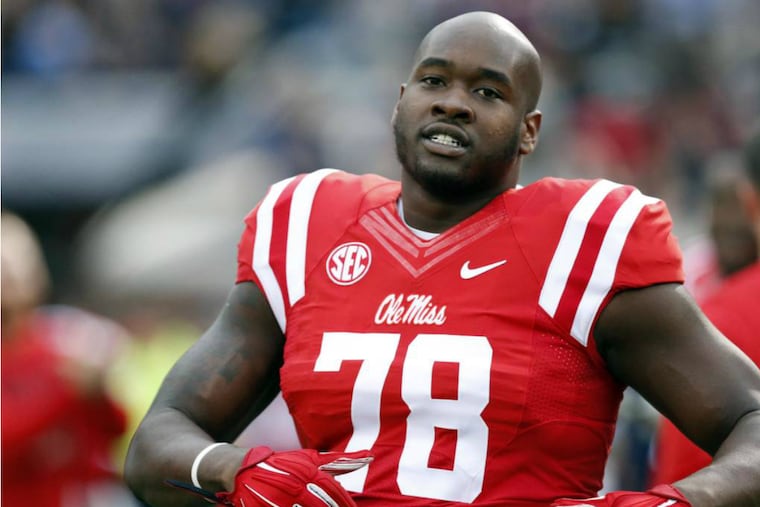
LAST THURSDAY the NFL inadvertently and unintentionally made a case for paying college players. Minutes before he was expected to go within the top three or four picks in the NFL draft, Laremy Tunsil found out both his Twitter and Instagram accounts had been hacked, sharing with any potential future employer a two-year-old video of him smoking out of a gas mask bong and messages suggesting he was paid under the table while playing for Ole Miss.
Tunsil tumbled to the Dolphins as the 13th pick overall - the Eagles' original draft position - costing the offensive tackle by, even modest estimates, more than $8 million in lost wages.
Quick aside: Given what we know now about how the draft played out, given the Eagles clear willingness to draft risk players with big upsides, is it not at least a conversation to ask if they would not be better off today had they never made that deal to get Carson Wentz? They would have arguably the best offensive lineman of the draft, have kept their picks in ensuing rounds and ensuing years, and had both depth and talent at the quarterback position.
Just a thought.
But back to Tunsil.
The bong video was two years old. The request for money from an Ole Miss assistant athletic director, which Tunsil admitted to on the night of the draft, was against NCAA rules but not necessarily immoral. As former Georgetown coach John Thompson warned us so many years ago, NCAA rules and morality often have nothing to do with each other.
The first evidence of this is what the Dolphins said immediately afterward, that they had investigated Tunsil, knew of his past recreational use and were satisfied with their findings. Said Tunsil immediately after the draft, "I do not have a drug problem. You can check all my college tests. I never failed one."
It's very likely that any team ahead of Miami that was interested in him checked this as well. So why the precipitious drop? One theory, advanced by ESPN's (and former Meadowlands miracle worker) Herm Edwards is that teams were scared away by what those tweets and Instagram hacks might say about those who Tunsil might owe, or who might think they are owed.
"The Miami Dolphins as well as any other team that did their background work on Tunsil knew that socially, he smokes dope," said Edwards. "That's not the issue here. To me the issue is that the people in his circle, whoever they were, this came out. That's an issue. Because now all of a sudden you have to say, 'Who has he surrounded himself with? We've drafted the player . . . But who's coming with him?' "
Someone or someones who feel jilted or owed perhaps? On the eve of the draft a stepfather who Tunsil had previous legal troubles with filed a lawsuit over an incident that, depending on whose side you believe, was either about domestic abuse of his mother, or his contact with agents. Tunsil's attorney does not believe it was Lindsey Miller, the stepfather. "It's so counterintuitive," attorney Steve Farese told Sirius radio.
A jilted agent though - well, given the incidents of the last 12 months, it's more than plausible.
Tunsil served a suspension for several NCAA infractions, including contact with agents. The suspension, seven games of his 2015 season, reaped this: The use of three loaner vehicles over a six-month period without payment; a four-month, interest-free promissory note on a $3,000 down payment for buying a used vehicle; two nights at a local home; an airline ticket purchased by a friend of a teammate; and one-day use of a rental car.
He also owned up immediately to asking for money from Ole Miss coaches for rent and so that his mother could pay her $305 electric and water bill.
Hammer him for the bong if you like, but only if you can't recognize one. I went to college in the late '70s and early '80s and I will say only this: When the juice gets spilled on the carpet it leaves an awful smell that you simply can't shampoo out.
But I was no elite-level athlete, and did not earn my school big dollars. I may have even cost them some by the end, I can't remember. I'm really glad though that Twitter and Instagram weren't around.
Hell, ESPN wasn't either. Or big mega-conferences with billion-dollar television deals and mind-boggling bowl payouts. Coaches did not receive CEO money back then either.
So I ask you, especially those of you who still think compensating these guys for what amounts to a 40-hour work week that earns these universities hundreds of millions of dollars is bad - would Laremy Tunsil have been less likely to do any of this if he was making even minimum wage for his efforts? If he could pay his mother's electric bill, drive around in a used car, live a life that is even remotely linked to the value of his labor?
And if he was less likely, then ask this: Does the NCAA owe him - morally speaking, of course - about $8 million?