McLane: What we know so far about Carson Wentz
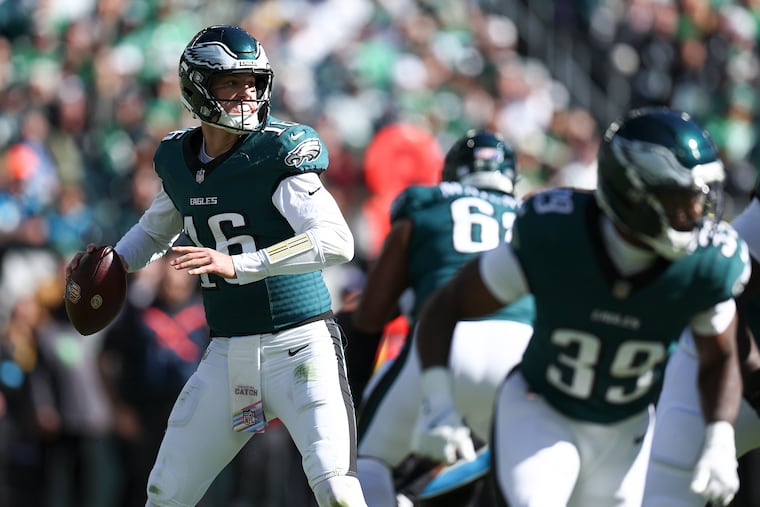
If he wasn't 6-foot-5, 237 pounds, a quarterback, the No. 2 overall pick, and the single most important player the Eagles have drafted in over a generation - the hope for a floundering franchise - you might not have noticed Carson Wentz at training camp over the last two-plus weeks.
If he wasn't 6-foot-5, 237 pounds, a quarterback, the No. 2 overall pick, and the single most important player the Eagles have drafted in over a generation - the hope for a floundering franchise - you might not have noticed Carson Wentz at training camp over the last two-plus weeks.
Wentz has been the most watched, most scrutinized, and most interviewed player at camp, but not because of anything he has done. He has kept a workmanlike low profile. His practices have been dutiful. His manner has been deferential. And his answers have been anodyne.
Wentz operates in a rookie quarterback vacuum, while the outside Eagles world follows his every move. Every throw is appraised. Every decision is dissected. And every word is decoded. Extremists are ready to declare him either the coming savior or an eventual bust.
Perhaps there has been an indicator of either future success or failure, but not even a football savant could declare with any certainty how Wentz will ultimately perform. No one knows how he'll fare in his preseason debut Thursday night, let alone once he becomes the Eagles' starter.
But Wentz has about 30 practices in the book since May, and almost any objective observer would have likely made the following evaluations of the 23-year old after his first three months in the NFL:
He has a right arm that is more than strong enough to make all the necessary throws.
He is an above-average athlete for a quarterback.
He can be an effective thrower on the move - perhaps partly because of that athleticism.
He can be inaccurate and needs to work on ball placement.
When he has missed receivers on intermediate-length routes, the passes have tended to sail high.
He has a tendency to hold the ball too long in and out of the pocket.
The combination of both positive and negative could be used to describe almost any first-year quarterback at this stage. Wentz is a work in progress. He's learning a new offense with new terminology. He's having his throwing mechanics altered. He's being asked to grip a new ball differently. He's adapting to new teammates, a new tax bracket, a new city and a new existence.
Put that way, it's no surprise the Eagles plan on starting the season with both Sam Bradford and Chase Daniel ahead of Wentz, and if they had their preference, sit him all year. There has been little to suggest that the team is pulling the reins back on a foal that is already a thoroughbred.
Wentz has conceded that he's far from the home stretch.
"The biggest thing is just mentally playing faster," Wentz said earlier this week. "Knowing what's going on, knowing what's going on with protections. I feel that I've come a long way and I feel comfortable with that. Again, I'm not a finished product."
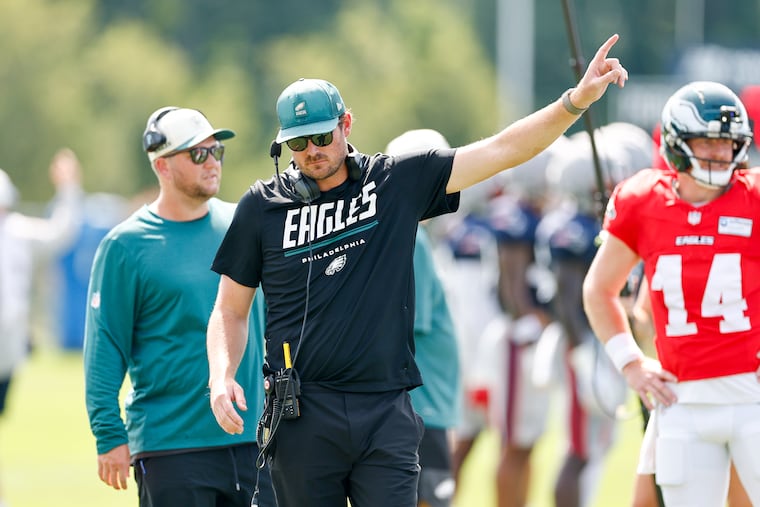
Wentz had an easier introduction in the spring and was thus more effective, but practices have been more competitive in camp. The days are longer and there aren't as many off. Eagles coach Doug Pederson said that he doesn't think Wentz has been overwhelmed.
"I've seen a lot of young quarterbacks that come in and struggle mentally with the terminology and the overall volume of offense that we have in at this time, but I haven't seen that from him at all," Pederson said. "We haven't had any communication breakdowns in the huddle with him. So, [I'm] very pleased with where he is at mentally and now it is just a matter of continuing to detail his work and fine-tune some of the mechanics."
Earlier in camp, Pederson said that Wentz could occasionally get "a little hoppy" in the pocket. He said that the coaches were "trying to keep his feet tighter to the ground." When Wentz has had issues with his lower body it has often affected his throwing motion and the passes have wobbled or sailed.
"It's mechanics, but it's also a decision-making process in the information and seeing what he's seeing relatively fast," Pederson said. "And in this game, lanes are tight. Just being able to get the ball out on time sometimes can affect how a quarterback throws."
Repetition will help. But it's impossible to say with any conviction whether Wentz has the quick-twitch ability to process what he sees in a split second. It may be the No. 1 characteristic that separates elite quarterbacks from pedestrian ones.
"You're not always perfect, first of all," Wentz said when asked about his overthrows. "Sometimes you're overstriding. . . . You see the guy break as you're about to release it and it looks like the defender is going to beat the guy to the ball, so sometimes you're just throwing it away."
Wentz clearly has the physical tools. It was fairly evident from the first day that he had considerable arm strength. He liked to go deep more than the other quarterbacks, but it's wasn't the distance covered as much as it was the zip behind the throws.
He may already throw on the move as well as Bradford or Daniel. One day, he rolled to his right, and with a defender in his face, threw off his back foot about 25 yards to tight end Trey Burton in the corner of the end zone. Sometimes, even when he's lost his balance, he's managed to contort his body and complete a pass.
"He's such a mobile guy," Pederson said, "that when he can scramble and get on the perimeter, he has the ability to make some tremendous throws and accurate throws out of the pocket."
But he won't be protected by a red jersey against the Buccaneers in the second half of Thursday's game. In college, Wentz could often avoid contact or come out unscathed because of his athleticism. The bullets fly faster now.
"He understands that," Pederson said, "but also you've got to know that your longevity in this league is to protect yourself and to be here week in and week out."
There's no hiding now.
@Jeff_McLane