Lanzi takes care of Flyers' dental needs
DR. GUY LANZI had seen worse facial trauma. In the years he has been associated as an oral surgeon at Cooper University Hospital, he has peered into the faces of high-speed car-crash casualties. Occasionally, he has been confronted with heartbreaking case
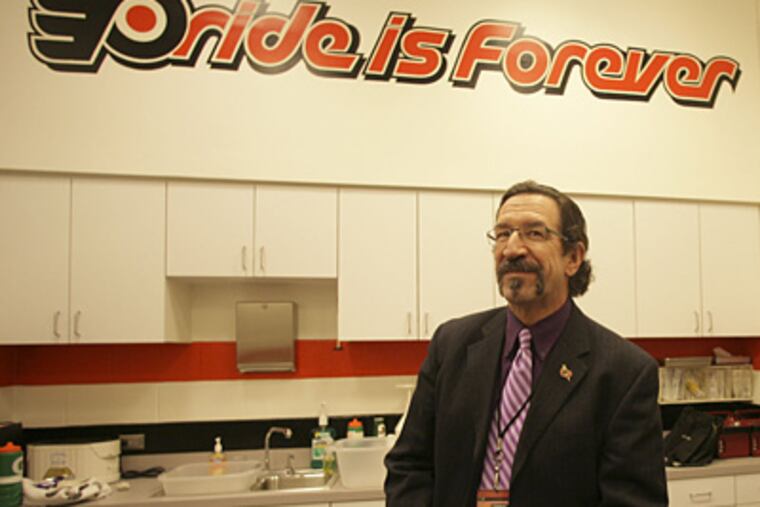
DR. GUY LANZI had seen worse facial trauma. In the years he has been associated as an oral surgeon at Cooper University Hospital, he has peered into the faces of high-speed car-crash casualties. Occasionally, he has been confronted with heartbreaking cases of physical abuse, even instances when he has been called upon to care for the victim and the assailant. While he does what any physician does in such circumstances - which to say, do what he has been trained to do and get down to work - it is not uncommon for him to later contemplate "the horribleness" of what he just encountered.
So, yes, the Flyers' oral surgeon had seen worse in the realm of face trauma than when forward Ian Laperriere headed back to the dressing room what is euphemistically called "repairs" during the first period of a game against Buffalo last Nov. 27. Laperriere had blocked a puck with his mouth and it had left him with a bloody hole where some of his teeth used to be. Immediately, Lanzi thought, "What a mess." The doctor could see that the 16-year veteran was "upset and hurt," yet he asked at question that is not uncommon among in these situations: "When can I get back in the game?"
Quickly, Lanzi sprang into action. With the aid his colleagues on the Flyers' medical staff, he assessed if the injury could be addressed at the arena, or if Laperriere would have to go to Cooper. "Initially, there was a lot of bleeding," said Lanzi, who "cleaned up" Laperriere and chose to treat him in house. Lanzi says that Laperriere was "flayed open," so it was relatively easy for him to perform an assessment of some of the issues the player had. Lanzi says he "numbed him up," which, by the way, is not something every player agrees to due to fear of needles.
"Any teeth that had to be extracted where extracted," says Lanzi. "He had a couple of teeth that were hanging on by threads. They came out first. Then we repaired the inside of his mouth, reassembled the gum, the teeth tissue and the inside of the lip. With an injury like this, you have to sew in layers."
Four teeth were extracted and the bridge that Laperriere had from previous dental trauma was destroyed. "So when we were done, it looked like he was missing a ton of teeth," says Lanzi, who adds that he also sewed in between 50 and 100 stitches to close up the wounds. By the beginning of the third period, Laperriere was back out on the ice with a face shield that Lanzi had urged him to wear. Laperriere also did something that Lanzi says hockey players invariably do.
Lanzi laughed. "He said, 'Thank you,' the doctor recalls. "As uncomfortable as I know they are with the injury they just had, I have never had one who has been impolite. Hockey players are gentlemen."
Laperriere could not have been more pleased with the outcome. "I am so happy with the job he did," says Laperriere, who says he will have 17 teeth replaced when his playing career is over. "Having been in the league for as long as I have been, I guess I was due to take one in the face."
Quite well thought of in his profession, Lanzi has been the oral surgeon for the Flyers since 1993. Generally, he sits 16 rows behind the Flyers' bench, although occasionally he will watch the game on a television feed from the medical room off the dressing room (top doc Gary Dorshimer sits by NHL mandate two rows behind the Flyers' bench in the event there is an on ice injury that requires emergency attention). Lanzi is also responsible for taking care of facial trauma that occurs to visiting players during the regular season. Given his background in oral surgery, he has been schooled in not just dental but facial trauma, including broken cheekbones, noses, eye sockets and jaws.
That Lanzi ended up in this field is somewhat ironic, given that that had an abiding fear of needles as youth. Thus, he fully understands when a player comes in during a game with a tooth that has to go and balks at taking Novocain. He remembers one Montreal player who had a loose tooth that he could potentially swallow if it became jarred free and Lanzi pleaded with him to allow him to numb it up. The player looked at the needle, and then at Lanzi, and said, "Pull it! Pull." Lanzi shrugged - and yanked it out.
"He knew he could do it," says Lanzi, who works in conjunction with Dr. Nick Rausch on dental matters. "In fact, he was extolling me to do it. So I did it. He went back out and scored a goal against us, if I remember it correctly."
While Lanzi says some players get "a little woozy" when they see their own blood, that it is not to say they do not have an extremely high pain threshold. Laperriere says, "You have to be able to play though pain." But he says players today are more conscious of their appearance than players were years ago. Safety is somewhat more of a concern than it is for young players than it been back when Joe Watson and Ed Van Impe played for the Flyers. Lanzi says "more and more players wear face shields and almost all of our guys wear mouth guards." He adds that only "30 to 50 percent" of the players are missing teeth and, even then, usually "just one or two."
For a view on how players of yesterday looked upon these things, you can do no better than Watson, who played for the Flyers from 1967-68 to 1977-78. Watson remembers that when he played "the teeth were usually the first to go," and that he was relieved of his top four when he was with Boston in 1965. He says that the area was so numb from shock that they "cut the gums, pulled the roots out, stitched me up and I went out and played the third period." The former defenseman adds that he lost his four bottom teeth when he went down to block a shot against Pittsburgh in 1972.
Rumor has it that instead of using toothpick to clean a particle of food from his teeth, he will take out his bridge.
Watson laughs. "I used to do that a lot," he says. "Clean them up in a cup of water and put them back in. My wife used to get so mad whenever I did that in public. What we would do also in the old days is go to a bar - [Bob] Clarkie had a habit of doing this - he would take his teeth out and put his teeth in somebody's beer. And when the fellow would come back to the bar, Clarkie would say, 'That's my beer now, you're not going to drink it, are you?' And the guy would say, 'Bleep no!' "
But Watson says Van Impe had a far worse experience. Slammed with a slap shot by an Oakland Seals player, Van Impe lost seven teeth and ended up with 52 stitches, 17 of which were in his tongue.
"When you are hit that hard, you are in such a state of shock you are numb," says Van Impe, then the captain of the team. "The doctor sewed me back up and I went out and finished the game." Van Impe says later that evening he attended a team function and began feeling as if he were going to go into shock. He says, "I told my wife to take me home."
"At the time, Joe Frazier was the heavyweight champion of the world," says Van Impe, who says he got a get-well letter from former Vice President Hubert Humphrey. "I remember feeling like I had gone three rounds with [Frazier]. They pulled my tongue out with a forceps and sewed it up. Imagine drinking scalding-hot coffee."
Lanzi has no idea how many stitches he has sewn in during his career. People ask him that question continually, but he says he can only guess. Given that he uses two to four suture packets per game - conservatively, say two - and that each packet continues 1 1/2 feet of sutures, that would add up to 3 feet a game or 120 feet during a 41-game season. In that he has worked for 16 seasons, Lanzi estimates that he has used 1,920 feet of sutures. For Laperriere, he says he used 10 suture packets or 15 feet in sutures.
Lanzi has sewn up everything but torn uniforms. "I have done hands, bellies and legs. Sometimes players come in and think, 'Ohhh, here we go. This is battlefield time.' "
Surrounded by the instruments of his profession, drawers full of equipment, cabinets brimming with medicine and a cooler full of ice - always an essential ingredient, by the way - Lanzi says he has the wherewithal to fix bloody noses and fractured jaws. But as he is quick to point out - and it is the eternal truth in all sports: Nothing hurts more than losing. Or leaves you feeling better than winning. *