Rooting for rivals can put fans in harm's way
INVARIABLY, YOU will see a handful of them, perhaps even more depending on whom the local team happens to be playing: jerseys donned by fans in support of the invading forces!
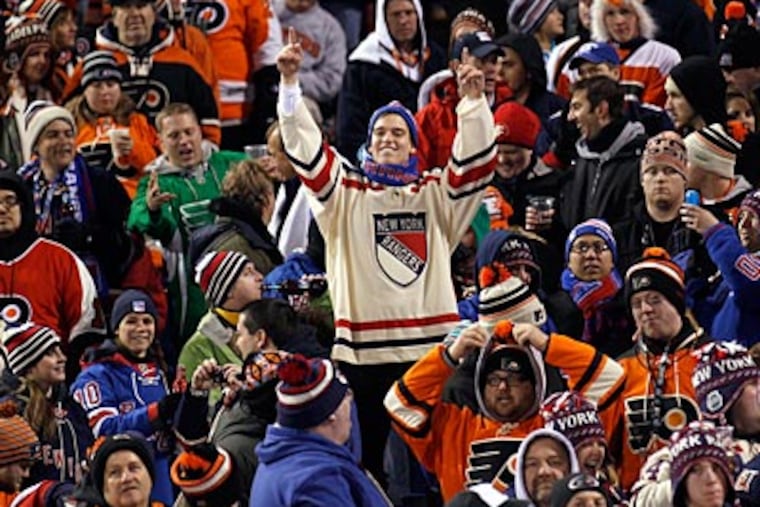
INVARIABLY, YOU will see a handful of them, perhaps even more depending on whom the local team happens to be playing: jerseys donned by fans in support of the invading forces! Philadelphia Police Captain Larry Nodiff had two of them - fans in Bruins jerseys and hats - seated two rows in front of him at a Flyers-Boston playoff game at the Wells Fargo Center last spring. Generally, the two Boston fans behaved themselves, even when they stood to cheer as Boston opened up a lead and the fans around them shouted: Sit downnnnnnnn!
They did.
"They turned and waved, as if to say: 'OK, OK' and they sat down," said Nodiff, a veteran of 37 years on the force. "What I found interesting was what happened toward the end of the game. The Flyers had given out T-shirts as a promotion. So the two guys slipped it over their Bruins jerseys, put their hats in the bag they were carrying and slipped out of the area dressed as Flyers fans."
Nodiff chuckled and added, "I said to myself, 'Well, I'll be darned.' "
Far less amusing is the case that Nodiff and the South Detective Division have found themselves investigating in the wake of the NHL Winter Classic at Citizens Bank Park. In the hours that followed the annual outdoor game, between the Flyers and the New York Rangers, two fans wearing Rangers jerseys were beaten by men in Flyers jerseys outside Geno's Steaks in South Philadelphia. One of the alleged assailants, Dennis Veteri, 32, of Glassboro, N.J., was arrested and arraigned on charges of aggravated assault, simple assault, conspiracy and recklessly endangering another person. Veteri posted 10 percent of the $100,000 that originally had been set and was released. But yesterday, a judge upped his bail to $400,000, and Veteri posted 10 percent of that after briefly being back in custody.
No other arrest warrants have been issued, according to Nodiff. But he said his detectives are "actively investigating two other males" in connection with the assault that injured 30-year-old Neal Auricchio, an off-duty cop and Iraq war veteran from Woodbridge, N.J. Nodiff said that while the other victim, Michael Janocko, 26, of Woodbridge, did not "require hospitalization or treatment," Auricchio is scheduled to have reconstructive facial surgery next week.
What happened to the two Rangers fans begs the question: Is it safe to wear the apparel of the opposition at a sporting event? While Philadelphia is widely perceived as an especially rowdy environment, some alarming incidents of violent fan behavior have occurred elsewhere within the last year or so. Last March on Opening Day, a San Francisco Giants fan was beaten senseless by hometown Los Angeles Dodgers fans and remained in a coma for months; the two assailants charged in that case are awaiting trial. At a San Jose Sharks NHL game in December, a 16-year-old girl in Vancouver Canucks garb was beaten over the head by a female Sharks fan. Has the hostility among fans become so intense that by wearing the jersey or hat of a rival you are simply asking for trouble?
Given that his jurisdiction incorporates Citizens Bank Park, Lincoln Financial Field and the Wells Fargo Center, Nodiff does not have to search long for an answer to that question. He said that what happened to the Rangers fans is a "rarity" in terms of severity, and that the beating the fan was subjected to is far from a commonplace occurrence. But he did add this: "Do I think there may be skirmishes or verbalizations between fans on their way out of the arena or stadium . . . possibly." That would include heckling, razzing, and other forms of taunting that potentially could erupt into violence, which some fans agree has been an ongoing occurrence not just in Philadelphia but elsewhere.
While fans, by and large, behave respectably at games, there is the perception by some that just the opposite is true. According to Aubrey Kent, Temple University associate professor and director of the Sports and Recreation Management and Sport Industry Research Center, "It could be argued that violence is actually less of a problem in the sport domain than in regular society." Kent said he doubted "any of the other assaults that occurred around the holidays in our area has gotten a fraction of the coverage that the Flyers-Rangers fan incident has.
"This feeds an incorrect perception that sports fans are more prone to violence than others," Kent said. "It is also unclear that the 'sport' element has anything to do with the violence. British hooligans give soccer a very bad name . . . but in reality it is just rival gangs using the sporting schedule to conveniently arrange their clashes . . . The rival jersey is just a convenient excuse for someone who is looking for trouble."
Kent added, "Anywhere you have a dynamic that is overly young, male and alcohol-fueled, you will have violence occurring. That could be in a club or bar just as easily as a sporting event."
Kent State sociology professor Jerry M. Lewis agreed. In the course of his study of more than 200 violent outbreaks at sporting events - which generally tended to start out as celebratory - Lewis said that the perpetrators were largely "young, white male" who were to some degree under the influence of alcohol, which he added "gives them permission to do what they wanted to do anyway." But Lewis did not think the scenario that ensnarled the two Rangers fans was a common occurrence in American sports. Asked why a fan would wear the jersey of an opposing team in a crowd of rival fans, he said, "There are two answers: One is they do it out of pride for their team. And second is they just have a desire to taunt."
So, some fans are just "asking for trouble?"
Lewis laughed. "Oh yes," he replied, "I had a professor who once said that 15 percent of everybody is a jerk."
Lewis encountered one at a Cleveland Indians game.
"LeBron James had just signed with the Miami Heat," he said. "And here was this fan dressed in a Heat T-shirt parading up and down. Boy, the police had to intervene in that one. That was how ugly it got . . . a lot of cussing going on, giving the finger and so on. I think the guy was trying to show off for his girlfriend, who was trying to lead him away."
Dr. Robert Carrothers, an Ohio Northern University assistant professor in sociology, said while altercations between rival fans are uncommon, he did say that one probably could expect harassment. He said he wears Indians garb to away games and has not encountered any problems. He added, "There is still the assumption of general safety." He said if it appears there are more fan-on-fan incidents today than in previous generations, it perhaps has to do with the fact that the sale of team athletic apparel has only become widespread since the 1980s. Correctly, Carrothers observed: "Look at games in the 1950s and 1960s and people are sitting in the seats in coats and ties."
How big a problem do the fans themselves think it is?
Paul Groffie, of Marlton, N.J., attended the Winter Classic and was "exposed to horrible behavior from both [Flyers and Rangers fans] but even more so by our fans toward them." Groffie, seated in Section 109 in the presence of what he said were 30 to 40 percent Rangers fans, added: "It was beginning to feel unsafe - before the game ever started . . . Very lucky WW III did not start in our section . . . We went to the Boston Winter Classic and were treated to some razzing, but I did feel safe there. A real shame."
Mike Kamrad, of Collegeville, said he has never witnessed a fan being physically abused for wearing a rival jersey, but said he has "certainly witnessed verbal abuse of varying degrees." The Flyers season ticketholder added that he has seen it "at just about every game . . . mild to moderate sparring," which he says is part of the fan experience and tolerable "if not enjoyable." Kamrad said, "Only a few times each season [usually against rivals or during the playoffs] does this escalate beyond unfriendly banter and into threats of violence."
Thomas Kincade, of Northeast Philadelphia, has not seen any physical incidents either. "I have been present when the fans delivered the a-hole chant to anyone in the section donning enemy colors," Kincade said. "I have no problem with that unless there are children involved. Kids should be allowed to root for their sports heroes without fear of repercussion."
How safe would they feel wearing of rival jersey?
Some fans said they would do it.
But others are not so sure.
"In this day and age, at most stadiums, I would not feel safe," said Steve Kellner, of Pemberton, N.J. "When I lived in Houston, I felt very safe wearing my Eagles jersey to a game. But I went to an Eagles game at the Meadowlands and some idiot poured beer on my then 8-year-old son."
Kincade added: "There are certain cities where you are just asking for trouble by wearing opposition team colors. Without a doubt, Philadelphia is one of those cities. Add New York, Boston, Cleveland and Oakland."
Ted Doberstein, of Hatboro, said he has been concerned for his safety whenever he has worn his Philadelphia jerseys at one of the New York sporting venues. Doberstein said: "I actually had a beer bottle hit me at Shea." Doberstein said that fans can wear opposing team jerseys in Philadelphia, but not if they "stand up and prance around."
So: To wear or not to wear?
Marty Kenney, of Paoli, summed it up this way: "Skip it . . . No sense provoking some late-game or parking-lot drunk . . . it has been the reality for too long."