NHL union brings nothing to the table
NEW YORK - Flanked by fresh faces like Vincent Lecavalier, Marty St. Louis and Brad Richards, NHL Players Association executive director Donald Fehr strutted into the league offices on Monday night with a tan, leather briefcase in tow.

NEW YORK - Flanked by fresh faces like Vincent Lecavalier, Marty St. Louis and Brad Richards, NHL Players Association executive director Donald Fehr strutted into the league offices on Monday night with a tan, leather briefcase in tow.
The only problem was that there was nothing in it.
After an 8-day hiatus in negotiations, the NHLPA requested a meeting with the NHL but did not present a concrete, new proposal to give the league's policy makers anything to even think about.
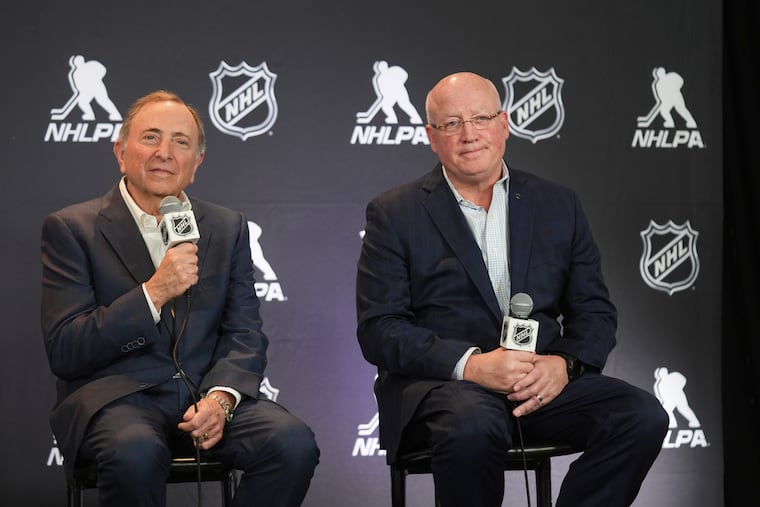
Without anything new to discuss, it must have been an awkward 90-minute meeting, with 18 players staring down Monday's negotiating committee of commissioner Gary Bettman, deputy commissioner Bill Daly, Toronto general manager Brian Burke and owners Murray Edwards (Calgary), Jeremy Jacobs (Boston) and owner Ted Leonsis (Washington).
You don't have to be Copernicus to gather that no progress was made on Monday. Instead, it was more of the same - with the same tired spin. The NHL says it's not interested in making another proposal; the NHLPA wants to negotiate each issue individually.
"It's our position that we've made a couple comprehensive proposals in a row," Daly said. "We'd like to know where they are on all of the issues. We asked that they put together a comprehensive proposal for us to consider."
The only positive is that Fehr said that it was "more likely than not" that the two sides would meet again on Tuesday in New York.
Fehr, however, said he was "not in the prediction business" when asked whether Monday's discussion would lead to a detailed proposal presentation by his union on Tuesday.
My question is: What the heck does the NHLPA have to lose by making a full presentation?
After both sides presented their spin on Monday, an NHLPA spokesman reiterated that the union has "made it clear" as to exactly where it stands on each issue. Yet, the spokesman also did not deny that the NHLPA has failed to put it all down on paper.
It couldn't possibly hurt.
For the last week, the biggest complaint out of NHL headquarters is that the league doesn't know what exactly will please Fehr and the players. All it knows is that the NHLPA wants to protect players as much as possible from revenue-share reductions and contracting changes. Those in Bettman's camp claim they don't have the slightest clue as to what numbers will get the job done.
So, after false reports on Monday said the NHLPA would return to the table armed with something to pore over, the discussion was about player contracting issues - like term limits and the elimination of frontloaded deals that the Flyers have so favored. The only problem is that the two sides remain far apart on the far more important core economic issues, like the revenue share among clubs.
"Our position all along on the player-contracting issues is that they become considerably more important to players as the cap becomes limited," Fehr said. "We've made proposals in a couple of areas in this regard which move toward them, but we wanted to talk about the rest of these to see where we are. We had hoped to engage them in a discussion about the player-contracting issues - at least tonight they were unwilling to do that."
Without the economics settled, Daly said, the contracting issues really shouldn't be in play yet.
"They suggested they moved significantly in our direction on economics, so we pushed them a little bit on that to understand where they are on economics," Daly said. "I don't think we got any more clarity on that. Until we know exactly where they stand on economics . . . we think it's all tied together. We'd like to hear it all together."
Even if a proposal is presented on Tuesday, linking player salaries to a fixed dollar amount in a locked-out season with decreased revenues would make for a slippery slope.
The Flyers were not represented in the meeting on either side.
Daly did acknowledge that Fehr presented a "piece of paper," which outlined the NHLPA's proposal for how to handle frontloaded contracts on the salary cap. That's one of the biggest issues facing the Flyers - the league has made it clear it wants to close the loophole on those type of cap-circumventing deals.
Previously, all contracts - regardless of length - were counted against the cap based on salary divided by years. Fehr's idea, which the NHL acknowledged it understood, would create some flexibility as to how teams decided to count those type of deals. The NHLPA vowed to make more information on that proposal available on Tuesday.
Maybe the whole process would move forward if they could just present more information on an entire proposal. The worst the NHL can do is say no. Without any progress, the league could cancel games up through Dec. 15 as early as Tuesday.
"I think from our perspective, we need a kind of broader understanding as to where we are," Daly said. "I don't really know what to expect. We want to see if they can wrap something up and give it to us."
" @DNFlyers
Blog: philly.com/FrequentFlyers