Smooth MacLeish was a Flyers anomaly
Because of its sports teams' futility in the early 1970s, Philadelphia was known as the City of Losers. Rick MacLeish and the Flyers helped change that image and started a renaissance on the Philly sports scene with their unexpected march to the 1974 Stanley Cup.
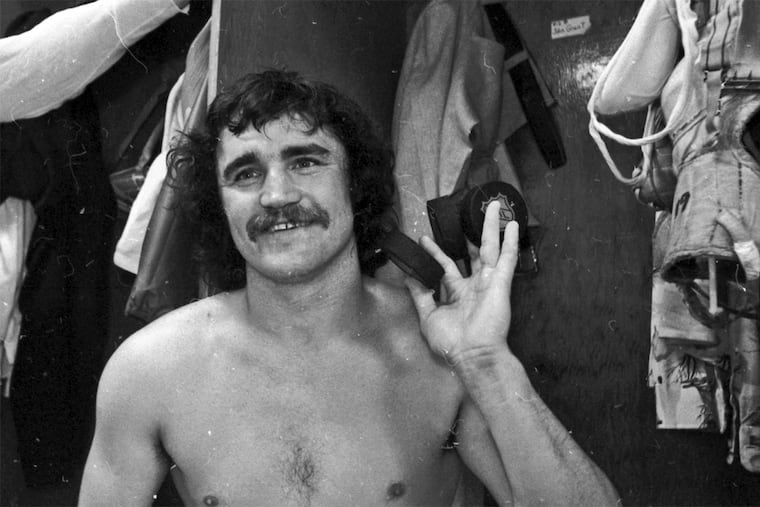
Because of its sports teams' futility in the early 1970s, Philadelphia was known as the City of Losers.
Rick MacLeish and the Flyers helped change that image and started a renaissance on the Philly sports scene with their unexpected march to the 1974 Stanley Cup.
MacLeish, 66, died Monday after battling numerous medical problems that hospitalized him for about nine weeks.
In Flyers history, the magnitude of MacLeish's impact is not appreciated until you talk to his teammates.
Bobby Clarke called MacLeish the "most talented player the Flyers had during the 1970s."
Those are eye-opening words when you consider that Clarke, generally regarded as the best player in franchise history, also played during the '70s.
Winger Bob Kelly echoed the sentiments.
"Rick was probably the most gifted natural centerman that the Flyers have ever had," Kelly said. "He was a tough kid who skated and worked hard. Although he played in the shadow of Clarkie, he was every bit as good as Clarkie."
The relentless Clarke worked hard for his goals and assists and was the ultimate leader. Clarke's style - a slash here, an elbow there - was the opposite of his angelic, choirboy looks.
MacLeish, on the other hand, played with a smooth finesse that defied his Dead End Kid appearance.
Or, as the late, great Stan Hochman once said in a Daily News column: Clarke was burlap, MacLeish was silk.
Quiet and unassuming, MacLeish racked up playoff numbers that were heavy-metal loud. The Ontario native steered the Flyers to Stanley Cup championships in 1974 and 1975 - he was the NHL's leading playoff scorer in each of those years - and he will always be remembered for one of the most magical moments in franchise history.
In Game 6 of the 1974 Finals at the percolating Spectrum, MacLeish tipped in Andre "Moose" Dupont's drive for a 1-0 win that gave the Flyers the Cup against the shocked Boston Bruins.
For those who grew up in that era, it was a goal that will live in fans' hearts forever, like Dick Sisler's pennant-winning homer for the 1950 Phillies, like Chuck Bednarik tackling Green Bay's Jim Taylor at the Eagles' 9-yard line and not allowing him up until the final seconds expired in the Birds' 1960 championship win, like Tug McGraw (1980) and Brad Lidge (2008) recording strikeouts to end the Phillies' World Series-clinching victories.
The Flyers, in just their seventh year, weren't expected to challenge the mighty Bruins for the Stanley Cup. The Bruins had Bobby Orr, Phil Esposito, and experience on their side.
The upstart Flyers - known for their brawling style and despised in every NHL city except Philadelphia - would be no match, the experts had predicted.
The so-called experts were wrong.
They overlooked the fact that there was more to the Flyers than their physical, intimidating style.
Much more.
MacLeish, the Steven Stamkos of his day, was a prime example.
Oh, he was physically strong and he could defend himself, but he was also an anomaly on a team that relied on grit. He could skate like the wind and was a pure scorer, a man who seemed to be playing on cruise control before accelerating, blowing past a defender, and beating a goalie with the best wrist shot ever displayed by one of the Flyers then or in the seasons that have followed.
Remember how laid-back Mike Schmidt made things look so easy?
Well, that was MacLeish on the ice. He was so gifted that he could be gliding down the right side, looking as if he were out for a leisurely morning skate with his family, before exploding to his left and, just as he got between the two circles, firing a wrist shot into the upper right corner.
It was his patented move and it produced many of his 349 career goals, including 50 in 1972-73.
MacLeish had tough times after his hockey career ended: a divorce, drinking problems, a heart attack suffered while playing in an alumni game, and the tragic death of his beloved 4-year-old grandson, Tyler.
Those close to MacLeish said he never recovered from the loss of Tyler in 2007.
MacLeish's two daughters, Danielle and Brianna, said they take comfort in knowing their dad has been reunited with his buddy, Tyler.
They can also take comfort in knowing that, to a generation of fans who were introduced to hockey when the Flyers were granted an expansion team for the 1967-68 season, Rick MacLeish was a pioneer
His fluid style played a major role in getting many of us hooked on a then-foreign sport and making it a big part of our lives.
No. 19 wasn't as famous as Clarke, Bernie Parent, or Bill Barber - three players from the 1974 and 1975 Cup champs who later went into hockey's Hall of Fame - but he was every bit as valuable.
Rest in peace, Hawk. Your graceful play made your adopted city proud.
Sam Carchidi is an Inquirer staff writer. scarchidi@phillynews.com
@BroadStBull www.philly.com/flyersblog