Young golfer doesn't accept blindness as handicap
WHAT HANDICAP? Patrick Malloy never has known what it's like to have the use of his eyes. That's hardly kept him from leading a pretty normal life, including playing golf. And sometimes even helping others who can see.
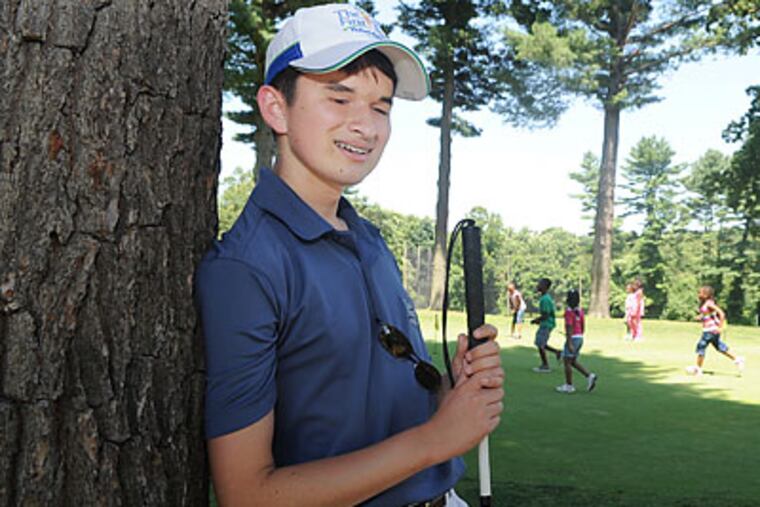
WHAT HANDICAP?
Patrick Malloy never has known what it's like to have the use of his eyes. That's hardly kept him from leading a pretty normal life, including playing golf. And sometimes even helping others who can see.
Take his first day at Council Rock North High 4 years ago, where he was the only blind student.
"All through eighth grade I'd go there once a week with a mobility instructor, and in the summer I went over with my mom so that I would know the routes and know how to get around," he explained. "She took her stopwatch and said, 'I want you to have the same experience everyone else has. I don't want you to get any special treatment.' If everyone else had 5 minutes to get to class, that's what I had, too. She would time me and say, 'OK, we did this.'
"I was coming out of a class, dropping things off before the next one, and a couple of friends came up and I said, 'How's it going? You finding everything?' They were like, 'Well, actually, no. We're looking for our social studies class.' And I said, 'Oh, that's what period I have next. You can walk there with me.' "
He smiled at the irony.
Welcome to his world, which has been built around opportunities rather than barriers.
Starting next month, the 18-year-old Malloy will be a freshman at Muhlenberg College, where he admits he might finally have to learn how to cook. He wants to become an attorney, perhaps specializing in disability law. In June, he was awarded a $10,000 scholarship from the Royal Bank of Scotland as its male Achiever of the Year for his involvement with the Philadelphia Chapter of The First Tee program, where he's a participant and intern/mentor.
The thought of him being anything but mainstream never remotely enters his equation.
"A school for the blind is great for some people," Malloy said. "But I know that the world isn't going to cater to a blind person's needs. A regular school's going to teach me that. That's the way my parents brought me up. They could have looked at it and said, 'He won't be able to do this or that, or the other thing.' But they said, 'OK, he's blind. Let's approach it the other way. What can we do?' "
Apparently, just about anything he takes on.
"His blindness makes him who he is," said Dave Smith, the PGA director of golf operations at Walnut Lane Golf Course, where he's site director of the First Tee. "You can tell his mind is always working. If he can't see it, he's trying to analyze it in another way."
Smith has been working with Malloy for a decade, or ever since Patrick decided to give the game his late grandfather loved a try. Smith was working at Yardley Country Club at the time, and they hooked up through the Mid-Atlantic Blind Golfers Association. Three years ago, he moved to Walnut Lane and brought Malloy with him. Two days a week, he helps Patrick's father, Mike, with the commute from Bucks County.
"[Smith's] sort of like a member of our family now," said Malloy, whose mother, Eileen, is a speech therapist and whose older sister, Kaitlin, recently graduated in only 3 years from Gettysburg College. "Golf's a challenging game for anyone, whether you have 20-20 vision or no vision whatsoever. Blind golf is essentially a team sport. You need a person to put the ball on the tee and help you line the shot up. Then it's a lot about feel and muscle memory. I like the sound the ball makes when you make the putt and it rolls and rolls and there's that click when it falls in the cup. Or when you hit that perfect drive and you almost feel it coming off the club face. You don't have to see it to know how good it was."
A member of the National Honor Society, Malloy has put into Braille multiple copies of TFT curriculum, which incorporates nine core values. He also has created programs for the Overbrook School for the Blind and St. Lucy Day School for the Visually Impaired. Yet it's the lessons he imparts as a member of TFT coaching staff that are particularly inspirational.
"I always tell the kids, 'I can't see the golf ball, but that doesn't mean anything to me,' " Malloy said. "As long as I have a good, consistent swing and I've been lined up correctly, I'm going to find that ball. I'm generally met with surprise at first. That's understandable. Once they actually see me out there, they realize this is a guy who happens to be blind, not a blind guy who happens to be a golfer. Not only do they learn about golf from me, they learn how to accept a blind person. I do everything they do.
"I let them ask me any question they want to. Someone wanted to know how I could see if I was blind. I said, 'Well, I don't see with my eyes like you do. I use my other senses, and I can picture things in my head.' There's something you could never have told a kid to ask. They just came up with it, out of the blue. I just remember thinking it was a great question.
"The First Tee is all about accepting diversity, promoting an acceptance. I bring a certain perspective to that."
It's certainly a distinct one.
"We even exposed him to teaching older kids," Smith said. "And you can hear a pin drop. You can see them focusing in on whatever he's talking about. We'll get to a point where it's, 'OK, demonstrate the skill of putting,' or 'Demonstrate the skill of chipping.' And he does. They'll be, 'Oh, my, I should learn like that.'
"We're trying to create better individuals, through life skills. How does he not fit into every single one of the values we have? And how can he not relate that to every one of those kids? Young men and women want to share their story. So it becomes easier for them, because that kind of opens things up. They all know perseverance. For some it might be making a bus every morning. For Patrick, it was being able to mainstream, because that's what he wanted to do. They see him, and maybe realize that their situation isn't as hard to overcome as they think it is. That's why he's so effective here. He can really bridge that gap.
"We were at a function a while back, and there was a woman who said something to the effect of, 'Oh, you poor thing.' And he said, 'Oh, no, that's OK.' He's probably heard that a lot. We talked about it on the way home. His attitude is, 'You don't get it. I'm fine. This is who I am. I just can't see. But there's so much more about me than that.' "
And not because he has the ability to smack one out there, or curl in a tricky 15-footer. Golf is merely a part of him, albeit a revealing one that's helped set him apart. Now, and hopefully for as long as he wants it to be.
"The main thing is, I do everything that my friends who are sighted do," Malloy stressed. "I'm really proud that someone would think what I do is special and recognize that. At the same time, I don't know any different. It's the way that I've been doing things my whole life. For me, it doesn't matter if they say I'm special or not.
"I never felt sorry for myself, not at all. I feel that if you look at your life in that sense, you're going to go through it saying, 'Why didn't this happen?' Or, 'Why didn't that happen?' You're always going to live an unhappy life. Then nothing good is ever going to happen.
"For me I say, 'OK, I can't see, but what else can I do?' I have four other working senses, and I can play golf, and I can go to a great college. What do I really have to be upset about? I've never been one to really worry about things. If it sounds tough, I'll deal with it. I think of college more as an adventure. You never really learn about stuff until you get out there and experience it. I can probably burn food just as easily as a sighted person.
"I think if you had told me when I was like 10 or 11 that I was going to be the Achiever of the Year, I don't know if I would have believed it. I think I would have said, 'Yeah, it could be possible.' I always go through life saying, 'Can I do it? Let me try and see if it'll work.' "
Normal? How about anything but.
"People can be very fearful of the blind," acknowledged his mom, Eileen. "Patrick has never approached it as a tragedy. It's just what it is. He's realistic about accomplishing his goals.
"I think golf has brought him so many wonderful things. It's just a great connector with people. Everyone has their challenges. His are a little more obvious. Some people might take a step back from him because of it. That's their loss."
Handicap? Sure sounds as if Patrick Malloy should be the one giving out strokes at the opening hole to try and make for a pretty even match.