Marcus Hayes: Haney's hack job on Woods
'THE BIG MISS," indeed. It did not have to be. Hank Haney's book about Tiger Woods did not have to further diminish the most significant athlete alive. It did not have to paint Woods as detestable.
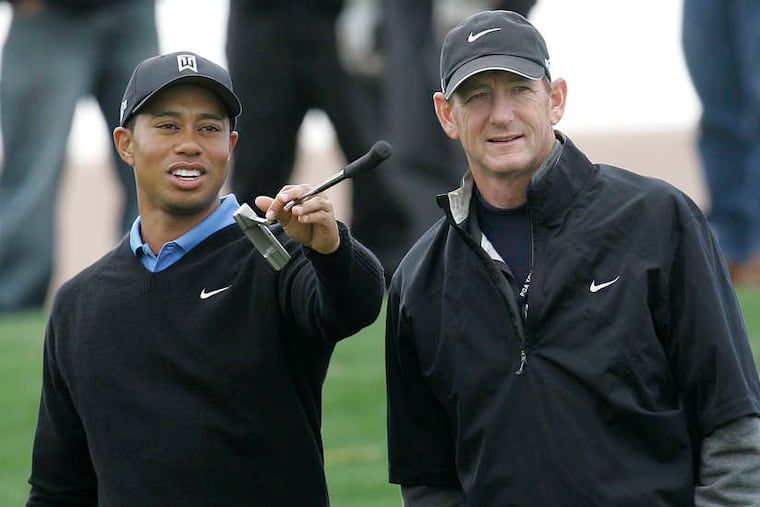
'THE BIG MISS," indeed.
It did not have to be.
Hank Haney's book about Tiger Woods did not have to further diminish the most significant athlete alive. It did not have to paint Woods as detestable.
It did not need to depict Haney as a spurned sycophant, now turned disloyal and petty.
That is what it does.
On the eve of the Masters, where Tiger once reigned and where, revived, he could again, Haney and his publishers decided to release 247 pages of revenge.
To the delight of Tiger haters the world over. In the shadow of the venue where Masters chairman Billy Payne took Tiger to task in 2010.
The timing is excellent.
The product is excrement.
This could have been an honest and revealing work that detailed the time with Woods from Haney, an innovative swing coach who, from 2003 to 2010, worked with the greatest athlete the game has known.
In fact, it is that.
It also is petty and hollow.
The amateur psychoanalysis, the titillating intimations, the vicious characterization of Tiger Woods are, at best, salacious, at worst, malicious.
Haney and his publishing house did not return interview requests. Haney last week addressed the press in New York, where he insisted that "these just aren't Tiger's memories, these are my memories, too."
Which is true, as far as Tiger's game is concerned. But not his life.
Can Haney really be this stupid? If he is, in fact, stupid, if he does not realize what he has done, then, perhaps at some point Haney will realize the depth of his betrayal.
Eventually he will understand that, when a man invites you into his home for days at a time, you forfeit any right to comment publicly on his relationship with his wife. You are his guest, and an employee, at that; what you observe is confidential.
That when butcher paper is taped over the windows for privacy, whatever is said in the house must remain private.
That when you meet your client on a part of the driving range reserved for him alone, you may not relive your interaction with him and his wife, Elin, as they move toward the most public and painful divorce in recent sports history.
Readers finish the book feeling ashamed that Haney took them into Tiger's living room right after his family left him; that Haney brought them to the practice tee, where the couple clearly shared no warmth.
Which is too bad.
Often, Haney offers clear insight to Woods' personality . . . but he does so with hard evidence, not with dangerous surmises.
Haney provides a fine dissertation on the construction of a golf swing and deftly deconstructs Tiger's. Haney explains the changes he suggested, from grip to shot shape to green-side strategies.
The book is worth $26 for that information alone.
Haney claims that most of the feedback he has received from the public has been favorable. That probably is true, in part because the book is insightful, but more likely because the book hurts Woods, who is incredibly unpopular.
When writing about anyone except Woods, Haney is gracious and revealing. He sketches himself as a recovered hack on the course and as a recovered drunk off it.
Haney also calls Woods rude, sullen, cold-blooded, disgraced, detached, stoic, passive-aggressive, unhappy, aggravated, insolent.
That's only the first 10 pages.
By the end of the book, Tiger is a stingy millionaire who tips badly and welshes on bets. Tiger is an obstinate, arrogant pupil. Tiger is a needy, nerdy jock who exaggerates his injuries.
Most disturbing, in Haney's eyes, Tiger is a socially retarded egomaniac with little regard for others.
Or maybe that's just the way he treats Haney.
Clearly, neither Haney nor former caddie Steve Williams (Haney repeatedly speaks for Williams) fully understands that they existed in Tiger's world not as confidants or teammates, but as hirelings. They are treated as such.
Woods fired Williams, who subsequently called Woods a "black asshole." Haney quit in advance of a likely firing.
Be careful how you regard their remembrances.
From the start - before the start - the book misses the mark. The title itself intentionally misleads.
"The Big Miss" is not about Woods messing up his life. Rather, it is the concept that, for professionals, a big miss - a duck hook into the water, a monster slice out of bounds - can ruin a competitive round. Woods, according to Haney, abhors the Big Miss, especially with a driver in hand.
But the cover shows a forlorn silhouette of Woods from behind, gazing into the distance, his golf glove in his back pocket. Woods has not hit a golf shot.
The picture instead implies that Woods is reviewing the disaster his career and marriage became after he crashed his car into a fire hydrant on Thanksgiving in 2009.
Haney traces the tear of Woods' left anterior cruciate ligament to an incident during a Navy SEALs training exercise that Tiger never confirms. Haney's evidence? Two people say they heard it happened.
Officially, Tiger said he tore it while on a regular golf training run.
Officially, Tiger will not comment on the contents of the book.
Haney addresses the supposed blizzard of communication between Tiger and his mistresses by noting that Woods' cellphone often buzzed.
That's it. The phone buzzed a lot. Haney never read one of the texts, but, hey, the phone was buzzing . . .
That type of reporting gets newspapers sued.
For Woods' game, Haney takes credit for every improvement. In their relationship, Haney always is the conciliator; Woods, always the boor.
But the abrasive nature of the book lies mostly in Haney's assuming the role of psychoanalyst.
Tiger is isolationist because he was a black kid in a white man's sport.
Tiger is a military junkie because he never satisfied his father, who was a Vietnam War vet.
Tiger identifies best with children because he never had a childhood.
And then there is the hyperbole.
Haney asserts that a win at Augusta in 2010, with Woods seeking redemption, would have been the most dramatic win in golf history.
Not Francis Ouimet winning the 1913 U.S. Open? Not Jack Nicklaus winning his sixth Masters at age 46 in 1986? Not Tiger's 91-hole, one-legged comeback win at Torrey in the 2008 U.S. Open?
Haney claims that the gifted Kuehne boys, Hank and Trip, are as talented as Woods. Woods beat Trip Kuehne in the final of the 1994 U.S. Amateur and possibly ruined him forever; Trip Kuehne never turned pro. Hank has never won on the PGA Tour.
These sort of absurd assertions devalue all of Haney's opinions. For years, the only question that mattered concerning Woods was whether he would match or exceed Nicklaus' record 18 major championships. Woods has 14.
As Haney watches Woods sleepwalk through a desultory practice round before Sunday at Augusta in 2010, Haney writes, "He's never going to be the same again."
As he stood before a press assemblage in New York last week, Haney said, "I wouldn't bet against him."
Haney's real opinion? Who cares?
The book could have been the prettiest shot in golf: a lovely, high draw down the right side that takes trouble out of play, that hits and shoots forward across the fairway and gives that short, straight line to the pin.
Instead, Haney pushes it way out of bounds.