Bobby Jones' enduring foursome
Though his sweet Georgia drawl, his ready smile, and gentlemanly nature combined to conceal it well, Bobby Jones was a physical mess as he checked into Barclay Hotel in Philadelphia late in September of 1930.
Though his sweet Georgia drawl, his ready smile, and gentlemanly nature combined to conceal it well, Bobby Jones was a physical mess as he checked into Barclay Hotel in Philadelphia late in September of 1930.
The world's best golfer, Jones was exhausted. He'd crossed the Atlantic twice that grueling summer. The travel, the uncomfortable celebrity, the commitments to golf as well as his family and law practice, all had taken a toll.
Though just 28, he suffered from serious ulcers and countless other aches and ailments. More ominously, early signs of the muscular disease that eventually would cripple and kill him had surfaced.
But Jones came to Philadelphia because he had a mission to fulfill, a circle to complete.
"Merion to Merion," his friend, the Atlanta sportswriter O.B. Keeler, had told him. "It's your destiny."
The symmetry was sweet. His national career had begun at Merion Golf Club in 1916. Now he wanted to end it there with a victory in the 1930 U.S. Amateur.
Next week, 83 years later, 42 after Jones' death, the golf world's spotlight will again be on Merion and its history as the 113th U.S. Open begins there. And much of that history was made by Jones.
He loved the compact course with its wicker-basket charm and shot-making demands. He played in his first national tournament there in 1916 as an unbridled 14-year-old. Eight years later he returned to Merion to win a second consecutive U.S. Amateur.
Now he hoped it would be the venue for the culmination of a golfing dream so ambitious he alone could imagine it. Sportswriters would later call it the Grand Slam.
Jones had carefully devised his plan for immortality. In 1930, he would attempt to win golf's four greatest events, though an ocean and four months separated them.
He traveled to the British Isles early that spring and came home with both the British Amateur and British Open trophies. In July's searing heat, he captured the U.S. Open.
Now only one step remained, the U.S. Amateur at Merion.
His Grand Slam
In the 1950s, confined to a wheelchair, Jones returned to Merion for a nostalgic visit.
"There were tears in his eyes," the late Skee Riegel, 1947 U.S. Amateur winner and longtime local golf pro, recalled in 2005. "He couldn't play anymore. That was the saddest thing I ever saw."
That day he was wheeled out of the clubhouse and across Ardmore Avenue to the 11th hole.
As scenic as that now-famous hole is - with a rolling brook that slices across a gently dipping emerald fairway and wraps around the green, with clusters of white bunkers and an imposing border of mature trees - it hardly seems the setting for what remains one of the greatest accomplishments in sports history.
But it was there on Sept. 27, 1930, that Jones completed his Grand Slam.
When an overmatched Eugene Homans conceded a short putt, Jones' glorious quest and his historic career were over. The 8-and-7 victory gave him the Amateur title and the game's four most coveted trophies. Thousands of fans swarmed the kidney-shaped green. Several Marines surrounded Jones. Sportswriters dug deep for superlatives.
"A precipitous and soul-searching and well-nigh impossible ascent to that mountaintop where all the Old Indestructibles of Sportdom [reside]," an understandably anonymous Inquirer sportswriter wrote the following day.
That historic triumph at Merion concluded a breathless summer for "The Immortal Bobby."
No one before had conceived of doing what Jones did because it simply was not practical. Most American golfers could not afford the time or money to sail the Atlantic and compete in the British Open and British Amateur. The same was true for British golfers and the American tournaments.
But several years earlier Jones, who never turned pro, had seen a way. When he noticed that the 1930 Walker Cup - pitting the best British and U.S. amateurs - would be held in Great Britain early that spring, he began quietly to prepare.
He played in a couple of American events, then sailed for England in April. There he captained the United States to a Walker Cup victory. Instead of returning with his teammates, he stayed. On May 31, he won the British Amateur at St. Andrews, where he was as beloved as any Scotsman.
Next, three weeks later, came the Open at Royal Liverpool. Jones won that, too. He sailed home, and his arrival in New York was met by a ticker-tape parade down Broadway.
On July 12, he captured the U.S. Open at Interlachen in Minnesota. More than two months remained before Merion's Amateur. But there was little time for rest. Jones had to catch up with family and law chores and was feted nonstop.
He traveled to Philadelphia that last week in September and checked into the Barclay on Rittenhouse Square.
"Back then," said Steve Ryan, a Merion member who wrote about golf history, "there were no Holiday Inns. He commuted to the Barclay. Each night he would make himself a couple of corn-whiskey highballs [this was during Prohibition] and soak in a bathtub. He always said it wasn't until his third highball that he could finally relax."
Smooth swing
Jones defeated Canadian Sandy Sommerville in his first match at Merion and Fred Hublitzel in the second, both by wide margins. The final three rounds of the Amateur then called for 36-hole matches.
He won easily in the quarterfinals and semifinals to set up the match with Homans, the Ridgefield, N.J., golfer who had beaten Charlie Seaver, the father of future baseball Hall of Famer Tom, in his semifinal.
Neither played particularly well in the morning round that historic Saturday, though Jones finished with a commanding lead.
Meanwhile, 11-year-old Walter Barrows, a young golfing enthusiast, had read about Jones' quest and decided to visit the course that day. He showed up in the afternoon, just as the two finalists were completing their 27th hole, Merion's 9th.
"I ran up to the 10th tee and got a position right in front," Barrows, a longtime Merion member who died in 2007, recalled in 2005. "I have a vivid memory of how smoothly [Jones] swung the club. You could see a little bend in his hickory driver at the arc of his swing."
By now the crowd had swollen to several thousand. Fans then were largely free to roam and trample where they wished. They engulfed Jones after each shot and an aerial photo taken that day shows some standing in the traps along the 10th green.
Newspaper accounts and Jones' biographies vary on just how that 11th hole was played that day. But the one indisputable fact is that both golfers hit the fairway with their drives.
"As soon as they pitched to the green, I jumped over the brook and stood in the frog hair along the green," Barrows said.
Most accounts say Jones was inside Homans, who had a 25-footer, on the green. Homans missed, conceded Jones' putt, and became a footnote to sports history.
"All of a sudden the crowd surged, and the Marines, who were in full dress uniform, appeared to form a circle around Bobby Jones," Barrows said.
Only Keeler, in his Atlanta newspaper, originally referred to Jones' feat as the Grand Slam. Others tried more clumsily to label it. The New York Sun's golf writer, for example, termed it "the Impregnable Quadrilateral."
Back at Merion's stately white clubhouse, Jones donned a jacket for the trophy presentation. Afterward, he hinted to sportswriters that this might have been his final competitive event.
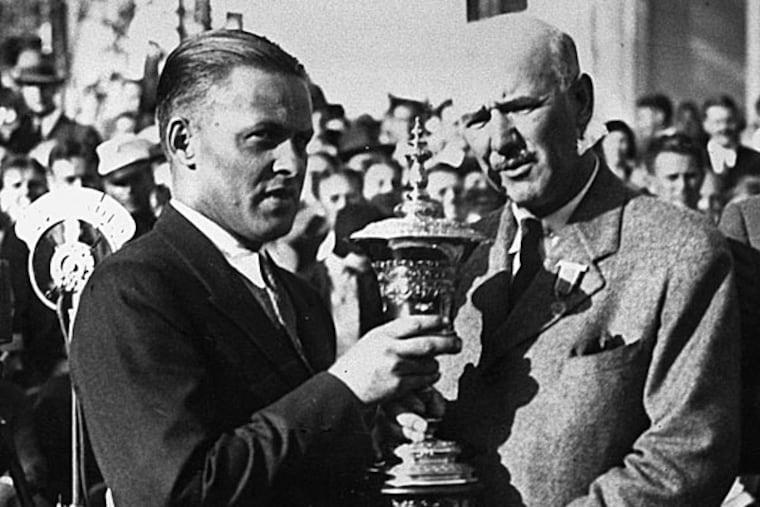
Then he stepped out onto the veranda and received the gold trophy from U.S. Golf Association president Findlay Douglas.
"I expect to continue to play golf but just when and where I cannot say now," Jones said. "I have no definite plans either to retire or as to when and where I may continue in competitions. I might stay out of the battle next season and feel like another tournament the following year. That's all I can say about it now."